Ivy
Leaf's Archives
5th May 2003:
Off we go from Holland to Britain by way of the Channel Tunnel. We have rented a
microscopic Toyota that my husband assures me is well regarded in the motoring
press. That’s all very well, however, from a mature women’s point-of-view,
cylinders and alloy wheels are next to nothing compared to a comfortable seat
that will either turn out to be a friend or a painful foe during the six-hour
drive to Letchworth (north of London). The seats of the car turn out to be
excellent, but why does a modern car have no central locking? All this reaching
for door locks is a nuisance and despite my husband’s admiration of the fuel
consumption computer, I’d rather have central locking.
My husband and I passed the long motorway hours
discussing the evolution of the automobile in regard to the evolution of
ladies’ underwear; not, I imagine a frequently discussed topic! That one
affected the other is unlikely, however, they progressed in parallel, both
responding to a changing culture. After all, the well corseted matron who could
sit and drive comfortably in the upright seats of the old Rover 110 would be at
a loss in the semi-horizontal position required in some of today’s vehicles. I
remarked that if I ever got into a Lotus, I’d never be able to get out again.
My husband responded that if I he ever saw me in the driver’s seat of a Lotus,
he’d ask the Police to broadcast a warning and clear the streets !
We spent the night in the charming Swan Hotel at
Bedford. My husband and I like to pick out the historical hotels that are
totally distinct from the production-line modern edifices. This hotel, which
dates back to the Middle Ages, sits right on the river, and provides a relaxing
view of the bird life attracted to the waters. Sadly, the clientele of the hotel
fail to match its faded elegance and seem to be mainly company
employees on ‘management courses’ whatever they may be.
The old streets of Bedford told an all-too-familiar tale. Estate Agents, banks, and the big stores abound. The High Street
could almost be anywhere else in Britain. The small corset shop has vanished
forever, or has it ?
6th May 2003:
We arrived at Letchworth, home of the Spirella Corset Company since 1910. There
we met the curator of the Letchworth museum, who had expressed an interest in our
web site, and very kindly allowed us to view some of the memorabilia of this
famous company. Spirella, for many decades, was the focus of life in Letchworth.
Several thousand employees worked at the huge and elegant factory that still
stands in the City. Thousands of photographs document the social clubs, the
cricket teams, the annual pantomime and the hundred and one little events that
turn an amorphous workforce into a team. The town was quite stricken when the
factory closed in the late 1980’s. Bought by their old rivals Spencer, the
manufacturing moved to North Wales, and thus decades of experience was lost.
Seven decades of history ended and so did a way of life.
The factory was visited regularly by Royalty,
politicians, starts of TV and the screen, and by the occasional Olympic athlete.
Fit or unfit, stout or slender, the woman of the 1960’s was undressed without
her ‘foundations’.
The curator was extremely kind in giving up
several hours of his time to show us around the museum and the archives. If you
wish to know more about the history of Letchworth (and I should emphasise that
the museum concentrates on the social history of Spirella rather than on the
details of corsetry), the web site is to be found on:-
http://www.letchworthgardencity.net
7th May 2003: A two hour drive took us to the south coast where we visited the
charming Mrs. I, a Spirella corsetiere since the late 1950’s. She still
services a clientele of some three dozen ladies and amazingly (but infrequently)
still picks up new clients. Her enthusiasm and energy are an example to those
several decades younger. We chatted about her times in West London, where famous
personalities and politicians were numbered amongst her clientele. We ordered a
Spencerette girdle, more for our collection rather than as an item for wearing.
The price of these items, Mrs. I. explained, is quite off-putting to potential
clients, although existing clients are used to the high cost. After all, if you
want quality, you have to pay for it. Mind you GBP 160 (USD 240) for a girdle is
a bit eye-watering.
We left the charming Mrs. I and drove along the
south coast, back towards the Channel
Tunnel. The marginally warmer climate in this area has attracted thousands of
retirees over the years, resulting in a proliferation of corset shops, the
majority of which no longer exists these days. The old Alstons shop in Bexhill has closed. This shop that was once part
of the famous Alstons rubber corset company, never sold these corsets on the
street but was the retail outlet for the more traditional corsetry offerings
from Camp, Lady Grace, Excelsior and Namsie.
The old corset shop in St. Leonards is still alive
and well, as is the similarly named small shop in Dymchurch. How long they will
last is uncertain; that they remain trading is remarkable.
14th May 2003:
We received a lovely surprise in the post: a complete set of Spencer
corsetiere's measuring garments. These are quite different from the Spirella
system and much rarer. Having spoken to corsetieres from both companies, it
seems that the Spirella system was simper, being a set of variously sized
'upper' and 'lower' foundations with multiple lacing and hook-and-eye
adjustment. The fitter would select the size appropriate to the client; fit her
in and then take the measurements. The Spencer garment is a 'one-size-fits-all'
with complex straps and buckles to accommodate the huge potential for size
differences. This large range of adjustments actually makes the garment quite
difficult to fit, even before the measurements are taken. My husband is trying
to fathom how the device works. Our friendly Spencer corsetiere was lost on the
subject, admitting that most fitters, after the training course, abandoned the
garment in favour of direct measuring over the client's own foundation garments.
We'll persevere and try to show you examples of both (Spirella and Spencer)
systems later on the web pages.
21st May 2003: The Spencer girdle that we ordered from Mrs. I arrived in the post. With her influence, the order took about seven days to turn around. The girdle is excellent and quite unlike anything that could be purchased from a store today, however, I have to compare it to the Spirellas and Spencers that I have known right from the 1960's. Besides them, it fares less well. The satin panels are, in fact, a cotton/rayon blend. The suspenders, instead of being metal, are plastic; the elastic, although very strong, is lighter than its predecessors, and the zip, of course, is nylon. Nevertheless, it is a proper girdle, the modern materials will probably outlast those of the 1960's, and it is still heavy, strong and powerful enough to shape that protuberant abdomen. Even the cost, a horrifying 160 pounds sterling, is little more than in proportion to several decades ago. Mind you, a firm pantie girdle costs from 10 pounds to 60 pounds, and the Spencer of 2003 is bullet-proof compared to these feeble offerings. My husband felt the weight of the 2003 Spencer compared to a regular Marks and Spencer OBG from the 1960's and reckoned that the Spencer was slightly heavier. The marked difference was the cut, particularly over the rear, where no down-stretch satin elastic appears on the Spencer; only well cut satin panels.
A Spencerette girdle from 2003 (if you can afford it).
31st May 2003: So our holiday is over and
we have returned to the PC where we can start to assimilate some of our new data
into the web pages. This will involve a huge amount of scanning and editing of
digital photographs. I will have to climb in and out of a number of measuring
garments to show how these items were used. My husband already has come up with
a thought provoking comment whilst photographing some of our new acquisitions.
Having put a Spen-all onto our dummy and having fastened no less than 33 (!)
hooks and eyes, he said in exasperation "Why on earth did the simple busk
fastening go out of fashion?" Such questions need to be answered. Please
be patient, this may take a little while.
September 2003: At last we have taken the time to put our collection of Spirella pins together. This collection began years ago and has grown together with our collection of corsetry memorabilia. Spirella (and probably most of the famous corset houses) issued pins to celebrate the long-term anniversaries of service and, particularly in the USA, dollar profit achieved. The pins date back to the 1920's and turn up on Ebay quite regularly. I was given a Spirella pin by a corsetiere who still works for Spencer. It is one of my favourites and features in the Spirella corsetiere's page.

28th
September 2003: We are always on the look-out for recollections of this
bygone era. Obviously, the recollections of a corsetiere are as confidential as
those of a doctor, however, from time to time, completely anonymous references
can be made to episodes from the past. I received today one of the rare
confidences from a Spirella corsetiere that I can relate without embarrassment
towards the parties concerned. Jobs and locations have been changed; however,
the descriptions are otherwise taken from the letter. As
an introduction, I will mention a letter from a lady
Mayoress who wrote to extol the virtues of her foundations in carrying out
the rigours of her office, but a Mayor? Well, that is a different matter.
October 2003: We were updating some of the pictures that appear on our web pages (we really much procure a proper corset stand to display our collection), when I came across a couple of Canadian Spirella corsets from the 1970's. I remember receiving the package from a Canadian lady containing these corsets that had belonged to her Mother-in-law. Usually, and sadly, such garments are consigned to the dustbin, the younger generation having no appreciation of their history, but in this case, the lady had kept them. She had no real explanation for this fortunate decision. She knew how much the corsets had cost and was simply reluctant to throw money away. It was her browsing of the internet that ultimately brought the corsets into our collection.
A lady's corsets say much about the wearer. The lady in question passed away in the late 1980's and had obviously suffered from a 'bad back' for some years. The second corset (unlike the one in the photographs) shows all the signs of regular use, yet it has been well looked after. Small repairs, inevitable in a well-worn corset, are present but expertly executed. These were strong, unyielding garments, which only a regular corset wearer could stand. The slight hip-spring of the corset suggests quite an elderly lady in whom the weight loss of age has reduced the differential between waist and hip. One can guess that the lady was probably born at around the turn of the last century, and would probably have experienced her first corsets as a teen-ager. If she had worn corsets all her life, and many women of that generation did, she would be quite unable to live without them in old age. It may be that she returned to corsets in later life as her back began to weaken. In either case, wearing a corset would be familiar to her, perhaps even a way of life.
The corsets are made of exquisite materials which would not have been the cheapest in the brochure. I suspect that the lady took pride in her appearance. She may well have been comfortably off; the repairs simply suggesting the older generation's natural tendency to mend, rather than replace. Certainly, corsets are like shoes, if you have a comfortable pair that you can wear all day, you will look after them. The removal of the exterior belt is interesting. The lady would have had excellent posture (there was little choice in such a garment), and I imagine this elderly lady, well-dressed and quite fussy about her appearance, would have been mortified if her corsets had announced their presence either aurally or visually. I suspect she removed the exterior strap since she would be concerned that it might show through her skirt. In such a strong corset, the strap is largely redundant. Perhaps the corsetiere added the strap as one of the 'optional extras' to increase her commission. The corsetiere, however, missed out on selling the third pair of suspenders, since the corset has but four, front and side-mounted. Again, this is typical of an elderly widow, for whom the task of attaching rear suspenders once the corset is donned, is virtually impossible. I know; I've tried it, and along with several of my elderly friends we can agree: That's what husbands are for!
Late November 2003: A chance to travel in the Far East is always a pleasure, particularly as the mercury dips below 40o F and the days become progressively short and bitter in Europe. I'll not dwell upon the effects of corset bones and under-wiring on airport security devices, but, as my husband remarked with a sly smile, if I pass through the security gate and the alarm sounds, he feels confident that the machine is in good working order.
The 14 hour Amsterdam to Singapore flight was remarkably pleasant. Unaccountably we got upgraded, and we spent the flight (on a totally packed 747) enjoying excellent cuisine and wines to match. The charming Singaporean hostesses (of which more later) seemed all to eager to ensure that we should consume our way into a 10 hour torpor. This I achieved whilst my husband, so he related, spent four hours grappling with Nintendo golf and lowered his record to 82; whatever that means. All men are boys at heart!
|
|
On the way back to the hotel, somehow inevitably, my husband's mind began to wander along those channels denied to the female imagination. The lore surrounding the airline stewardess and the girdle has been discussed for about seven decades. My husband, inevitably started surmising that perhaps what lay underneath the sleek form of the 'Singapore Girl', the immaculate airline stewardess, was not as simple as we imagined. I rapidly brought him back to earth. Decades ago, we all wore girdles. Today, we don't; and particularly Singapore Girl! I suspect my voice rose as I said this. But I do wonder who would buy these garments. Whoever does, and goes for the full upper and lower garment, will be confronted by no less than 12 bones and 24 hooks and eyes, and, I must add, no easy way to heed the calls of nature. There are, of course, any number of tubby Singaporeans (as there are anywhere), but are they trying to compete with their sylph-like sisters? Or are they designed for the 'billy-boys', that used to haunt Bugis Street before Singapore became squeaky clean? Who knows? I would love to have tried on the girdle, but my Anglo-Saxon frame is too large to accommodate oriental sizes. The salesgirl giggled in that polite covered mouth way, typical of Asia. Had she gone "tee hee", I would have burst out laughing as well. She suggested that I try America and, of course, she's probably right.
We bought a few items as representative of what was on offer. After all, the collection must keep up with the times.
Whilst on the subjects of corsets and hot climates (a cool day in Singapore still gets to 88oF), I was reminded of my Dutch Auntie in the Ardennes. My husband related the passage from the book of the "African Queen", where the sister of the missionary (played in the film by Katherine Hepburn), declined to remove her corsets even in the steamy heat of the African jungle. Personally, I didn't have a problem. Air-conditioning is everywhere these days, except apparently in Europe where we had the hottest summer in years!
As a footnote, it is certainly worth recording that the amazing foundations of Singapore were made by several manufacturers, but the most prominent was Triumph. This remarkable company that has prospered for decades and that was selling back-laced corsets in Germany in the 1990's, is still producing proper foundation garments in the latest millennium. Well done Triumph!
So, in one unlikely corner of the world, a vestige of the corset and girdle lives on.
Late December 2003: The build up to Christmas has brought its usual crop of letters from friends and acquaintances. The octogenarian corsetiere from Liverpool (she joined Spencer in 1956 and has been with them ever since) wrote us a lovely letter in her strong clear hand. It was filled with those items that concern the elderly; her health, meeting her son and daughter and the loss of her 'foundation' in the post. Corsetieres who work from home are totally reliant on the postal service to send order to head office and to receive the finished article some weeks later. We felt sorry for our friend. If you've worn 'proper underwear' all your life, the arrival of a new (and expensive) girdle or corset is both an occasion and a necessity since it may be replacing a garment that is past its prime. I hope the postal service recovers her missing girdle.
At a Christmas carol service, a well-dressed lady in her 50's dropped her carol sheet in front of my husband. After three attempts to bend down to pick it up, my husband did the gentlemanly thing, and retrieved the sheet for her. "Skirt's too tight" she explained laughingly. "Do you think .." started my husband; "No. She doesn't" I told him, although glimpsing the roll of flesh above her waist-line (which to me anyway spoiled her very elegant outfit) I added "but perhaps she should".
So far this Christmas, we've sung carols with a group from my husband's office. There were over 20 nationalities represented from countries as diverse as Nigeria and Venezuela. We've enjoyed a pre-Christmas dinner with a group of Norwegians and Malaysians. On Christmas day we'll brunch with Canadians and British. Later in the day for Christmas dinner, we'll join New Zealanders and some Dutch friends. Quite a cosmopolitan Christmas, and, of course, that's how it should be. Peace and Goodwill to all men.
Merry Christmas
And so, into 2004 ....
The beginning of the year always feels anticlimactic after the hectic bustle of the festive period. I did, however, bump into an old 'aunt' (a friend of my mother's) who was interested in our efforts to record the history of Spirella and Spencer. This lady, who is now into her 90's, was a teenager in the flapper era and never regularly wore the corsets that her mother imposed upon her. She wore a girdle until the early 1970's which was absolutely typical of her generation, and remembers precisely when she abandoned her girdle for a panty-girdle. Like so many changes in people's lives, they can be dated by association with songs of the period, or particular events. The lady in question had been to a wedding in London where she met some American acquaintances. The year was 1972. Recently widowed, she visited these friends in the summer and, as an inveterate shopper, purchased a quantity of American panty-girdles of a style and quality that she couldn't find in Britain. Her girdles were replaced by panty-girdles in the autumn of 1972. I asked if she had tried Spirella's Coppelia brand, which were definitely well-made and very firm, however, she laughed and said that they would have cost about three times as much as her American girdles, and, like many ladies, felt reluctant to be visited by a corsetiere.
From a simple conversion with a charming, elderly lady, we understand the problem faced by the famous made-to-measure corsetry houses. Their products were expensive, and whilst their main product was the corset, the cost could be justified by the perfect fit and finished article. With a more elastic garment, fit is still vital, but persuading a potential customer becomes harder. Certainly, the girdles from Marks and Spencer were so well made and powerful (in those days), that the Spirella corsetiere needed a convincing sales technique. This lady had been a devotee of the Marks and Spencer girdle, however, her visit to America changed all that, and her move to the panty-girdle represents, in her case, the demise of the 'generic' corset. She did not remember the brand name, but regretted not buying more than she did the time.
Her reluctance to visit the corsetiere, to me, was strange, but I believe it's really a matter of upbringing. If your mother visited the local corsetiere, there's a good chance that you would be introduced as a teenager as well. "Oh, I never needed to visit one of those ladies" my 'aunt' replied when I probed a bit further into her reluctance. She would be drawn no further, but I suspect she felt that a visit to a corsetiere suggested some imperfection of the figure, which, of course, was not her problem at all!
February 2004: I received one of those lovely stories that are just so funny that they have to be true. The lady who recounted the tale was in her 70's and, as she admitted, somewhat thinner than she had been 12 years ago when the incident took place. It was the early 1990's, and her husband had just taken delivery of a large company car, A Rover Sterling. I'm sure my husband could tell you the number of cylinders and all that sort of thing, however, from a lady's perspective, it had gorgeous leather seats, and, a novelty at the time, electric seats with four pre-set positions. Her husband had explained all the functions of the car, and she got into the driver's seat and began to fiddle with the controls to get herself comfortable. She pressed one of the pre-sets and the seat slid far away from the wheel; no good at all. She pressed another and it slid forward, and forward, and forward trapping her against the wheel. In her panic she couldn't find the electric controls and it was several minutes before she could release herself. Apparently her bust was quite painfully compressed by the steering wheel, and to this day, she does not know whether her husband had adjusted the pre-set as a joke. (My husband adds that perhaps it was a 'booby-trap'; honestly!!). I have another tale about corsets and cars.
March 2004: We were delighted to receive permission from a Danish lady, Marianne, to publish her recollections. Marianne worked in her Aunt's corset shop and speaks frankly about her attitude towards foundation garments. There's no romancing these firm supports of a bygone era, that is a male pre-occupation. I argue with my husband on this one, but in reality I know of only a few women who have worn genuinely tight and constricting underwear into the latter decades of the 20th century. One was a friend of my Mother's who, being comfortably off, spent her money on dressing well (by the standards of her generation). She ignored her corsetiere's advice (for she was a Spirella client) and had her brassieres made with no elastic at all. Her corsets had the minimum of triangular elastic inserts commensurate with sitting and walking, but no more. She explained that her foundations gave her an absolutely unchanging figure on which her clothes hung at their best. It wasn't that she enjoyed wearing these firm foundations, but that she wore them to look good, which in turn made her feel good.
Of course, here comes the exception. I know of one lady in her early 50's who still wears a front and back-laced Spencer, (the old Spirella 325 model). She admits quite frankly that the tightness makes her "feel like a woman".
April
2004: The British Pub: How it has changed over the
years. When I was a teenager, I would never have dreamt of entering such a place
unless escorted by my parents. Nowadays, everybody visits the establishments and
this has lead to all sorts of behaviour, however, one institution in which my
husband and I regularly indulge, is the 'pub lunch'.
We
have our favourites and enjoy nothing more after a walk in the country, than a
cheap simple meal washed down by a glass of wine and sometimes more than a pint
of beer. We were indulging in the harmless past-time of 'people watching'
recently over a rather excellent steak and kidney pie when a van pulled up (my
husband explains that it's called a ‘people carrier’ but it looked like a
van to me) and disgorged a family into the car park. They seemed to be a
reasonably typical, lower-middle class group: Mum and Dad in their 30's, fraught
and tired after the drive and controlling the children: Two children of
indeterminate pre-teenage years, similarly fraught and tired: Grandparents,
quite sprightly 60 year-olds, and lastly, from the seventh seat of the car, and
not without difficulty, came the Great Grandmother. (I hasten to add that this
is all supposition on our part, however, assigning roles makes people watching
all the more interesting).
The
contrast between the old lady and the remaining three generations of the family
was quite startling. The children, the parents and the grandparents were
uniformly clad in denim, of hues that failed completely to match. Any woman or
girl below middle age revealed the mandatory bared midriff, and, I might add,
the mother had quite a spare tyre on show. The old lady, on the other hand,
might have come from another planet. Twin-set and blouse tightly covered her
stout frame, a testimony to frugality and an unchanging fashion ideal refusing
to give way to what must have been quite a weight increase to fill her clothes
so fully. She collapsed, rather than sat down into a chair, her legs springing
apart and her bosom rising up alarmingly. “Corsets ?’ whispered my husband.
I nodded in understanding.
The
whole scene was actually rather sad. Nobody seemed to be very happy, and the
constant sniping and bickering between the first three generations grew
tiresome. Certainly, the elderly matron had heard it all so many times before
that she had quite switched off. Not that she was infirm or ill in any way, it
was as if she had given up the battle in despair at the younger generation. Only
when half a pint of Guinness was delivered to her side did her eyes light up
briefly and she adjusted her barrel-like torso all the better to accommodate the
Irish brew.
My husband and I discussed the scene on our return home, firstly agreeing that the bared midriff was one of the less desirable phenomena of this present beleaguered century. We talked about the old lady. Almost certainly, born about 1925 I would guess, she would have encountered her first corsets during the war, or if they were hard to come by then, just afterwards. I couldn’t imagine her unsympathetic offspring helping her with back-lacing, so that probably meant front-lacing. Her hands appeared strong and un-afflicted by arthritis, so lacing rather than buckles would seem plausible. I imagine her corsets were purchased some years ago, when she was slightly thinner and had more money to spare. They would be regularly washed and repaired. Probably the poor old dear was wondering where she would ever find a new pair that she could afford. It reminded me of a lady approaching her 100th birthday that my mother used to visit. My mother asked if she was looking forward to receiving her personal telegramme from the Queen (a quaint British tradition). She said “Oh yes. But what I’m really looking forward to are my new corsets”. She had persuaded her family that the one thing she really wanted was a new set of stays to see her into her second century!
May 2004:
| We attended a huge ball in Singapore recently where I
noticed my husband regarding the statuesque form of an acquaintance of ours.
This tall, and normally elegant, lady had donned a peach-coloured Thai silk
dress for the evening, and according to my husband, had violated most of his
personal ideals about how a well-dressed lady should appear. (I should add
that my husband's ideals are about three decades out-of-date, however, so
are mine, so we tend to agree with Spencer's ideal 1960's woman on the
right). Brassiere and knicker lines, with attendant bulges were apparent.
The locally-made silk dress had no weight and therefore failed to drape
correctly. It hung like a stiff curtain from her nethermost bulge. As the
dancing progressed into the steamy tropical night, patches of perspiration
appeared under her arms and progressed to link below her bust and across the
back of her unlined dress. On dear! Not that we were any cooler. My husband was attired in full highland rig with a winter-weight kilt, and as for myself, well, the heroine in the novel "African Queen" remarked early on in the story that corsets and the tropics don't mix. We laughed as my husband conjured up the image of the staid Katherine Hepburn fending off the seedy Humprey Bogart with a crack of her rolled-up stays across his head; apparently an effective technique for dissuading ardent lovers in Victorian times. |
 |
But now it's time for our annual holiday as my husband's international travels cease for a period of four weeks. We have been away from our base for quite a while (which explains our lack of attention to the site), and my sister who checks the apartment and mail regularly was amazed by what she called a "cubic metre of corsets" awaiting our attention! We'll pay a visit to the archives of the Letchworth museum where the memorabilia from the Spirella corset company resides.
|
The cubic metre of corsets awaiting our attention exceeded our expectations. The amazing 1950's Marks and Spencer girdle is described elsewhere, however, it seems that at some point in the 1960's, a batch of pink corset grade satin made its way to the major manufacturers worldwide. From France to Charis, Spencer and Camp in America, come superbly finished foundations in this Rolls Royce of materials with, as far as I can judge, virtually no shade or weight differential. Tomorrow, we leave Holland for England on the HSS (High Speed Super Ferry). We plan to visit the Letchworth Museum (see below). My husband gets quite excited about this trip and talks about gas turbines and an incredible 45 knot top speed. He mentions that this is faster than Gibbs amazing ship, the 'Blue Riband' holder, "United States" which crossed the Atlantic in the 1950's. No doubt the clientele were better dressed as well in those days since, for all its speed and convenience, the HSS is little more than a very fast, floating motorway cafe. |
 |
It is always a pleasure to meet the friendly and helpful staff of the Letchworth Museum. Letchworth was the British centre of Spirella corsets for eight decades and generations of women grew up, married and introduced their daughters into this huge corsetry concern. Corsetieres were the 'field agents', however, back at HQ in Letchworth, a staff of thousands cut and sewed, managed the accounts and supplied corsets to support the Empire.
There is a huge social history attached to the interaction of Spirella and the people of Letchworth. Our interest, however, is focused on the corsetry and we were able to gather some fascinating information. Did you know that 30 million corsets were sold each year in Britain in 1916, or that Marilyn Monroe did NOT wear Spirella corsets in the film, "The Prince and the Showgirl"? In that film, however, Dame Sybil Thorndyke and most of the other actresses did! Spirella's corset collection was sent to America for her attention, however, she declined to wear one.The lady on the left models a Spirella 305 in 1951. This style was the mainstay (pun intended) of Spirella's business. The 305 was the basic front-lacing corset that has it's roots as far back as 1916, however, the 300-series terminology (Spirella loved its numbering system) started in the late 1930's. It was made under the Spirella label until the late 1980's and still exists as the Spencer 'posture corset' today; five decades later!


|
So our holidays back in our home countries of Holland and Scotland come to an end. We were blessed with amazingly fine weather, however, today the continuous downpour of the European Summer is upon us. It is surely time to pack our bags and return to the Asian tropics where we spend much of the year. My husband has CD's with 100's of new images scanned from the archives of Spirella and our own collection of manuals and magazines. The 'cubic metre' of corsets has been sorted and photographed. Over the next few months, we'll spend the long tropical evenings inserting more images and text into the web site, and hopefully show you more of the Amazing World of the Corsetiere.
|
|
|
Men! Sometimes I feel that if I was a steam engine, or a motor car, my husband would pay me more attention. I was feeling quite down for some odd reason the other day. I even felt rather frumpy as we prepared to attend dinner at a friend's house. Dragging my husband from his computer (to which he appears to be married), we drove the short distance to his boss's house. Why, oh why, did my husband buy a small sports car. Does he not realise that proper foundations on an older women and sports car are unhappy companions? Unusually, I didn't enjoy the evening and we left early. My husband commented on his boss's wife's appearance. "Do you think she was wearing her daughter's clothes? Everything was at least two sizes too small; you could virtually read the maker's label on her knickers" he commented artlessly. "It's better than being a fat blob" I answered. "Women! You must be joking. You were the only women there with a shape." What is it about us girls that even an offhand comment can transform our entire mood. Since it was early and my husband (to his regret) had stayed on soda water, we dropped the car roof and drove home the long way round and rather fast. My hair was in my teeth at the end of the drive. As my husband helped me from the semi-recumbent posture dictated by modern aerodynamics, he added "Was that the car springs or your stays?". I laughed. Men!
The picture on the right from 1958 is a classic Spirella 'before and after' (click on the picture). My husband added "Nice Saab". |
|
Whatever happened to Strodex? This brand tried to rival Spirella and Spencer in Britain, but I had forgotten about it until recently. Their specialty was made-to-measure, and judging from the complex surgical corset, and the fashionable corselette in our collection, they covered the entire spectrum of corsetry, however, rarely do we encounter articles these days. Another specialist corsetry firm that failed to 'make the grade', was Fan of Stockport, England. Their belts were unexceptional except for their terminology. 'Reducyr', Corporect, Fyshline, and 'Fan seCURES you' elicited a groan from my husband who thought he had heard it all! We were lucky to receive a large quantity of data from a researcher into corsetry. This work is meticulously detailed and it reveals how jealously even the basic principles of corsetry construction were guarded. Perhaps this explains the demise of Strodex and Fan, whereas Spirella and Spencer prospered. We intend to publish this data given the time. My husband added "Watch this server space", which is about as corny as the Fan advertising! |
 |
Later in August: Several readers have asked about the demise of Bunty's Recollections. It was the huge, and sudden, data transfer from our host server that scared, first my husband, and then Bunty when she was informed. It seemed that her page had become incredibly popular, and her promotion from a willing accomplice in our researches, to something more public rather unsettled her. For that reason, her page has been temporarily suspended. Nevertheless, she still comes up with some very pertinent views on corsetry in general. Consider this one:-
A mutual friend, somewhat under-endowed, told Bunty and myself that she was going to have her breasts enhanced surgically. "DON'T DO IT" we chorused. Bunty and I come from the "what you're born with, you live with" school of thought, however, our friend had been persuaded otherwise, and was quite short with us. "It's OK for you". (At 49F, Bunty does not need any enhancement). In a last ditch attempt to dissuade our friend, Bunty said "You'll be crawling on your knees for bras!" Her comment left us mystified.
After a less than pleasant experience, our friend re-emerged from her ordeal, with, it has to be admitted, rather fine breasts, of which she was inordinately proud. She later admitted that she now understood Bunty's remark. In Britain, at least, the larger cup sizes are always at the bottom of the rack, hence "you'll be crawling on the floor". It's just one of those penalties that the big bosomed lady has to accept!
During our last
holiday in Britain (May 2004), we visited an elderly family friend who had
recently moved into a retirement home. As always, the nurses and staff are
charming and friendly, and make a big effort to inject some sparkle into their
charges’ remaining years, however, it’s a depressing reminder of what may
become our own fate.
This visit, however,
was enlightened by a lady, who had heard about our corsetry researches, and she
started to regale us with some excellent
stories that we have added to the site. Not a corsetiere, herself, she was
fitted as a teenager in the pre-War years when she always wore a corset. She
worked in the Land Army during the war, waiting for her boyfriend to return from
the army in North Africa. During this period, she abandoned her corsets as being
rather impractical when wearing the trousers demanded by her job. Married after
the war, she reverted to a corset briefly and sporadically, favouring a
conventional girdle which she obtained from Spencer for many years, until the
price became to steep for the limited resources of a British pensioner.
Spirella was
instrumental in designing the G-suit worn by jet pilots after the war. The
complex lacing of this suit required specialised advice not available outside
the corset industry. However, I digress, this is not what the thrust of my
husband’s recent query was about. Did Spirella or any of the major corset
houses have women who tried on and wore prototype garments? I have never heard
of this, but it must have happened. Were there actually, corset test pilots?
Usually when we
acquire a corset or girdle for our collection, either myself, or our friend
Bunty, will try it on, if it’s anywhere near our sizes, just to see what it
feels like, is it easy to adjust, do the seams chafe, are the suspenders well
positioned and a hundred other small details that can turn a comfortable ally
into a torture device. I’ve been caught out a few times in my role as
‘corset test pilot’ when my husband’s been pleased with my appearance, and
suggested that I give the new corset a good ‘field trial’ by going down to
the local pub for lunch. A corset always requires ‘breaking in’ and the
chances that an unworn, and un-fitted garment will be instantly easy to wear is
very unlikely. Indeed, on one occasion, my husband was obviously quite amused at
my attempts to wriggle into a position of even vague comfort. The Spen-all
that I was wearing was just a shade too long. That’s not a problem in a
flexible garment, but this wasn’t, and the front boning was digging into my
thighs at one end, and, at the other end, had hoisted my bust to such an extent
that I could barely see my meal. I suggested, quite loudly, that next time, he
try on the new corsets!
Men and Corsets:
|
We always love to receive cartoons. There are many out there and we have a dozen or more located around our web pages. There is the schoolboy humour of the ‘seaside postcards’, where the cowering husband and the disproportionately large wife feature strongly, and corsetry is an obvious source of merriment for the cartoonist and his audience. Spirella’s house magazines contained many cartoons, which all tell their stories of the fashions and morality of those days. We
received an excellent cartoon from ‘GOOD HUMOUR’ magazine. The husband
and wife are in their bedroom. The husband, obviously about to go on a
military (or police) parade, is holding his wife’s corsets. She says “Parade
or no parade, you can't have it!”. I
love this cartoon because it has none of the covert smuttiness of the man
wearing women’s underwear. It is genuine, straight-forward humour.
Typically of many cartoonists, is the lack of knowledge of what a corset
actually looks like. One can always tell if a cartoonist has seen a woman
in her corsets or simply imagines what he thinks a corset looks like. In Jan
Sanders' famous corset shop cartoon, the detail on the corsets is
typically minute, the exaggeration of multiple lacings added simply to
emphasise a point. |
|
Strangely
enough, the cartoon arrived several days after one of my elderly correspondents
reported the following encounter. In Britain, there is an organization called
‘meals-on-wheels’. Volunteer drivers take pre-cooked lunches to folk that
are unable to get about too much. One old lady confessed to wearing corsets
until the late 1980’s when Spirella was taken over by Spencer. After that she
tried Twillfit and some other less satisfactory garments, before resigning
herself to, what she called, a ‘roll-on’. She then added that her husband
also wore corsets made ordered from the same corsetiere. This would have been in
the late 1960’s for the women had been widowed for 40 years.
October 2004:
We have been very
lucky recently to meet and correspond with some elderly ladies and gentlemen who
have provided some charming stories of times gone by. Our interest, of course,
is focused towards the corsetry of that period, but, in the way that the elderly
do, they wander from the point. So interesting are their stories, however, that
we just sit there and listen, and soon the afternoon has passed.
If you consider an
average women in the days when corset-wearing was commonplace, you are dealing
with a 20-year old in 1914, or a 50 year-old in 1945, and perhaps a 70year-old
in 1960. Later than that, corset-wearing became very rare. Of course, certain
women continued, as they do today, to wear corsets but they are so small as
hardly to be called a sample. The ladies above are now all going to be well over
100 years old and so recollections will have to come from their children.
Even if we consider
girdle-wearers, in Britain, most 40-60 year-old women consigned their girdles to
the dustbin in 1970. The youngest survivor of this period is going to be well
over 70. In fact, it is the latter group of the elderly that are providing us
with information, partly about themselves, partly about their mothers and
grandmothers. Often it is husbands reminiscing about their wives. Habits that
might have been annoying on a day-to-day basis become, with the passage of time,
and the dimming of memories, simply charming eccentricities.
From this dwindling
supply of mental memorabilia come the tales of how to keep rubber corsets warm
in winter, the uselessness of a Playtex girdle as an eraser, and cautionary
tales about the dangers of tight-lacing. There are many more tales out
there, and we are always grateful to receive them.
Obviously, we have to
be discerning about which tales are real, which are imaginary or confused, and
which are fantastical wish fulfillment. Typically, the elderly fail to remember
actual episodes in their life, they remember a memory that changes, and often
exaggerates, as times passes. However, with discrete questioning, and assessment
of peripheral detail, (often the biggest give away for a false story) the true
stories can be identified.
further into October:
This tale might not initially appear associated with corsetry, but the outcome certainly is, and it happened just recently to myself.
I was working in our garden, cutting dead leaves off a bush, when I felt a sharp sting on my arm underneath my blouse. More stings rapidly followed, as I realised that I had dislodged a nest of red ants that were crawling all over me. I rushed, as fast as my frame and underpinnings allow, into the house where I started to divest my blouse on the way to the bathroom. Perhaps I did shriek, certainly my husband was quick to appear with a flippant "second honeymoon my dear ?". "Get those ants off me" I shouted, or words to that effect. I was panicking a bit I have to admit. Several dozen ants later, order was restored, and my husband was left to clear up the remains of the dead leaves with, I noticed maliciously, frequent slapping of his arms and legs. A few days later we were sitting on our patio when a sharp pain assailed my left breast. My husband leapt into action with a rolled-up newspaper, "I'll get them" he shouted. I had to explain that on this occasion, ants were not the culprit, simply the under-wiring of my bra, which had broken free from its socket and was poking sharply into my flesh. It reminded both of us of David Niven's account of the tightly corseted actress.
| The news these days is unremittingly awful, and perhaps any
attempt to lighten, or make fun of war is wrong. However, 'humour in the
trenches', and the bands of performers, such as Bob Hope and many others
who have visited troops in action, have played an important part in morale
boosting. Indeed, Spirella and their corsetieres contributed to the
British war effort, not least by contributing husbands and sons, but also
by by sewing parachutes, contributing corset and girdle bones for the
steel collection effort, and reducing the rubber content of their
underwear. We recently purchased an early 1950's example of an Ambrose
Wilson catalogue. This firm persisted in its traditional corsetry pages
well into the 1980's, and sold 'Miss Mary of Sweden' garments until
recently. One of the pictures from this catalogue prompted my husband to
quote from a 1960's science fiction film of which he is (regrettably)
familiar, 'Quatermass and the Pit'. "The Germans had more secret
weapons than we ever discovered". Indeed, the V1 and V2 rockets
were terrible enough, the V3 disturbing, and as for the formidableV4, well
...!!
|
|
In my regular
contacts with the elderly, I have noticed how badly out of shape so many old
women have become. Typically, they are hunched, their (remaining) bosom hidden
in the stooped concavity of their chests, with their stomachs protruding like
footballs.
In my regular
contacts with the elderly, I have noticed how badly out of shape so many old
women have become. Typically, they are hunched, their (remaining) bosom hidden
in the stooped concavity of their chests, with their stomachs protruding like
footballs.
What happened to the
ram-rod straight harridan of yesterday? Was she simply a figment of our
imagination ? I asked our friend Bunty, partly because
she knows our interests, but also because she is imbued with considerable common
sense. She thought about my comments and replied “You’re looking at a
generation that were not used to corsets; they were born too late, but they
never benefited from the ‘fitness craze’ of the last three decades”. They
are ‘in betweens’. Bunty and I decided to call these shapeless women the 'lost
generation' or 'human question marks' on account of their posture. Far from forcing their daughters into uncompromising foundation
garments, the opposite was true. Born between about 1920 and 1940, the daughters
persuaded their Mothers to ‘burn their bras’ without offering an acceptable
alternative. The results of this postural disaster crowd the Old Peoples’
Homes of today. Our Grandmothers knew the benefits of a corset, our daughters
appreciate the benefits of exercise, but a woman cannot retain her shape without
either.
My husband (as
always) was fascinated by this discourse, and vanished to the computer in the
study, from whence he emerged, hours later, looking bleary-eyed but triumphant.
“You really are right Bunty. Look at this spreadsheet” he crowed, waving
several pieces of paper under her nose. “Of course I’m right, you silly man,
and I don’t need a computer to prove it”.
Oddly, enough, as in
so many of our researches, unexpected results and conclusions come from the
simplest challenges of accepted fact. As I stated above, perhaps it wasn’t the
Mothers that forced daughters into old-fashioned underwear after all, the facts
point to exactly the opposite, certainly since the last war. My husband wasn’t
going to relinquish his spreadsheet quite so easily under the gimlet gaze of
Bunty, and produced a graph. Bunty and I immediately scoffed at this typically
male creation, however, once explained to us, we realised its potential to
provide tantalizing glimpses into the sociological history of corsetry through
the decades, a subject on which a library could be written.
Since we are
expanding our site to cover George’s ‘Technical
Corsetry’ researches, we have added my husband’s explanation of his
graph under this section.
What is it about the
term ‘tight corsets’? In Herman Wouk’s book ‘Marjorie Morningstar’,
the heroine is cautioned about “those divorcees in their tight corsets”. In
another book, the main character falls into a loveless marriage
“..mistaking her tight corsets for voluptuous promise”. My aunt
was fond of saying “you need tight corsets to catch your man, and tight
corsets to hold onto your figure”! In contrast, my Mother, in an
uncharacteristically catty moment, referred to an acquaintance, who I thought was
rather glamorous, as “Hah! But she wears tight corsets,” as though it were
some underhand deception. She regaled me with warnings that ‘tight corsets’
would give the wearer varicose veins and liver disease. I suspected that the
latter was not a direct consequence of the corset, but rather of the social
habits that such a wearer would adopt!
My husband and I spend so much time in the company of older folk, that it's refreshing to entertain younger guests, particularly as the festive season approaches. Cocooned, a it were, in the time capsule of our research, we sometimes forget that life goes on and the, sometimes inexplicable changes in fashion and the world around us, are dictated by a generation younger than ourselves, and two generations younger than many of our acquaintances. It was Bunty's misfortune to have badly twisted her knee, that allowed us to spend half a day with two of her nieces who drove their aunt over to visit us. We were sorry for Bunty, and ourselves, since we had recently procured some German corsets that would have graced her substantial frame, but "No modelling for me this trip, Chaps" was Bunty's greeting to us. "Tell the girls about your project" she added helpfully, "M---'s studying art at the Courtauld Institute". To my embarrassment, I discovered that I was known to her nieces as the 'corset lady', and perhaps far more embarrassingly, my husband as the 'corset man'.
The girls were indeed most interested and absolutely amazed at the sight and size of our collection. Bunty persuaded the older girl (20 I would imagine) to try on the corset that graced our site recently. The younger girl would have nothing to do with it, although she was keen to help. I told Bunty to stand back and let the girls work it out for themselves. I might add that my husband was banished from the scene and, at the request of M--- no photographs would be taken. The results were predictably hysterical, since the concept of the underbelt was completely alien to them, and we had to intervene before it became strapped in as a back support! "Now" I said, "Put these on" and I handed her a pair of Elbeo support stockings. "But, it's impossible" she laughed. "You're learning. The stockings are attached before the garment is laced tight." She cast off the corset far quicker than she had donned it and tried on the Marks and Spencer 'roll-on'. Getting the girdle on over her young hips was easy, and this time she possessed enough flexibility (and care) to wriggle the powerful stockings up her legs. Attaching the suspenders, however, turned into another farce, and the girls were reduced to helpless giggling whilst I did up the back and side suspenders for her. "How does it feel. Walk around a bit." M--- paraded around the room and struck a few poses at Bunty and her sister. "The stockings are pulling the girdle down" she said as she yanked the girdle back into place. Bunty and I laughed. "So now you know. If you had to wear those stockings, you'd need a far better anchorage. You see, one of the primary functions of the corset or girdle is to anchor the stockings." The girls were amazed at a world they had heard about but never experienced. They were most grateful that they didn't need to wear such garments these days, but the artistic one commented on the superb construction and attention to fine detail.
Peace and Goodwill to you all.
Merry Christmas
Thoughts at the end of the Year
Our thoughts on tight-lacing have elicited quite a response from our readers. The majority of the comments focus on the waists of Ethel Grainger and Cathie Jung, however, these record-breaking women occupy the extreme end of the tight-lacing spectrum. Our interest lies in conventional tight-lacing, that is to say, the use of the corset or girdle to define the waist slightly more than comfort would dictate. Rarely would women tolerate the tightness for more than a few hours, the desire being to look good for a wedding, or some similar occasion. One of the reasons that some excellent examples of corsets survive today, is that their use was rare. Garments worn daily and washed regularly do not stand the test of time, although Marks and Spencer’s girdles are exceptionally tough. Perhaps even in the latter case, a tighter girdle was kept for special events, the more comfortable sizes wearing out on a regular basis. I know of many women who, in all honesty had a waist of 32”, buying garments sized for 28”. Were they trying to fool themselves, the shop assistant or their friends? It is quite possible, for I have seen it done, to get a 34” waist into a 26” panty-girdle, however, the resultant spare-tyre is quite unacceptable.
One of the Spencer corsetieres, with whom we regularly correspond, rarely encountered anything that could be described as tight-lacing. She did, however, mention that she had a few clients in the 1960’s who wore foundations that she considered far too tight. One lady in particular had her corsets and brassieres far tighter than our friend considered desirable. There was no elastic in the brassiere at all, and only two pieces at the base of the corset to allow ease of movement and sitting. The client would not be persuaded otherwise. The consequence was that brassiere in particular was forever being returned to have the hooks and eyes repaired. The client never blamed the corsetiere. She wanted her foundations tight and her clothes tight, and she was prepared to pay the cost.
Our friend agreed that a new corset is certainly stiffer and more unyielding than its long-term design intends. Corsets are like shoes, they need to be broken in, after which they form a most comfortable ally. Which brings us onto our own definition of tight-lacing. A well-fitted corset is a support that can be worn without its presence bringing attention, either to the wearer, or the casual observer. A tight corset will be observed and felt by both parties, which, of course, may well be the intention.
|
May 2006: Trip to The Figesta
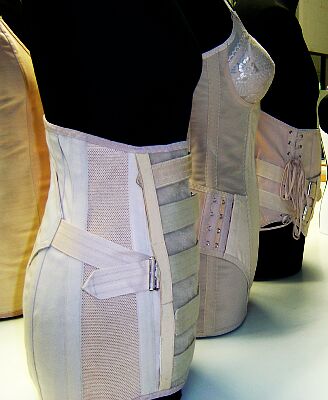
Factory in Germany It was a great honour to be invited to the Figesta factory, south of Hanover, in Germany. It's wonderful to know that made-to-measure corsetry is alive and well, and we owe Herr Schröter (the Director) and Frau Schäfer (Head Fitter) many thanks for their time. |
|
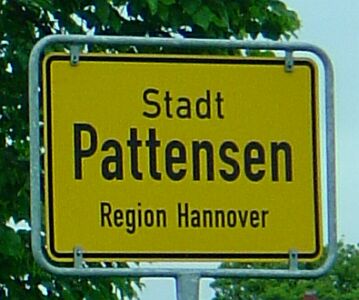
A trip by car, certainly in west continental Europe, is not the pleasure it used to be. Possibly a revelation to the citizens of North America, increasing numbers of Europeans simply don't own a car. Often, public transport is so clean, efficient and quick, that there is no need. A car is hired for the odd vacation or trip to distant relatives. With petrol at 1.4 Euros per litre (US$ 6.5 per US gallon), those relatives better live close by! Nevertheless, an invitation to travel the 420 km from our home base to the Figesta factory in Germany, was a good excuse for my husband to rent a car. The model of the car didn't interest me, but Ingrid did!! Ingrid was 'the voice' of the dashboard that told us to turn left, or right as the occasion demanded. When my husband got the instructions wrong (as he often does), Ingrid was calmer than I would have been, and simply re-directed us. I suppose she hasn't known my husband as long as I have! But what a superb invention this navigation device is. Without erring or wavering, it took straight to the lovely town of Pattensen and to the charming hotel 'Zur Linde', established over 70 years ago.
|
|
We dined on excellent German red wine (not the country's specialty, but we simply like red) and avoided the seasonal asparagus (of which we get plenty in Holland.) We gorged ourselves on wienerschnitzel, since we believe in trying the food of the region. Utterly gorgeous, it reminded me that on the next day we would visit one of the last made-to-measure corsetry businesses in Germany, if not the world (!), and that I would be in even more need of their models 110 and 75 than I had been before! |
|
| The factory, alas, is no longer situated at the traditional site in Hanover. Modern times, cost and takeovers have dictated a more modern location in the Pattensen industrial estate. However, I cannot explain further without recounting the history of Figesta, that I feel is better placed on our web page dedicated to that firm. |
|