Spirella
Magazines
The Spirella (house) Magazine was published from the inception of the company
in 1910 until 1972 and forms a wonderful and illuminating history of the
business of the corsetiere. In its pages new products were introduced, letters
from satisfied customers praised their products, and the best saleswomen received
not just their awards, but pictures of themselves along with the 'new car' that
their commissions had purchased. In the early years, a strong moralistic
undertone was evident. Discipline, dedication and duty were repeatedly mentioned
and the consequences of slovenly behaviour were illustrated as examples unworthy of a
Spirella consultant. Of course, the deeper undertone is the American hard-sell
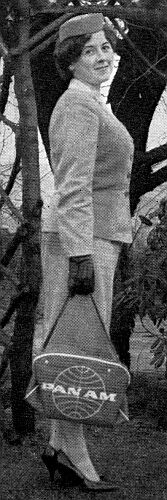
at work, after all, corsetry might be extolled as a feminine virtue, but the
bottom line was profit, and it was the corsetiere in the field that made that
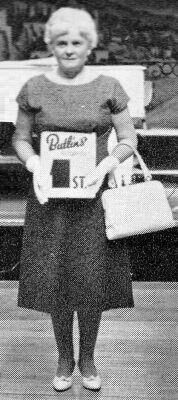
profit.
Weddings received much attention. Any
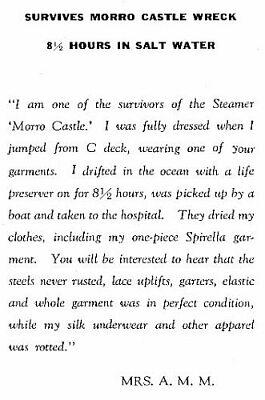
corsetiere worth her salt, and with an entree into the family facing an
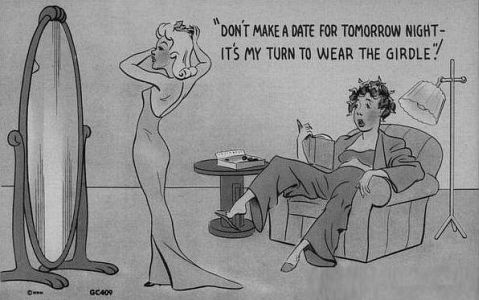
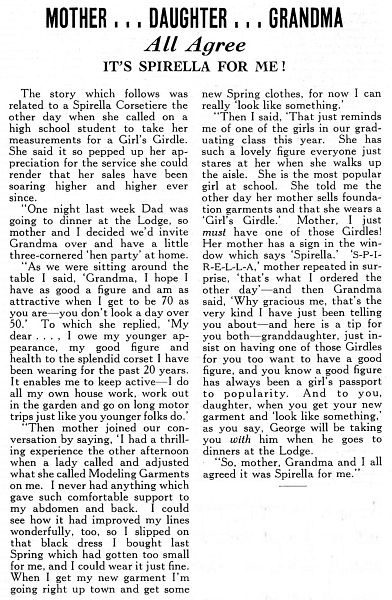
impending wedding, could finance her Summer holidays on the commission. It was
not unusual to hear stories of a corsetiere who had sold a dozen lowers (as
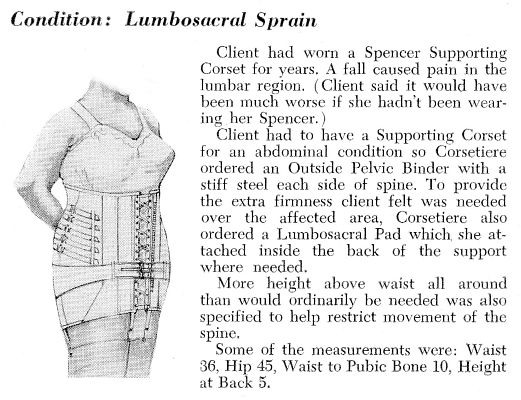
corsets and girdles were quaintly called) and another dozen uppers (brassieres)
to the potential guests and family anticipating a wedding.
But let the letters to the Spirella magazine speak for themselves:-
Letters
published in the Spirella Magazine
1)
From
Cottingham, near Hull, comes news of a Spirella client of 101 years of age. Her
consultant is Mrs. B., who has just placed a further order on behalf of the
client, a Spirella 305 in Sterling. Reports Mrs. B: “She has been a
Spirella wearer for more than 50 years and systematically, as her five daughters
reached the age of 16, introduced them all to Spirella. She has also got many
other women to buy Spirella.”
Jan
1970
This
letter written in 1970 means that the old lady was born in 1869 and that she
started with Spirella in, say, 1918, some eight years after the company was formed in
Britain.
2)
“My
Best Sale” by Mrs. McD., Liverpool
“I
completed my training in April 1958, and during the next month, I called at most
of the houses in my little road, with the result that I got orders for one
strapless bra, two bras, and three 305 corsets. The following week I called at a
hospital where my friend is the Matron. Nurses and orderlies were very taken
with my own 314 bra and 305 corset and I finished up with orders for nine 314
brassieres and six 305 corsets, and a promise of more orders the following
month, which I received.”
Feb
1960
3)
After
the birth of her daughter, Jean ordered a 305 to correct and maintain her
figure, and has since recommended Spirella to many other young mothers she has
met at the baby clinic. During last Summer she had two 305’s, a 384, a 321
and a 325.
April
1960
Many
corsets were sold during and after pregnancy.
The 325 was a formidable front and
back-laced corset. I'm sure a persuasive
saleslady could easily have talked her client into the extra lacing, not to
mention stronger bones and extra suspenders. Although Spirella did not
manufacture support stockings, they were a fundamental selling element in corset
suspenders and were widely worn by women in the 1960's.
4)
Convincing
the public that a laced foundation was necessary was of concern to Spirella in
this article from April 1965.
Not
every client needs a 305. But often when a client really is in need of support
of this excellent laced foundation a corsetiere is faced with resistance from
the client. It is generally a resistance towards the wearing of a laced
foundation, which is perhaps associated in her mind with heavy garments and
“grandmother” styles. How then do you overcome this problem ? When you are
certain that the 305 is the correct choice, how do you set about convincing your
client ? This is the question we put to a corsetiere recently.
“The most important point is to be wearing a 305 myself. I tell them that it is
the only garment that will keep their tummies flat, and to prove it I show them
the 305 that I am wearing. Then I sit down in it so that they can see my tummy
is still flat, and I bend down to demonstrate the 305’s flexibility. If
necessary I put on my girdle to show the difference."
5)
Support
without constriction, and for no-one is this principle more apt than a
professional concert singer. She needs to look attractive on stage, but any
constriction over the diaphragm would be likely to affect her performance and at
best be most uncomfortable. Little wonder then when a client of Mrs. O. of
Leeds attended a concert at which her daughter was appearing as an amateur, and a
professional singer was also on the bill, the professional singer was immediately
interested in Spirella. Mrs. O. arranged to have a 305 and 31 made for her,
sending special instructions for the 305 to be made “not too tight over the
diaphragm.” Reports Mrs O.: “The difference was very marked and she
rushed home delighted and determine to get her evening dresses altered to her new
shape. I think she will be a very good advert for Spirella.”
April
1969
6)
While
fitting a client we were discussing the radio programme Desert Island Disks,
writes corsetiere Mrs. A., of Croydon. Said the client: “You know, if I
were asked what luxury I would take to a desert island it would be a spare
305.”
May
1965
7)
The
life expectancy of a corset is quite personal. If worn daily for 16 hours between
rising and retiring there is still a great variation in how often the garment is
washed, is it rotated with other corsets, is it worn next to the skin and how
much does the client perspire? All affect the longevity of the corset; however,
the following letter from June 1958 is remarkable.
Five
years of constant wear in a hot climate is a stiff test for the best of
foundations, but a Spirella 305 in Orchid material gave perfect satisfaction
under such conditions. The garment belonged to the sister of corsetiere Mrs. L.
P. of London. Mrs. P. reports: “I supplied my sister with the garment
in 1953, when she was in England on holiday from Rhodesia. Soon afterwards she
returned home. I heard recently that the stitching on the garment has now gone
after five year's wear in a hot climate which meant that the garment was often
drenched in perspiration and had to be washed almost daily.”
|
8)
Taking
a number of St. John nursing cadets to camp is very much a full time job, but
Mrs. E. D., of Peterborough, nevertheless found it a profitable exercise.
She writes: “We travelled to camp on a very hot day, pitched our tents and did
the necessary initial chores. It was so hot that I decided, along with most of
the other officers, to have a shower and wash my smalls. Being good campers, we
had already erected a clothesline, and on this I pegged my newly washed black
325 in Bouquet and white 413 bra. They created such interest that I finished up
with five orders for Spirella.
December
1959
Indeed,
a 325 would draw attention. This formidable device with
front and back lacing would be quite a novelty to the nursing cadets, even in 1959.
9)
There
are many letters extolling the virtues of wearing the correct foundation garment
and a little bit of name dropping helps as well.
Praise
for Spirella comes from last year's Mayoress of Worthing, who is a client of
Mrs. H. The office makes great demands on the energy of the Mayoress, who is
required to undertake a lot of work which can be very tiring, but, according to
our correspondent, the Mayoress found the wearing of Spirella foundations a
great help. Corselette style 709 (for evening wear), girdle
205 and bra 31 (for everyday wear) and pantie style
51 (useful to wear with shorter skirts) were
all very much in favour with the Mayoress. July
1970
10) A client of Mrs. C of Birmingham, was recently presented to the Queen
Mother. "I was wearing a 515
corset and a 384 brassiere and felt as
confident and as well corsetted as the Queen Mother herself," remarked the
client. July 1960
11) Air
hostess who makes heads turn for a second look in Oxford, is pretty,
20-year-old, Penny Bolton. One reason is that Penny’s uniform is quite unusual
thereabouts – she being the only air hostess
in the area for Pan American Airways. The other reason is her smart and
“second glance” appearance. This Penny attributes to Spirella foundations,
which keep her figure trim. April
1961
|
|
12) A client of Mrs. H. of Liverpool,
ordered her third set of foundations in three years and when placing the order
remarked: “They will be ready in time for the football season won’t they?”
As one of Liverpool’s keenest supporters, this client (who has trouble with
her back) apparently never misses a match, home or away, and finds her 325
invaluable because of the many hours standing that her hobby entails. September 1963
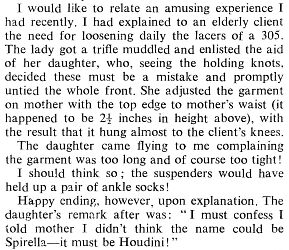
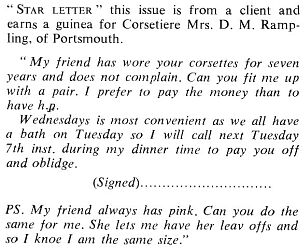
| Below are two excerpts from the
Spirella magazines of 1960 that show what corsetieres had to put up with:-
13) The rewards gained from wearing a good corset
were quite diverse. Remember we are back in the 1960's, holidays are now
affordable after the end of rationing and the war years. The great British
lower-middle class flocked to Butlin's holiday camps. With a tightly-laced
305 and a pointy brassiere (right), and not a little
breath-holding (!), you could even win British's Best Granny award;
and doesn't she look good! August 1961. |
|
14) My husband loves to recounts the
hoary old story of the four brassiere cup sizes:- "Egg cup, coffee cup,
tea cup and challenge cup." Spirella beat my husband to the story by
decades (in January 1959) when a shop assistant described three brassiere
sizes:- "The Totalitarian - designed for suppression of the masses; the
Salvation Army - to uplift the fallen; and the Political Agitator - to make
mountains out of molehills." My husband agreed that Spirella's story was
better!
|
|
15) One of our favourites that we recently
re-discovered in the 1938 Spirella fitters' manual is the story of the
American lady who jumped from the blazing wreck of the liner 'Morro
Castle'. It prompted us to include a few related articles.
 |
Spirella set great store by their
corsets' life-saving properties, although I doubt if any withstood the test that
my aunt tried. In a London Hotel (and thank Goodness it was the foyer), she
entered the open doors of the lift, and fell into the machinery below, since the
lift had stuck one floor above. She was recovered unharmed, although completely
filthy and covered in grease. The hotel staff were most solicitous (as well
they might be), and provided a room and a doctor in short order. "It's
amazing" he said, "she could have been killed."
Ever after my aunt claimed that her sturdy
corsets were her salvation, although we suspected that the cushioning effect
of numerous gin & tonics had something to do with it!
|
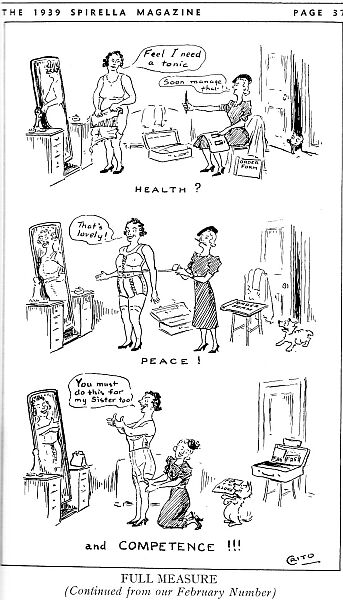
| 16) Spirella always encouraged their
clients to purchase three garments. This expense could be justified (at
least by a persuasive corsetiere) to extend the life of the garments. One in
the wash, one on the body and one in the drawer was the catchphrase. Imagine
our local corsetiere's dismay when trying to push this technique on an
elderly lady who resolutely refused to have more than one corset. "Old Mrs.
Smith across the road is the same size as me. I borrow one of hers when mine
is in the wash!" came the thrifty explanation.
The cartoon on the right goes on to show a similar economy and I know of
numerous examples of girdle sharing amongst the impecunious. A friend of
mine complained throughout her adolescence that all she ever got to wear
were her sister's 'hand-me-downs' and this included her girdles that often,
by the time they reached the unfortunate girl, were past their elastic
prime. One of her first purchases from her first salary was a brand new
girdle, all of her own!
The article on the right goes right for the jugular and
pushes the bounds of credulity, however, that's modern thinking. The article
was written for the May 1940 US Spirella Magazine and would not have been
untypical of the era. |
17)
 |
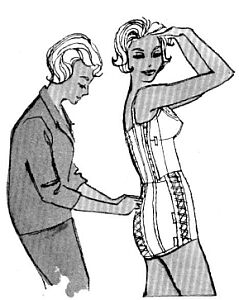
| 18) The sketch here was taken from
the Spencer Magazine of 1963. Although Spencer was a rival to Spirella, they
would merge in 1989 (in Britain) as an act of self-preservation. Spirella
had similar corsets in 1963 but the emphasis was more on fashion, whereas
Spencer had a thriving 'surgical' branch.
|
It is interesting to note that such
formidable corsets were being worn in the early 1960s. This would not last
much longer as the medical profession turned from being impressed by these
intricate confections of satin, brocade and steel to encouraging exercise
and the wearing of drab velcro-fastened abominations, but only if you must.
Going back to some of the Spencer medical brochures of
the 1920s reveals some fairly dramatic remedies:
From 1924 comes the sad tale of Mrs T. from Dayton,
Ohio. After giving birth to her third child, Mrs. T. started to suffer from
chronic back and neck pain. Her doctor suggested that the weight of her
grossly enlarged breasts during pregnancy had exacerbated an already weak
spine and he suggested that she visit her local Spencer consultant. The
consultant had already provided her with two back-laced brassieres to
accommodate her burgeoning size and now fitted her with a firm spinal corset
with underbelt (similar to that on the left). The corset was furnished with
shoulder straps to hold her back into the four rigid spinal steels |
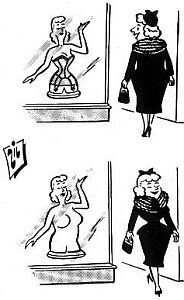
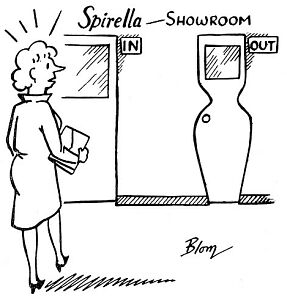
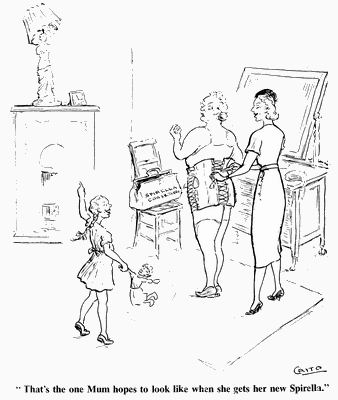
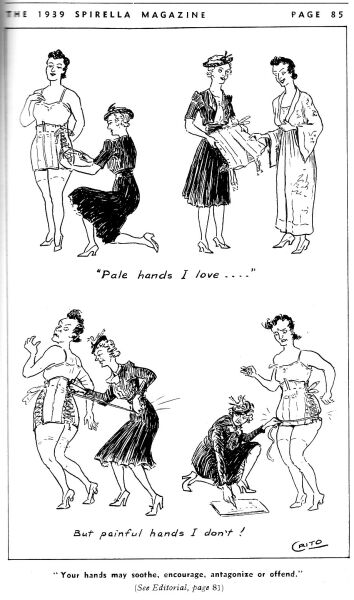
Cartoons
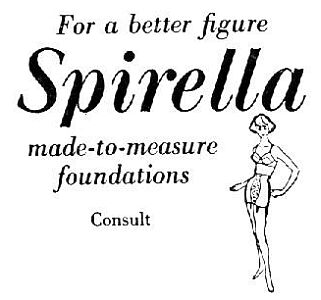
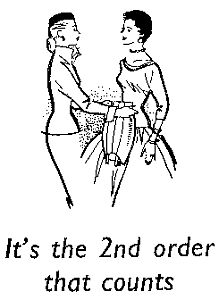
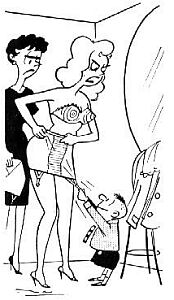
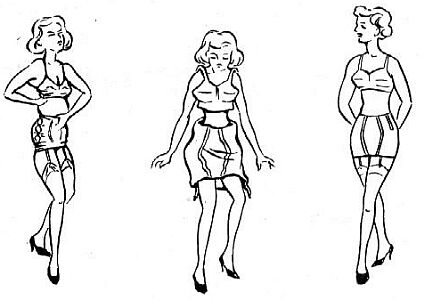
These cartoons were published in the Spirella magazines of the 1960's and
simply and elegantly reinforce the story of the sales technique.


Spirella played on the exaggerated shape that one might
achieve. Not
one of Spirella's own (right), but a modification of a card that even my husband
remembers from 1969! "As one of your loyal supporters, I just want to say .."
The image reappears in numerous cards of that period on both sides of the
Atlantic.
|
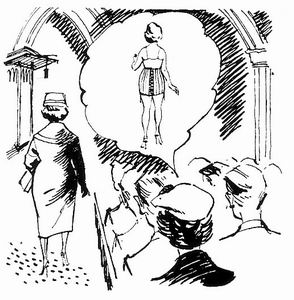
The cartoon of the
corsetiere in the church analysing a potential client's defects was taken from a
true story in 1957, nevertheless, the editor made apologies to the church beside
the cartoon. |
 |
|
|
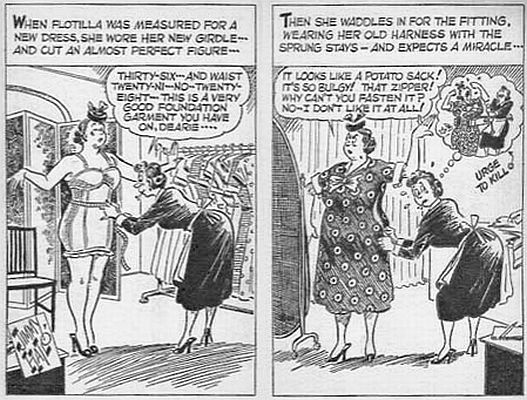
Not from Spirella, however, it echoes the heartfelt
sentiments of many corsetieres.
|
The style changes over the years. The last three cartoons
are older than the others coming from that period between the Wars. The
magazines from this period paid far more attention to the morality of hard work
and diligence than the frippery of the later years.
