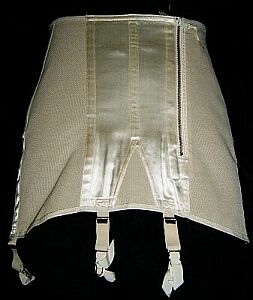
Girdles
Spirella's Girdle Descriptions
Coppelia
Spirelettes
The 205 Girdle
Panty-Girdles
|
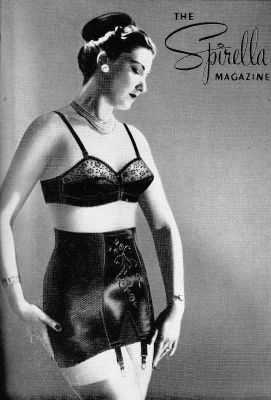 |
Girdles started to replace corsets in the 1930s and in 1966 six
million girdles were sold in Britain in nine months. A fair proportion of these
were accounted for by Spirella's 6,000 consultants as the corsetieres had become
known. (By 1966, the term 'corset' was having image problems in the
marketing department). Even in November 1968, a report from
Kayser Bondor disclosed that in a survey of over 3,000 women, 70 per cent still
wore conventional girdles and the vast majority of women needed and wanted
controlling garments.
As we will see (weddings),
1968 probably sounded the death-knell of the girdle, as British woman
suddenly adopted the panty-girdle that her
American sisters had been wearing for nearly a decade.
In fact, Spirella introduced the
Spirelette 122, their first
pantie-girdle, in 1953, but withdrew it in 1955. It was far too early for
British woman!
Today (2012), the girdle is probably
less well known than the corset that still has a small, but dedicated,
following. The panty-girdle, or shaper if you must, is the lower
foundation of choice, if, of course you chose to wear a foundation. But
let us return to the heyday of the girdle.
Spirella girdle 206
- 1956
Spirella girdle 246
- 1958
|
 |
In the 1960s the 200-series girdles were the foundation of
choice for the young woman, the bride and even the aspiring lady
politician. The 205 girdle has enough
of an interesting development to warrant a separate page.


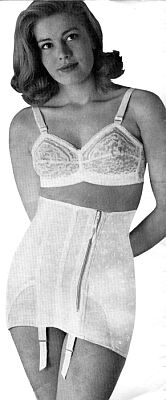

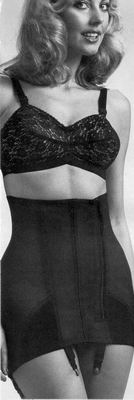
The 205 girdles (from
1956, 1964, 1965, 1970 and
1978 above) and the 206 girdles (below) were Spirella's longest selling designs. The
front panel of the 206 could be ordered in a choice of materials. The
odd selection of a cartoon on the left is not without reason, for the styling of
the 205 changed in the late 1950s.


The 206's from 1957, 1958, 1965 and 1968 show
the exquisite details available on these garments.
The 205 and 206 models ran from the end of the war until the
1970s. They were immensely popular, however, in response to the bigger hipped
woman of the 1960s, the 234 and 246 (below) were introduced in
the late 1950s; they were the first
new style in over a decade.
With
the post-war boom, people began to grow (as they still are today) and the 234 girdle
was designed in 1961 to accommodate the larger hipped woman.
The 234 girdles (1961 - 1964 above illustrate the different cut from the 205/6
series.
|

The 246 was a lighter girdle for the younger figure, however, fancy materials could be ordered at extra cost and were a favourite choice of brides. |


The more flexible girdles 207 and 208 (right) were
introduced in 1964, however, the 207 seems to have induced
head-aches in the poor models.
The 208, light and flexible, at last brings
a smile to the model.
|


A real example of a Spirella 207 showing the lovely satin side panels that the
Spirella pictures fail to capture. The 207 was a favourite of Mrs. Thatcher
during her early days in Parliament.
Excerpts from the
Spirella magazines describe these girdles
in far more detail.
Coppelia
|
The Coppelia 40-series range was introduced in the mid-1960s to
counter the cheap (and extremely well made) products from from the stores such as
Marks and Spencer. It was very difficult for some women to believe that the
extra expense of the made-to-measure girdle was justified in view of the choice
of fittings from ready made girdles.
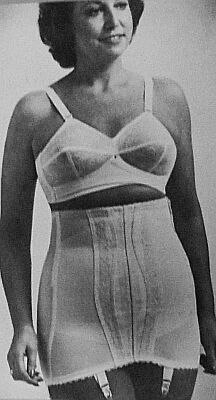
The girl in the middle below is a rare
example of a poorly constructed Spirella picture; the girdle is worn far
too low and very obviously, such a girl doesn't need a girdle like that,
although her mother might!
Frankly, with girdles like these,
long-line brassieres would have been more appropriate. |



|
Coppelias
40, 41, 41, 43, 44 and 45 from 1969 to 1972.
The lady in the 45 doesn't look as pleased
as she does above in her 41!
|
Latterly,
Coppelias became (in Britain) the first girdles sold by Spirella in stock sizes. The pictures come from
Spirella's last catalogues produced early in
the 1980s.
The Coppelia
girdles were, in fact, very well made, however, when they came on the
market, the era of the corsetiere as a skilled trade was on the wane. Many
corsetieres might as well have sold 'Tupperware', or 'Avon'
cosmetics. How many measurements do you need to sell a plastic tub or a
perfume? None; and that is my point. Coppelia was never a great success,
because it was too easy for an inexperienced corsetiere to foist on a
client, and the client would feel that, perhaps Marks & Spencer were
cheaper and better.
The emphasis had
moved from service and quality, to sales, sales, sales!
Coppelias
42 and 42.
|

 |
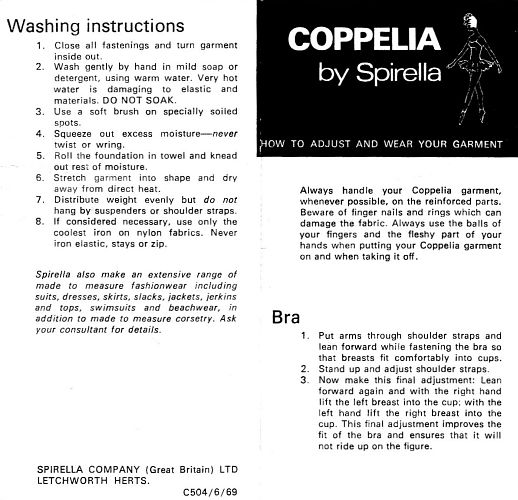
Nevertheless, in an attempt to persuade a new generation (Spirella
hoped) to embrace the girdle, or vice versa, Spirella provided detailed
instructions with each garment concerning laundering (very important)
and amazingly, how to put on the garment itself. Mostly, this would
appear to be common sense, however, the instructions for the corselette
may come as a surprise. The garment should be turned inside-out before
donning and effectively unrolled up the wearer. This is actually an
effective technique and is still encouraged by many South American
manufacturers who still produce all-in-one garments. |


These pictures show two Coppelia 43
girdles. On the left is the older one (late 1960s) with the signature details
of metal zipper and high quality satin elastic panels at the sides and rear. On
the right is the same style of girdle but dating from a decade later. The
quality of the satin elastic just is not quite the same and the zipper is now a
plastic affair. This insidious decline in perceived, if not actual, quality was
a sign of the times.
Spirelette
Spirella coined the term Spirelette in the
1950s and even introduced a pantie-girdle in 1953! This was simply an attempt
to woo post-war woman by offering less formidable underwear than that of their
mothers yet keeping them within the Spirella fold. It did not work and models
that were introduced in a blaze of publicity were quietly withdrawn but a few
years later.
|
 |
In the 1950s, Spirella coined the term 'Spirelette' for a
range
of lighter girdles. These were still made-to-measure, and should not be confused
with the Spirelette range that was introduced in 1963 and was pushed towards the
younger clientele in the 1970s (see panty-girdles). I believe that the name 'Spirelette' was a
response to arch-rival Spencer's, Spencerette. The Spencerette, was by no means
a light garment, but when the name was introduced, it was certainly lighter than
the corset it replaced.
The latter Spirelette was never fully made-to-measure,
and was simply available in an enormous range of sizes. Note how even a garment
aimed at the more youthful figure (216 from 1954 right), had the option of
front-lacing. How many housewives in their 30s and 40s wore a laced foundation
in the 1950s? We'll never know and the records of Spirella and Spencer that
might provide a clue, are probably lost forever. Certainly, not many of these
women would shout from the rooftops "I wear a corset like my mother and
granny did", although that would probably be the reason why!
Why is it that the photograph compiler
gives the model a semi-swooning posture? Scarlet O'Hara's corsets had
reached the cinemas 15 years before. |

|


Spirelette Girdles (above): the
122 from 1953, 126 from 1957 and
1953, the 127 from
1953 and 1957, and the 128 from 1954. Amazingly Spirella
offered a pantie-girdle (the 122) in 1953 and a laced girdle 216 from 1954
(right)
Girdles from the Ivy Leaf Collection
It is often quite revealing to look at real
girdles from Spirella (and other makes for that matter), since, to be
honest, the majority of girdle wearers in the last 20 years have been
older women.
The example on the right is an absolute classic Spirella.
Note the waist, 30", and the 34" hips have created more of a
tube, than some of the shapely girdles above, worn by shapely models. This
is the girdle of an elderly woman, whose 26" / 36" lower
proportions have changed with age.
| Flesh is lost from the derriere and a lack of exercise
allows the tummy to protrude. This was no corset designed to flatten
the stomach at all costs (left), this was typical Spirella,
made-to-measure, and designed to support the abdomen without
constricting it in any way (right). No off-the-peg corset or girdle
was made with such a scant hip-spring of 4". By catering to the
vagaries of the female shape, Spirella became justly famous. |

|
|

|
The following pictures of girdles have been collected over a
35 year period and are classics of their era.
|
 |
Above we have in the top row,
205 (post 1960), 205 (pre-1960
style) and a
206. In the bottom row, a 234, a 246 and an older American 202. On the left
in black is another 234. Despite the dramatic difference in materials, the
cut of the two 234's is identical.
The real girdles, in colour, and with the obvious lustre of satin,
nylon and brocade, say so much more about the garments than the black
& white pictures, although exquisitely modelled, will ever do.
Identification requires access to a Spirella magazine or
brochure of the period, however, such was Spirella's fascination, and
latterly ever-changing range of model numbers, that not even our collection
has a reference to all the models. Spirella's service to
its client allowed for the copying of older styles and these keep cropping
up at auction. Their provenance is hard to determine. |
|
|
 |

Details from a 206 girdle (1957 - left)
and one twenty years younger (1977)
|
If you are really lucky, then the garment may still have the
manufacturer's tag attached
(right). So much more than a high street purchase, this
tag tells of the garment model, the material, the corsetiere and client.
Even the date is recorded of this 30 year-old 206 girdle (left). It's a
collector's dream, for we look at a slice of history. Regard, however,
the difference between a 1957 206 girdle and the 1977 one. Both eminently
powerful and long-lasting garments, the older girdle has so much more
quality. Note the suspenders 'flashes', the adjustable clips and heavy
corset quality satin. The metal zip adds a touch of charm, but for once, the
newer garment has the edge since the old metal zips were not
as reliable as the plastic
variety! |

Provenance of the best sort!
The girdle's suspenders have been incorrectly assembled and this is why it
remained as a return with its tags. |
|
Incidentally, as an aid to dating Spirella's girdles, the
metal zip was replaced by nylon zips in 1958, but only on corselettes. The
nylon zip, however, was well established on Spirella's girdles by the early
1960s. That dates these girdles above. |
 |