Weddings


Weddings were probably the ‘special occasion’ where women could be persuaded to wear their best foundations. A persuasive corsetiere could have a field day once she got wind of an impending wedding. The Spirella magazines have many charming wedding photographs with detailed descriptions of who is wearing what under the satin dresses and the floral rayon print of the Mother. Typically in the 1960’s the mother and older relatives might be wearing a 305 corset or one of the heavier-style girdles, however, there are no references to the bride doing so. Usually the bride would be wearing a 206 girdle, a waist-nipper, or something similar. On a few occasions, the bridesmaid, apparently aged about 25, was described as wearing a 305, however, I doubt if this was a regular habit.

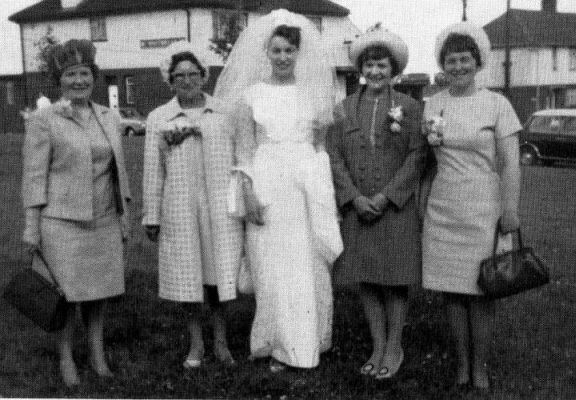
The wedding description below comes from November 1969. Note that even at the end of the swinging 60's, two middle-aged women are wearing corsets and amazingly, so is one woman barely into her 30's!

An exciting day for the bride and a proud moment for our consultant Mrs. H. of Peterborough. The bride wore Spirelettes 83 and 132 (a desperate attempt by Spirella to attract a younger market with lighter foundations), the bridegroom's mother (on her left), a Coppelia 44 and Modern Line bra; sister of the bride (extreme right of picture) wore a 305 and Fashion Line bra, and (on the bride's right) her mother in a 325 corset and style 72 bra, and Mrs. H. in Spirella foundations 305 and 30.

Reports Mrs. H.: "A guest at the wedding became interested in Spirella and ordered a Coppelia girdle and bra. Another guest had a Coppelia girdle and asked me to get her some support stockings." It was Mrs. H. who, in the August issue, explained how she had secured orders while helping out at a funeral.  Is nowhere safe??


At least Mrs. H was wearing the same foundations that she sold. Note that the sister on the right wears a laced foundation, one of Spirella's many euphemisms for corset. The year was 1969 and I could well believe that her Mother was a regular corset wearer. The fact that her Mother wears the complex (and expensive) 325 suggests that this is so; however, a 30-year-old woman? At the end of the 1960's such a garment for the sister I suspect might just be 'for special occasions only', such as this wedding. 


The reference above to stockings is repeated several times in correspondence from Spirella corsetieres. It was a clever ploy by the corsetiere to gain just a little more commission. What could be easier, having fitted the wedding guest with new brassiere and girdle for the occasion, to persuade her that some support for her legs was required. "There will be so much standing around. You really have to consider your poor legs". This ploy was so successful that Spirella branded their own support stockings (left). Spirella provided everything, even rayon directoire knickers for the mother-in-law! In the 1970's Spirella experimented with Matchmakers, a foray in the world of the twin set, however, there were far more experienced fashion retailers out there, and Spirella ignoring it's core strength of corsetry paid a price later.

Spirella's experience with parachute nylon during the war was used to good effect in knicker construction!


From 1959 comes a lovely photograph of a very attractive bride with a keen interest in her appearance as is revealed by her corsetiere's letter to the Spirella magazine.

The charming 21-year-old bride is a regular Spirella wearer. Her corsetiere, Mrs. N. of Norwich, tells us she had supplied her with one 700,  one 260, one 384, one 423, one 323 and one 206 : and all during 1959.

To translate from Spirella's love affair with their numbering system, the 700 is quite a formidable corselette (and would probably have been worn at the wedding), the 260 and 206 are high-waisted girdles, and the rest are brassieres, two of which are long-line style. By today's standards that is a remarkable trousseau.

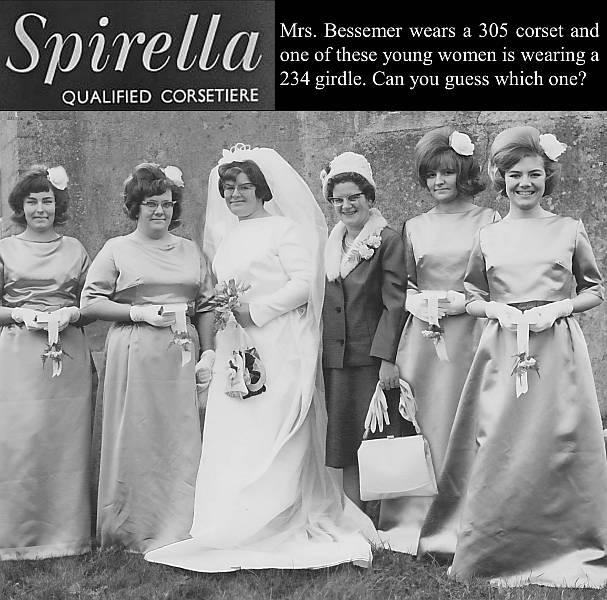
Weddings, present and future, were a source of vital intelligence for the diligent corsetiere with an eye for future sales. The bride, bride's mother, granny, bridesmaids and a host of relatives, in a time when life was far more parochial than present, represented an un-tapped vein of commission. How good a corsetiere are you? Let us see if you can spot the potential corset and girdle wearers in these wedding photographs.


Look at the photographs below that appeared in the British Spirella Magazines of the mid-1960's. Guess who is wearing the corsets, girdles and  pantie-girdles. It isn't very difficult, with a few exceptions. The real task of the corsetiere was to engage all these ladies prior to the wedding, and convince them that a new lower foundation was essential for the occasion. Having sold the idea of the new lower foundation, a matching brassiere would be proposed as an essential complement to the girdle or corset. There is plenty of standing around at these functions, so some support stockings for those aching legs will be required. 

There are thirteen ladies present, who ages range from 24 to 65. This means that some of the older ladies were born around the turn of the century, whilst the brides and bridesmaids would have been born at the end of the Second World War. Seven are wearing corsets, one is wearing a pantie-girdle and the rest are wearing open-bottom girdles.

Click on the picture to find out if you guessed what the lady was wearing. How good a corsetiere are you?


In practice, however, the majority of brides in the late 1950's and 1960's were looking towards the lighter foundation, and below (1958) and right (1965), all the girls are wearing Spirella's 'waist nipper'. In 1958 in Britain, a girdle would have been 'de rigueur', however, this was Spirella in a rather warm South Africa.

The text attached to these photographs from the Spirella magazine speak volumes about the aspirations of these young ladies.

Left above 1962: "Spirella client, Miss F. of Stockport, completes three generations of Spirella wearers. On the day of the wedding, Miss F., her mother and grand-mother all wore Spirellas. All are clients Stockport corsetiere, Mrs. B." Indeed, a good corsetiere could guide generations through their girdles, maternity belts and corsets.

Right above 1964: "This charming wedding picture shows the daughter of corsetiere Mrs. H. of Colchester, Essex. Her daughter wore a Waist Nipper and short bra style 93 for this most important day of her life. She hopes to follow her mother's example and become a corsetiere when she is twenty-one, later this year. (Note the Sp of the Spirella sign outside the door - IL).

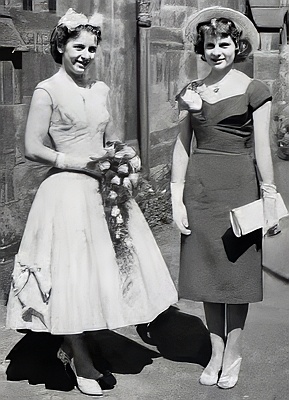
In this charming wedding photograph on the left (Spirella 1958), the girl on the left is reported as wearing a pantie-girdle 610 and the 22 year old on the right wears the traditional 206 girdle.  The girl on the right by today's standards needs no support whatsoever, yet in this photograph she epitomises the stylish figure of the late 1950's that has all but been forgotten.

This was a period of considerable change. In the earlier part of the century, womanhood, from girls to grannies wore corsets. From the 1970's to the present day, it was feasible for daughters, mothers and grannies to wear the same model of panty-girdle (or shaper as it is euphemistically called these days). But in the two decades post-War, Granny might wear the corset, Mother the girdle, and daughter the panty-girdle, but conceivably, and the evidence is there above, that order could even be reversed as is described below.

As the swinging 60's heralded in an era that we yet are struggling to understand, the modern Granny might wear the panty-girdle, and the young (overweight) bridesmaid from a traditional family, the corset.

One of Spirella's earlier wedding descriptions from 1952:-


"Another triumph for Mrs. H. of Congleton (left of picture). She sets an example to her clients by wearing a 305 corset. (This seems to be part of the corsetiere's uniform! - Ivy). The six women to the left of Mrs. H. are all wearing Spirella, including three generations of one family. Granny (3rd from right) has worn corsets for six decades and Spirella for the last three, her latest purchase being a 315 corset especially for this occasion. Her daughter (right of picture) wears a 305 corset and the bridesmaid, her grand-daughter, a 205 girdle. The other women all bought corsets and stockings from Mrs. H, helping her to secure the Midlands area award."


It's interesting to note the 315 corset on the oldest woman. This back-laced model was, in fact, rarely purchased, even in the 1950's. Granny, probably born around 1880, would have been used to a back-laced corset, whereas her daughter, born around 1910, would have entered a world where you laced your own!


Another wedding group from 1963 in which Spirella candidly informs us that there are to be found five corsets (four 305's and a 325) and five girdles (unspecified). Home-made satin is the order of the day, and to my mind, this makes the picture all the more charming. Once again, the 305 is the mainstay of the older women whilst the girdles and panty-girdles predictably work their way down the age range of this charming group. This was the first year that Spirella vigorously marketed their new brand of Spirelette panty-girdles and maybe the bridesmaids have adopted this new style. For sure, their mothers would by the end of the decade.

I once attended a wedding in Renfrew where I was introduced to the local corsetiere. She was a mine of information "That's old Mrs. W. She's been with me for years. Orders three 325's each Spring, regular as clockwork! The bride's wearing Coppelia just like her Mum, mind you, the youngsters can get away with it. Frankly, Mrs. H should be in a corset but she thinks it's so old-fashioned." And so the interesting prattle would continue as each female figure was analysed, dissected and re-built in Spirella's best.


What Lies beneath

The title of this dissertation is a classic ‘double entendre’ that was provoked by one of the typical Spirella wedding photographs above. As we have shown, Spirella made much advertising mileage from photographs of the females at a wedding, with a caption detailing the sorts of foundations that they were wearing. This intimate knowledge was volunteered by the corsetiere (with her clients’ permission of course) whose presence in the wedding photograph revealed her status as an adopted member of the family. Often, the bride would be the daughter of the corsetiere.

So what really did lie beneath the satins and rayons, and what ‘white’ lies were told in the interests of marketing. That both Spirella and Spencer took considerable latitude with their before and after photographs, suggests that the wedding descriptions may have been somewhat exaggerated as well. I do not know, but I discussed the matter with a group of elderly friends and, apart from some disagreements, we came to the following conclusions. To be fair, our conclusions do pertain to a standard wedding of the period, rather than the idealistic Spirella wedding where, not only every women from Granny to pre-teenage bridesmaid would be regaled in Spirella's finest foundations, but Spirella’s branded stockings as well!

This amazing advertisement comes from American Spirella

The lies about what lies beneath              


Granny always seemed to wear the complex, heavy and formidable 325 corset. These still turn up at auction and we have half a dozen in our collection, however, this is probably because they weren’t that popular and thus were preserved.


Mother as least was credited with a standard 305 corset, or, if particularly young and trendy, a 206 or 234 girdle, perhaps even a Coppelia girdle in the late 1960’s. These semi-made-to-measure girdles suffered by comparison with the high street brands, particularly in terms of cost.


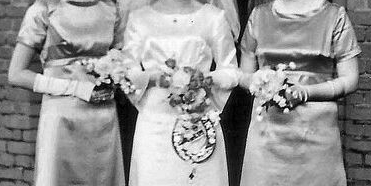
The Bride never wore a corset*, always a girdle, or at the very least, a special brassiere and waist-nipper. I know of one bride (not mentioned by Spirella) who had a back-laced 315 corset made for the occasion. Her dress was Victorian in style, and she claimed the back-lacing was a nice period touch. *Except in this charming piece of whimsy recently discovered.


Did the Bridesmaid, in her 20’s, really wear a 305 corset. Admittedly in some of the pictures, the circularity of the torso suggests that this might be so, but this, even in the 1950’s would have been rare.


The Guest, of course could wear anything that suited her age, and Spirella provided just that. Certainly, their garments were very expensive, but they lasted and fit perfectly (in theory). In the transition period of the late 1960’s, a teenager might be wearing a high-waisted, well-boned girdle, whereas her friend’s mother might be in a panty-girdle.


The Corsetiere could be relied on to wear the firm’s garments. You never knew when a prospective customer might want a quick preview of the latest 305 corset in tea-rose orchid rayon.


and       what really lies beneath


Granny probably did wear a corset in the late 1950’s and early 60’s when most of these photographs appeared. The Spirella 305 was very common, but not the front- and back-laced 325.


Mother would certainly wear a girdle, and, in the hands of a persuasive corsetiere, Spirella might be the brand, however, times were changing, and the girdles on offer from Marks and Spencer were, I’m afraid to say, the equal of Spirella’s offerings; and, much cheaper too!


The fact of the Bride comes closest to the fiction, since, on this special day, special foundations would be worn. Spirella did make excellent strapless brassieres and waist-nippers, and for once, could steal a march on the high street.


The Bridesmaid almost certainly would wear a girdle, or a panty-girdle as soon as they became more common. In reality, a women (outside of the acting world) rarely laces herself to fit into a dress; she simply buys a larger size.


The Guest of the 1950’s might well be wearing Spirella, Spencer, Strodex, Alstons or any one of the made-to-measure foundations, but as the concept of long-lasting quality was replaced by the impulse buy of the booming 60’s, the off-the-shelf market blossomed.


The Corsetiere might be wearing her trade garments, and I know many that did, however, I know an equal number that never wore Spirella’s corsets at all, and despite having sold thousands, never ventured beyond Marks and Spencer panty-girdles!

Obviously, these photographs were Spirella weddings, and the women that made it into the pictures would be clients of the corsetiere, and wearing Spirella’s best. However, particularly as the 1960’s grew to a close, the world had changed. A woman that had grown up with corsets cannot abandon them overnight and Granny would take her corsets to the grave, but the girdled mother would soon become panty-girdled. For a brief period, a well-preserved granny might wear a panty-girdle and the young bridesmaid, a corset, but this was rare. Spirella, although they did not know it, were facing extinction, since the fitting of an elastic garment will never be as critical as that of a non-elastic one. The premium that Spirella charged would ultimately doom them in a world where, if a woman could be bothered to wear  foundation at all, it would be, at best, a panty-girdle. I must add, in Spirella’s defence, that their Coppelia 51 and Spirelette 105, were extremely powerful and strong garments that could not be purchased on the high street. Alas, not many women appreciated this or even cared.


As we have said, when these photographs were taken, it is right to assume that that some of the older ladies (over 60) would be wearing a corset. Only one woman is wearing a pantie-girdle, however, this garment was not that common in the mid 1960's in Britain. Therefore, all the others are wearing traditional girdles. The two exceptions are the bridesmaids who are wearing corsets despite being in their 20's. One is a little 'chubby' and appears obviously under the influence of some constraining foundation garment. The other looks quite slim, and to be fair, the 515 was described as a girdle and could be ordered without lacing. To any woman of her age today, however, that garment would be called a corset, assuming that the woman of today knew was a corset might be.


In the early 1960's, the girdle was still (literally) the mainstay of the middle-aged woman, and the houses of the corsetieres  proudly displayed their professional signs. Unlike any other industry, Spirella and Spencer, anticipating Yellow Pages by more than a decade, bought full pages in the county phone directories to advertise the numbers of their corsetieres. 


The counters of the department stores groaned under the weight of corsets and girdles, and in  Marks and Spencer, girdles of an amazingly high quality could be purchased by the average woman. 


In 1967, this charming lady of my acquaintance (left) displays what the perfect middle class lady in her early 60's would wear to a wedding. Silk twin-set and pearls, hat, gloves, long-line bra from the Triumph Doreen range, zippered high-waisted girdle from Marks and Spencer in Sutton, and support stockings from Figure Foundations in Banstead High street. 


The flatness of her stomach is a tribute to the power of the Marks and Spencer classic girdle. Some of her less generous friends suggested that she wore a corset for such occasions, however, she didn't*. Having no children, an early adulthood on horseback, and proper foundations gave this women an excellent figure. That her figure is elegant, and well-controlled by mass-produced high street items, should have sounded a warning bell to the marketers of the bespoke corset houses. Within three years, this lady's girdles had been consigned to the dustbin as British women followed their American cousins into the panty-girdle. Her figure was never quite the same again.


(*We wrote the above account in 2003, however, in 2006, nearly 40 years after the wedding, we were contradicted by somebody who knew the lady in question.)


Indeed, the times were changing, and within a few years those same girdles and corsets would be be permanently 'on sale', the panty-girdle and then the brassiere would overtake the girdle for prime position in the stores, and the generic corset would become a sad object of fun, lying unwanted at jumble sales, and latterly charity shops.

Our descriptions of who wore what elicited such a flurry of correspondence from people, both men and women, who remembered what their mothers, sisters or grannies used to wear. After our own account (above), we received the tale of a Mother-in-Law and her expensive Barcley girdles. So many of these charming accounts were recorded that we have published a few that contained photos of the ladies in question. Obviously we have been discreet, as is our custom, so we have simply called these ladies, 'Aunties'. 


Spirella's Attempt 

Spirella attempted some charming photographs in the 1950's of what a lady might be expected to wear under her stylish dress of the period. This is similar to several US girdle advertisements from this era that I've shown below.


From the Spirella (UK) house magazines of the mid-1950's, come a good idea of the correct underwear to match the outfit. But just a moment; the two British women are almost certainly wearing their proper foundations beneath their dresses, but the American Spirella lady below gives the strongest impression that she removed her bra and corset before putting on the figure-hugging dress.


From Vogue 1955

Weddings and girdles prominently featured in one of the 1955 editions of British Vogue magazine. In this instance, the model guests at the wedding are not revealed in their underwear, however, the suggestion is that the late 40's mother and early 20's daughter will both be wearing the latest 'hi-waisted' or 'nip-waisted' girdles. Of course, fashion can conceal much, and the bigger-hipped bride can always resort to the crinoline to disguise what no girdle will ever achieve.


From the USA

Maidenform and Sears (1958) used 'what lies beneath' to good effect.

If nothing else, these pictures reveal how American womanhood beat her European cousins into the panty-girdle by more than half a decade.