From the Corset Shop in St. Leonards, Sussex that closed in 2009.

The Old Corset Shop
|
From the Corset Shop in St. Leonards, Sussex that closed in 2009. |
|
|
We had to resist the temptation to title this page "Ye olde corset shoppe" or something similarly nostalgic, but quite inappropriate.
|
The characters in the cartoon are amazingly reminiscent of those stalwarts from the British comedy series "Are you being served?", and everybody from the matronly Mrs. Slocombe to the rather dotty Miss Brahms is represented. |
The Hunkemoller corset shop in Amsterdam, quite possibly Jan Sander's inspiration.
|
In the full cartoon, a group of sailors have just bought some "frillies" for their girlfriends and are laughing at the poor old Chief selecting something 'appropriate' for his - obviously - well-built wife.
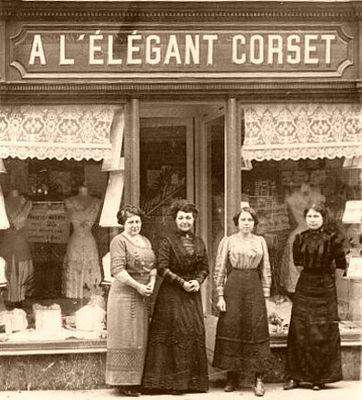
But let us regard a street scene from 1916, Ealing Broadway in west London, where the sign of the Corsetiere is proudly displayed and more obvious than any other. Women wore corsets in those days of course as the other street scene clearly shows.





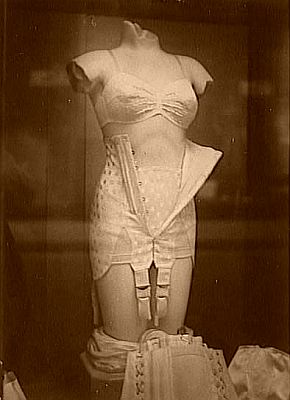

Schreier and Son, Virginia, 1915
|
|


From 1925, a Fifth Avenue Corset shop and from Den Haag on the Laan van Meerdervoort, Coppers-corsets. One of many in the 1970s; only Coja of Rijswijk still survives.


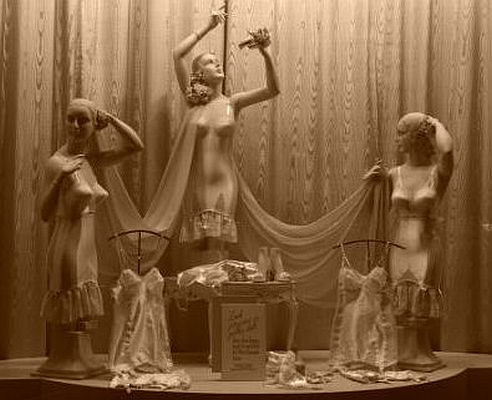

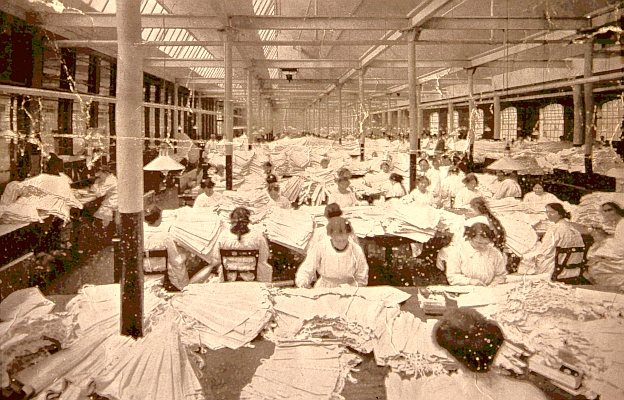
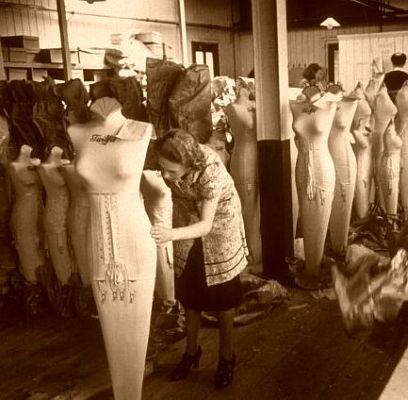
Not a shop, but where all these corsets were made.
The factory interior view on the left hand side shows the William Pretty & Son (1930) Ltd. factory at Tower Ramparts, Ipswich, Suffolk. At this time the factory had been taken over by R & W H Symington after Wm. Pretty & Son went into liquidation in 1930, hence the year in the company's title at this time. Symington's kept the Wm. Pretty name as it was such an established brand. This photograph was taken in 1938 when they published a brochure about the business. The view is of just part of one floor of the factory. The factory eventually closed in 1982, then under the Courtauld Group.
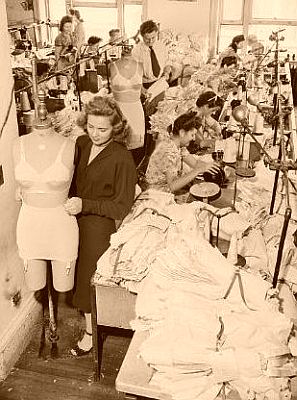
And let us not forget the millions of girdles that were made annually in the 1960s


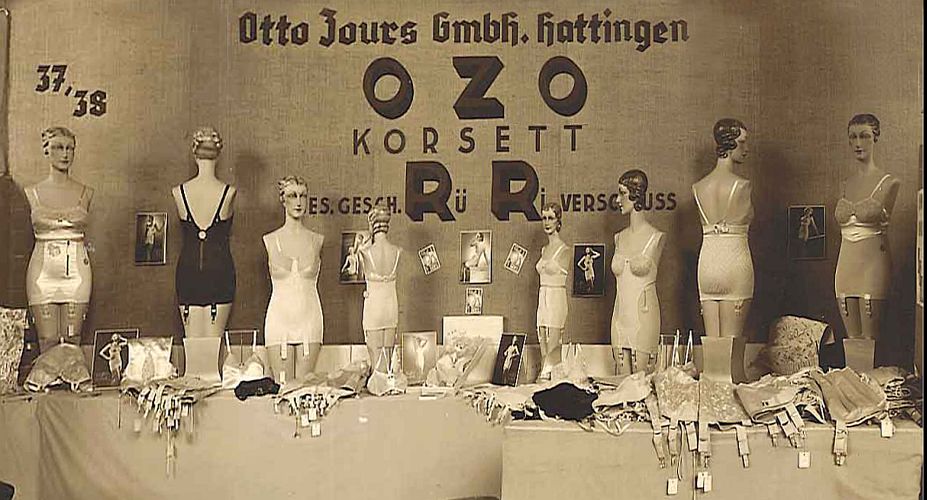
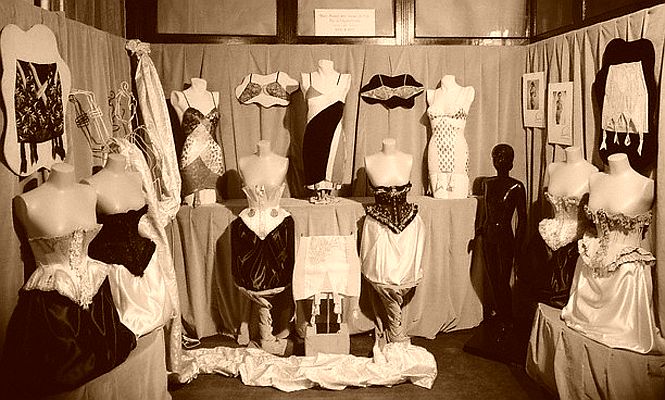
That's what we like to see; lot's of corsets, lots of variety, satins and brocades, everything required to keep the burgeoning Hausfrau under control.
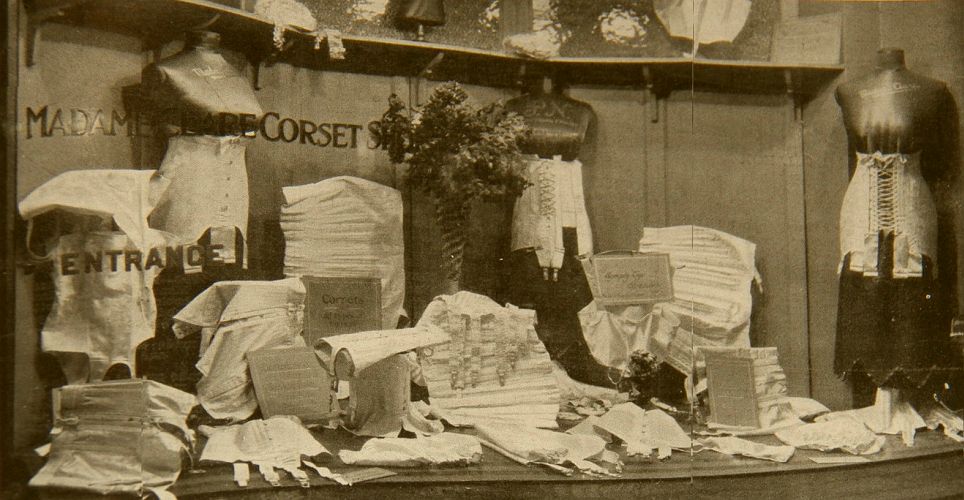
Madame Clare's Corset Shop of Philadelphia in 1922. 835 Chestnut Street, Philadelphia PA is now an art gallery.


Just in case you missed the point, a few notices might be put up...


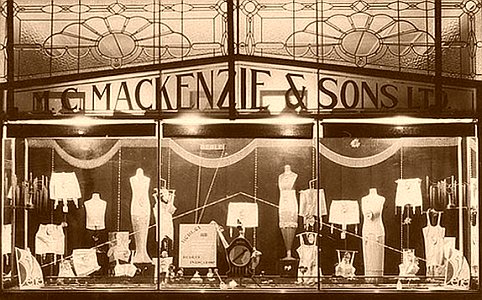
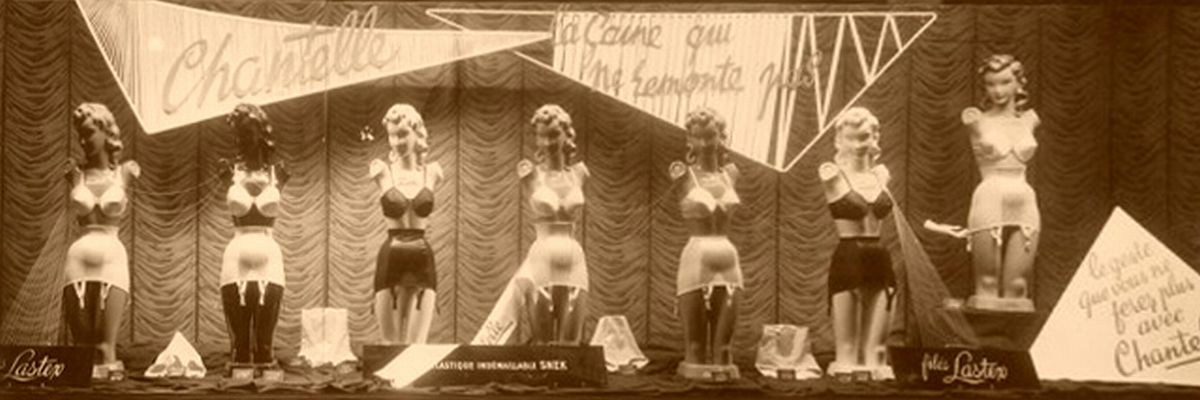
Flapper era, Art Deco and from France on the right, three ladies apparently cavorting around the woods in their satin-panelled corselettes. It is, of course a reflection! Why do models and even mannequins stand in that contrived concave fashion when wearing these corselettes. Is it that the corselettes are designed for shorter figures?
|
My husband and I are firm supporters of the 'crowded shop' and the museum that fills its rooms full of fascinating objects. The modern museum, with its acres of space designed to show off a few expensive trinkets, bores us and makes us wonder "why bother?"
The Victorian corset shops above left no space vacant. Every nook and cranny was filled with their wares. Even Roussel's emporium (1930 - below) has a reasonable foundation-to-area ratio; however, the Smart-form shop below in the mid-1930's displays but six garments in a massive 600 square feet. The emptiness inside would hardly seem likely to attract a prospective customer. But Smart-form, which was none other than the very up-market Barcley, sought a wealthier, supposedly more discerning clientele.
|
|


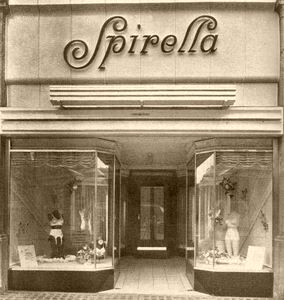
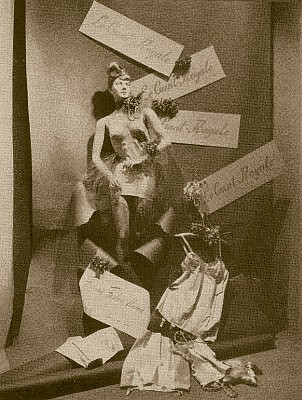
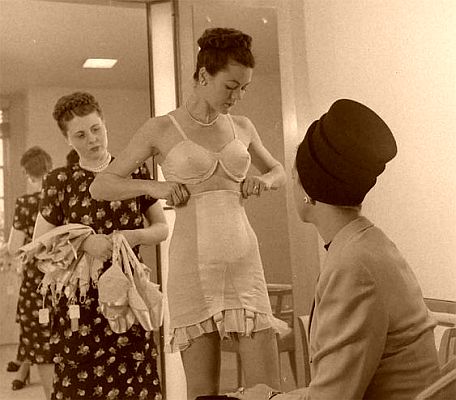
Another attempt at a corsetry display from a major department store in 1944 (below) looks more like the window dresser has gone off for coffee half way through her job! Staying on the western side of the Atlantic, the saleslady below (1944) demonstrates how one can transform one's bosom into the 'bullet' shaped cones that, presumably, rose in response to the ongoing war. The war featured strongly in corsetry advertising. Spirella's showroom (above centre - 1930) and their London shop (above right - 1952) are excellent examples of the upper end of the market.


This is what we like to see. Plenty of garments on display, a smiling and helpful lady, ready to give advice, and the line which we all fall for "I've just got in something special that I think would really suit you. It's slightly more than you wanted to spend." The picture (above right) shows a middle aged lady being shown quite a formidable corset, but that's what we wore in those days.
There's something odd here! The darker picture on the left looks like the one on the right, but the lady in the fur coat has appeared and the photo is taken from a marginally different angle. Looking at the bulging stomach of the lady, she has certainly come to the right department! One might surmise that, since all women wore girdles then, the one she is currently wearing has lost its strength and it is high time to get into her latest purchase that she carries in her right hand. |
 |
Berlei and Sarongster feature in the scene from Australia in the late 1950's (below). No doubt the shelves on the right would have contained garments from Australia's other major brands, such as Jenyns.


The picture (above right) links to an article on the corsetiere who only retired in 2014.


From the 1960's, a Lancashire corset shop. These were the hey-days of corsetry; however, the chipped paint on the skirting of the shop front indicates that profit margins were never huge in this trade, certainly not in the provincial towns and cities.


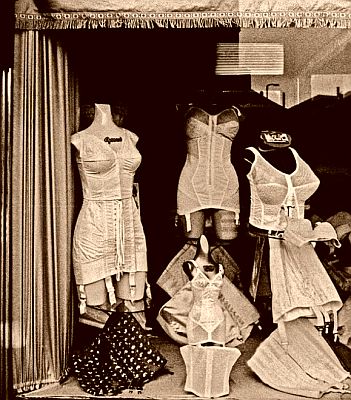


A cause for hope amongst us traditionalists is the corset shop in the middle. This photo was taken recently in Spain, one of the last bastions of traditional Triumph corsetry. On the right, we have a throwback to the 1960's but this photo was taken in 1983. We shall not see these times again!

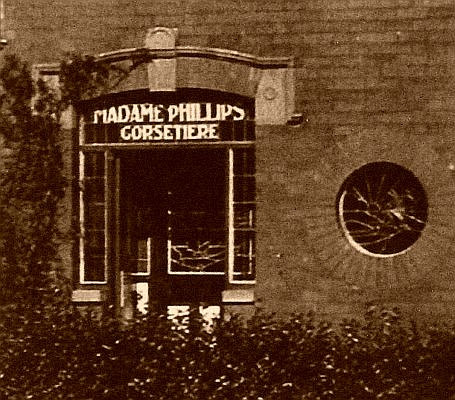
In 1950s to 70s Britain, the names and addresses of Spirella and Spencer corsetieres were published in one large page in the telephone directory (this was before yellow pages). A sign saying Spirella Corsetiere would be displayed by their front door or hung in the window. However, Mrs. Amy Phillips of Read's Avenue, Blackpool (1934) went a whole step further. The typically 1930s, bay-windowed house has beautiful patterns of coloured glass and (at quite some expense I imagine) she has had this magnificent sign placed above her front door 'MADAME PHILLIPS CORSETIERE'.
I know women who were terrified to visit the 'corset shop' and others who looked on its very much like a trip to the hairdresser. A pleasant, fairly mindless afternoon, quintessentially female, and secure in the knowledge that the end result would be an improved version of the person that entered the premises. The women that were scared probably had had encounters with the rare, but sadly real, 'dragon' of a fitter. "Ah, Modom will require the formidable corset section, I presume", or to quote the old music hall joke:- Timid overweight customer "I'd like to see some corsets that would fit me please." Rude assistant "So would I Madam; so would I!" Sometimes, indeed, I thought these shops should label their corsetry sections, 'formidable corsets', 'corsets for normal women', and 'girdles for nice girls'. A old acquaintance recounts an episode in Shinners of Sutton where her substantially constructed companion had vanished into a cubicle to try on a specially ordered corset. She heard the woman call the fitter and explain that she didn't expect so many straps and things. The fitter announced that with her figure, the more straps the better. There followed what sounded like a scuffle, but turned out to be the combined efforts of client and fitter to adjust the garment. Some time later both women emerged from the cubicle, red-faced and angry. In the street outside the large lady exclaimed "What a dreadful woman! I really don't think I'm going to get on with this contraption!" Her friend cautioned her to be patient and let the corset settle down for a week, and added, with an economy of truth, "It really helps your figure." "Don't you start" the other retorted "Do you really think so?" Such is vanity and the corset shop.
|
|
The picture on the left is Rossiter's department store, Paignton, rumoured to be the inspiration behind the TV series 'Are You Being Served'. |
|
We cannot leave this section without mentioning that fictional corsetry department of Grace Brothers that featured in the 1970's - 80's comedy 'Are you being served?' I'm sure in the paragraph above, the 'dragon of a fitter' must remind all of us of a certain age of the indomitable Mrs Slocombe and her scatty, although street-wise assistant Miss Brahms (left). Mollie Sugden and Wendy Richard had these characters off to a tee. Sadly, both passed away within a few months of each other in 2009 despite Mollie being 20 years older than Wendy. Like their corsets, we will not see their like again. Or will we?
|


The corset shop re-enacted in 2014 for the Ivy Leaf series of calendars.
I love the picture on the right. It predates the 'swinging sixties' and shows a mother and daughter out to purchase some underwear. Note that the teenage daughter has no 'self expression' in her clothing that is identical in style to her mother's: jacket, skirt, blouse, court shoes and stockings. Almost certainly the mother's stockings are held up by a girdle, and as for the daughter, a suspender belt perhaps, or after today's outing, a girdle, just like her mother. We discuss this below.
|

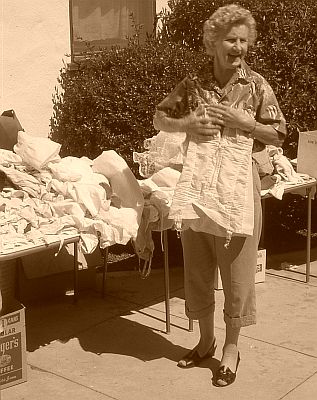
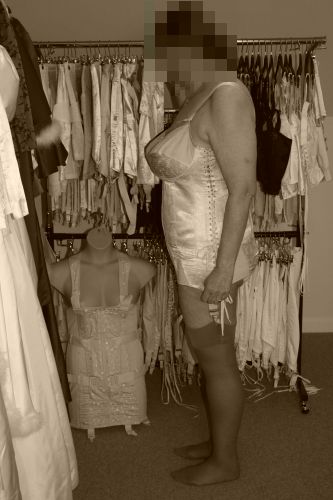
It's amazing what you can find at those rummage or jumble sales. The lady is delighted to find a barely used corselette.
Here are another two photographs that tell a tale. On the left is a German street market in the 1950's. The brassiere with the three strap fastening at the back dates it nicely. On the right is an American shop, but doesn't it just give away an air of faded glory. The permanent SALE sign, the missing flourescent tube. Profit margins would have been close to zero and it is not just the old advertisements that reveal the 'writing on the wall'.
|
|
But let us move into the hallowed sanctum of the fitting room. How many husbands have stood on the edges of the 'forbidden area' in the department store. Slightly flushed, slightly embarrassed, probably bored but with the nervous anticipation of footing what he suspects (correctly) will be a rather large bill. Silly man, he should be anticipating his wife, rejuvenated in both confidence and figure! I think everything is here to persuade the most recalcitrant of torsos into that special dress for the wedding. Hundreds of yards of lacing, innumerable buckles and straps, under-belts, spiral bones, double bones, rigid bones of alloy and steel. Brocades, satins, shiny (and rather noisy) nylons adorn both the foundations and the dresses. A mistake in the combination of these materials could generate enough electricity to draw sparks from the wearer's rayon gloves! To the uninitiated, the corset shop all too often conjured up a vision of unyielding strong satin, rows of hooks and eyes, yards of lacing, and bones, bones, and more bones! (paraphrased from the Spirella Magazine January 1958.) Brassieres of all lengths, corselettes, girdles, panty-girdles and corsets. All are represented together with the more risqué sounding basques, waspies and waist nippers. Everything can be adjusted from the heaviest of surgical corsets for granny, Jenyns' best flattening devices for mother, laced brassieres for matrons who can go without breath or food for an entire day, and imaginatively complicated panty-girdles for the bride, whose will-power between the first and last appointments has left her a size beyond her prime.
Spirella*, Spencer, Barcley, Jenyns and Camp*, all feature here - but sadly, they feature no longer in any shop that exists today. Most women will say "Thank Goodness," but some will miss the flattening and flattering persuasion of such archaeic devices.
|
|
* Actually, Basko-CAMP is still sold in Holland and Germany, however, the drab coutil garments are so utterly unfeminine. Spirella has been re-awakened in Sweden, but once again, their products are somewhat utilitarian.
|
Whatever happened to Whalonia, Freeman, Trueform, OTC and Avro. Camp is still with us (just). The box above tells its own story. It is very old and therefore contains an unfashionable garment. Perhaps this would not be a concern to the sort of aged client who might wear one, however, the unlikely size (50 inches) and the reductions in price tell of a declining interest. The word 'under-belt' is written on the box, for nobody in the shop remembers what model 4521 means anymore! |
|
|
|
This is a scene from a bygone era. All the foundation
garments came in these packets of similar size. They could contain anything
and everything from a panty-girdle for one's daughter to a formidably-boned
corset for granny, complete with under-belt, lacing and buckles. There were
so many boxes because women tend to come in so many different sizes!
What happened to these boxes? Many were thrown away, sometimes after long use as a receptacle for something completely unconnected with corsetry. |
|
|
Lastly, a sad reminder of present times. The shop below is one of the few remaining traditional corset shops in Britain. The shop is closed, although it is 2 pm on a normal working day. A closer inspection reveals that the proprietress only opens about 15 hours a week. This is not surprising; the lady has run the shop for decades and is well into her 80's. The window displays some relics of a former era and a corset that seems to have been returned, modified, and then failed to find a buyer. There is a good satin girdle on display; however, the general appearance of something better than neglect, but less than faded elegance, pervades the scene. The shop could easily be mistaken for a Charity Shop (Thrift shop in the USA). The badges of former pillars of corsetry, Camp and Spirella, proclaim wares that haven't been sold for years. Oddly enough, Triumph, the name on the door, still holds a firm foundation on continental Europe. The Camp sign is decades old, since the style was modified long after the shop had ceased connection with this company. The shelves, however, still hold relics from this company in the unusual and thus unsold sizes. Lumbosacral* and dorsolumbar supports could be found, but the proprietress had forgotten what they were supposed to do. Fiendishly complex maternity devices were shunned by modern women who felt that pregnancy was uncomfortable enough without having to wear a straight-jacket! The Spirella sign, again, a throwback to an era long-gone, would never have been placed in a shop window in the 60's or 70's. The High Street retailer and the bespoke businesses were keen rivals. The proprietress was simply trying to advertise every possible foundation garment to her diminishing clientele. The piles of unboxed corsets hint of damp in the store-room and a consequent unappealing deterioration of the boxes; the corsets themselves survived. Allusions to proud weddings of the past (but not the present) tell a sad tale: for the whole shop is nothing more than a fading reminder of something that has passed away. |
The old corset shop in Dymchurch, sadly closed |
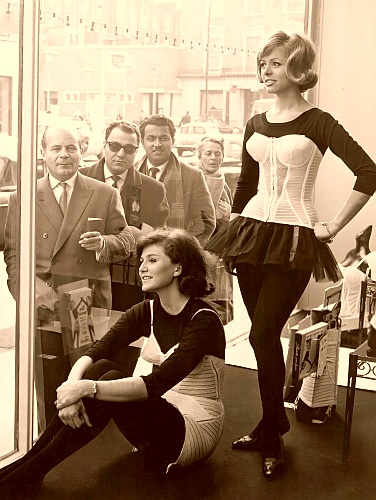
Real models in 1963!


|
The Corset Shop Returns
Indeed, what with the resurgence in 'shapewear', the modern corset emporium, whilst lacking the innate feminine charm of yesterday, at least is making some effort. Sadly, style has being discarded along the way.
Yet another 'sea of bras' (left). At least this market stall in France still has some proper foundations. Examples (above) from Portugal and South America, once again demonstrate the Latin demand for a feminine shape. This movement spread to the Far East as Japanese and Korean women discovered the power of Spandex and now, after a absence of several decades, girdles (even if they are called shapers) have returned to the shelves of the European high street.
Massachusetts 2005 A reader sent in this photograph from a Massachusetts corset shop. I love the rows of boxes and the slightly chaotic assemblage of articles.
New Zealand 2005
This is a photo of Maree, the owner, and Robin, her assistant, at the "Maree Louise Corsetry" shop in Papakura, near to Auckland, New Zealand. Notice a strange similarity to the ladies at the Coja corset shop in Rijswijk, Holland.
Coja, Holland 2008
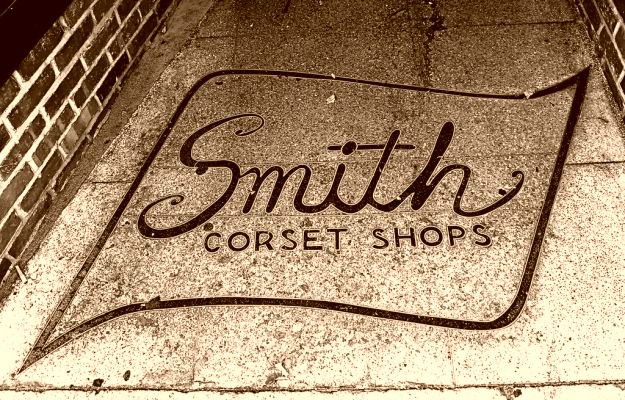
Sadly in operation no more. The firm closed in 2000 after 54 years of service, however, the wonderful signage remains to this day.
|