II: The Scientific Support and the Rivals
The Scientific Support
|
|
|
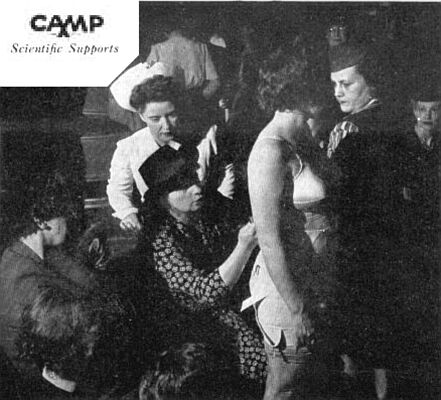
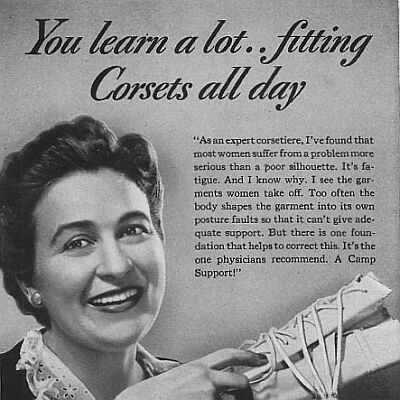
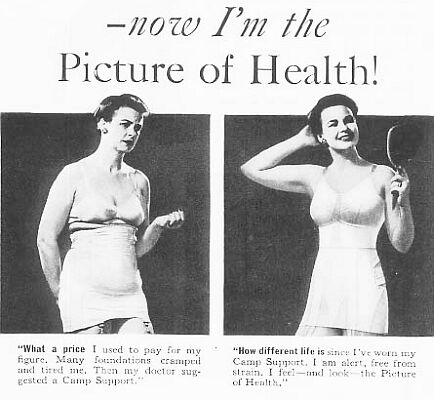
Camp shows images of good and bad corsetry (above). On the left (in one of the classic corsetiere poses of all time) is the happy relationship between the corsetiere and her smiling customer, proud of her 'new' figure and just waiting to try on that gown she bought for a special occasion. On the right, the poor lady in question is being poked, prodded and generally 'tut tutted' at by a group of nurses and formidable matrons who seem to be using the object of their attention more as an example of the lady who "didn't listen to her Mother when she was young"!
|
|
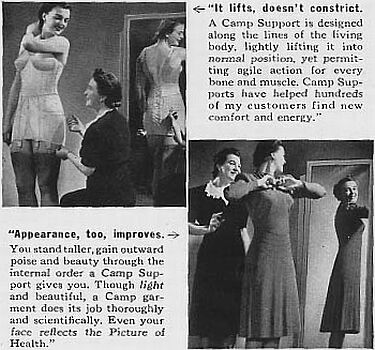
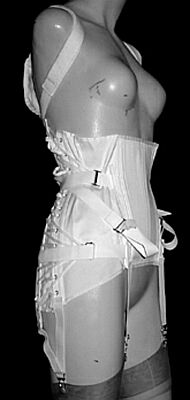
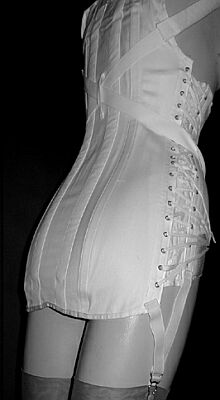
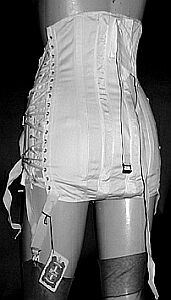
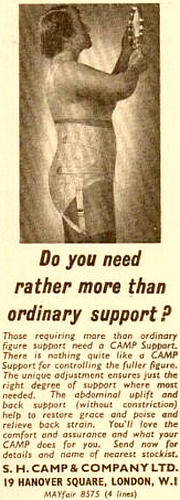
Camp, as did so many other firms, sold the overall benefit of the corset to the wearer's well-being. How you disguised the webbing and straps was, however, another matter!
|
|
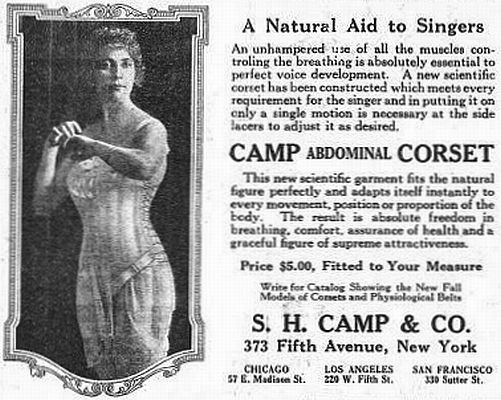
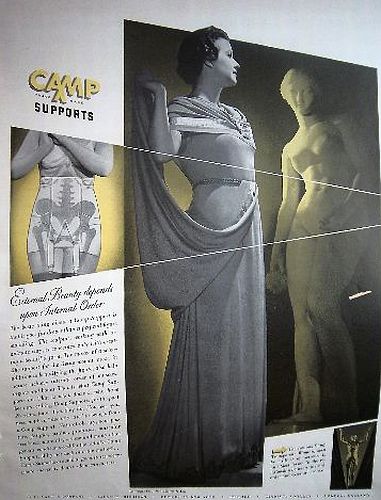
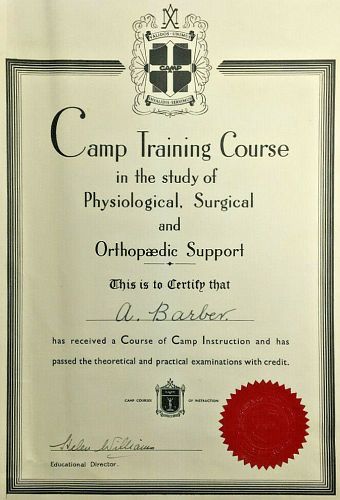
Camp was at pains to point out that they didn't just sculpt a woman's body, it was scientifically and medically sculpted!
|
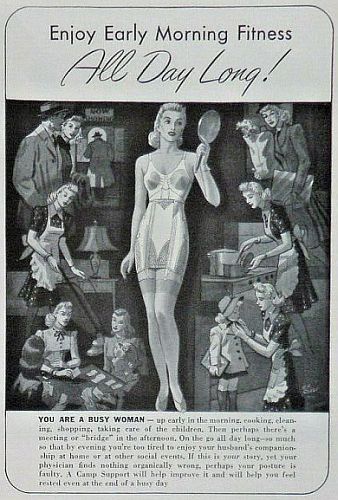
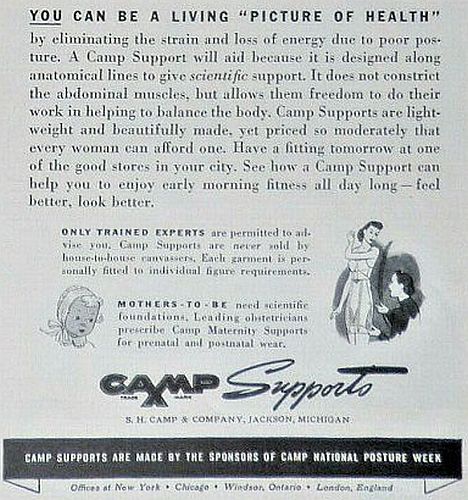
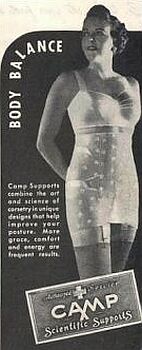
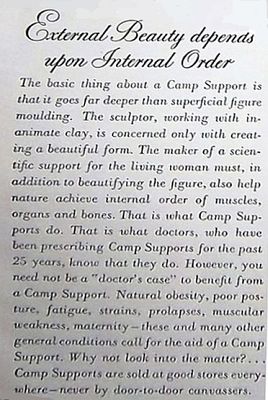
Typically of the period, 1941, CAMP extols the virtues of their scientific support whilst extolling the virtues of the wearer, for without her corset, she would not be able to contribute to society.
|
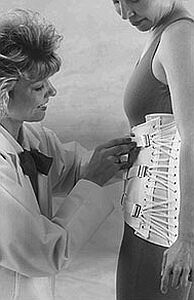
Basko Camp, Holland 1996 |
Even in the 1990's, the Dutch Camp fitter adjusts the webbing
straps of the corset. There is no fashion statement here. The support is
indeed, scientific and would be worn a briefly as possible by the patient
for some 'back problem'. Note that the assistant wears vaguely
medical looking garb (see the nurse above right). This aims the
advertisement squarely at the 'surgical corset' end of the market.
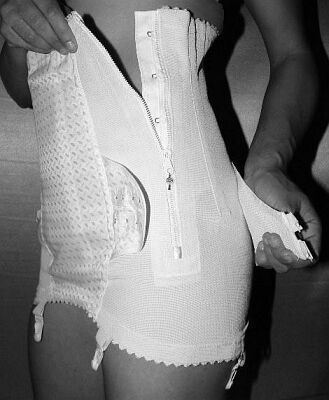
The customer wears a leotard under her corset which will prompt readers to wonder whether women wear their foundations over or under their slips and knickers. The confusion comes from the modesty of the advertising photographs. Any foundation that requires more than a moment to release is always worn under the, let us say, 'modesty layer'. For advertising purposes this is unacceptable since the layer conceals what is being advertised. |
|
|
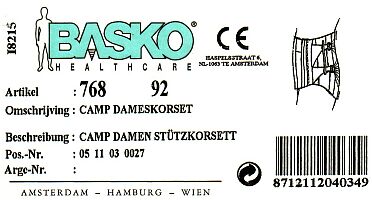
I purchased the 'Dameskorset' from the corsetiere in
Rijswijk, a suburb of the Hague in Holland. It must
have been about 1999. The corset doesn't fit particularly well, since latter
day CAMP's are notoriously short in the back; exactly what a lady of my
build does not need. Note how the corset is marketed under the BASKO name,
but described as a 'Camp Lady's Corset', the term 'Camp' referring to the
generic lacing style rather than the owning company.
The few remaining Spirella corsetieres were, perhaps professionally, scathing of CAMP. One fitter told me that she had recently 'rescued' one 'old dear' from her Camp! |
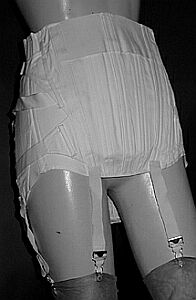
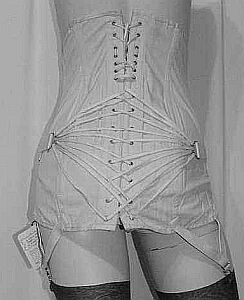
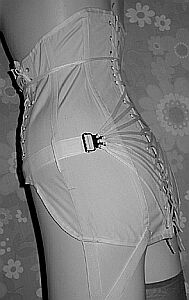
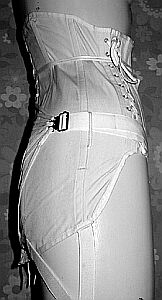
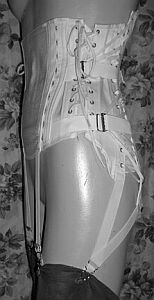
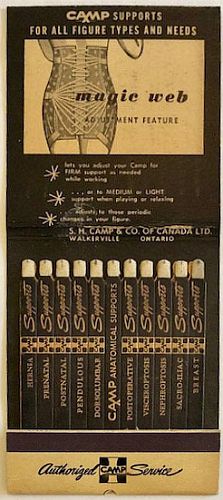
Nevertheless, the practical side of the Camp lacing system was a boon to both the fashionable lady and also the lady with a medical problem. The support was effective, easy to adjust and strong. It could be made, as shown above, as attractive as required and yet it fulfilled its primary function. As the 1970's drew to a close and the corsetry sections of the great department stores began their slide into the 'sea of brassieres' (as a friend of mine commented), Camp products began to show a change in emphasis from fashion to function. The materials became plainer. The rare satins vanished and even the brocades moved to coutil or nylon. The traditional colours of white and tea rose (Camp virtually made no black underwear except for the rare example below) were replaced by boring beige, and metal suspenders became plastic. The heavy fabric webbing of the straps was replaced by a thin, shiny fabric and, as a last indignity, Velcro replaced the hooks and eyes. The fashionable garment had become a surgical appliance.
I have no idea how this affected the finances of the Camp company; however, they still exist today and thrive in the surgical appliance market. The 1996 brochure shows the descendants of the traditional Camp corset and girdle, albeit in beige and notably in Dutch. Camp must have joined forces with a company called Basko, and the names Basko, Camp, and Basko-Camp are marketed in Western Europe and Scandinavia, but no longer in Britain. The latest web catalogue reveals that the traditional fan-lacing lives on in a wrist support, but its use in proper corsetry has died some 94 years after its invention.
|
|
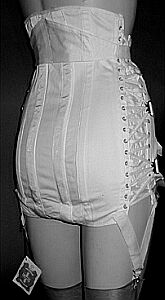
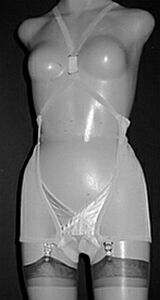
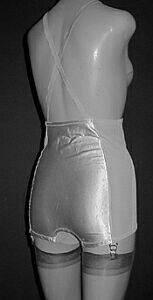
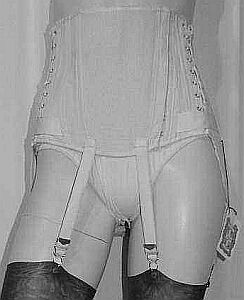
At one point, CAMP was famous throughout the world. America was a stronghold and many Camp corsets still appear at auction there. Indeed, it is the auction houses that still provide some regular wearers with their only source of corsets! Holland and Germany featured Camp strongly for several decades after the war. The CAMP sign was a feature of Dutch corset shops in the 1960's to 1980's. One still is on display in Rijswijk. Examples from Italy (left and centre) show some market penetration as well, and despite the 'Original and Unique' garment on the right, that surely is a CAMP. The Italians, quintessentially style-conscious, had many brands of their own from the fashionable to the heroically formidable. Pasta has a lot to answer for! |
|
The examples shown below come from the 1980's and are genuine
Camp products. Identical products are still sold (http://www.backbraces.com/pages-products/backsupports5.html
These products are also available as copies in Latin America. They were marketed in the 1990's under the brand name 'Pro Infirma' and it was interesting to note that in their shops, the only catalogues that the assistants referred to were old Camp catalogues.
|
A formidable corset by any standard, it bears all the Camp hallmarks. The long back steels (which were usually made of Duralumin) are held to the spine by means of shoulder straps (CT). |
Another strong support with triple side-lacers and a slightly dished front panel for the abdomen (CT). These are corsets from the 1970's and the durable rather than fashionable nature of the material indicates their intent precisely. I purchased an identical corset in Holland in 1986 and it featured in their brochures until recently |
Maternity Engineering
|
Maternity gave Camp's engineers a chance to excel. Triple-lacers were quite normal, and we have in our collection an amazing quadruple lacer, where the expanding mother-to-be could accommodate her swelling abdomen, provided of course that she had a degree in mechanical engineering! When you consider that Camp manufactured brassieres of a similarly adjustable nature, the poor woman concerned must have wondered ruefully about the expression 'confinement'.
Possibly the most outlandish creation that we have encountered, is a girdle designed for pregnancy. It performs a sort of 'Jeckyl and Hyde' function, where the rear is confined into the 'mono-buttock' sleekness required in 1960's America, whereas the tummy is literally allowed total freedom which, I would have thought, precluded wearing the skirt encouraged by the other side of the contraption.
The Cherry-Tomatoe Collection |
The Camp maternity corset (TP). The ease of the lacers' adjustability would have been a boon to the young mother-to-be.
The Camp maternity corset (CT). The swing rear suspenders and the five hole former are hallmarks of this brand. The corset on the right has, perhaps, gone a little too far to accommodate the expanding womb. Four sets of lacing (two on each side) take up so much of the corset that it's even hard to make the photograph show all the complexity. |
But let us return to what Camp, and the Camp system of lacing did best:-
Memories of the Camp Corset
Memories of the Camp Corset #1
Mummy and Granny wore Camps for as long as I could remember. I supposed that one day, when I became old enough I would wear one as well; it was a normal part of a ladies underwear. The cluster-lacing seemed an eminently practical way to tighten the garment. In our household they were quite unexceptional and I was surprised when a girlfriend from school remarked on "those old-fashioned torture devices" when we passed through the kitchen on washing day, corsets and bloomers hanging from the pulley in riot of tea-rose and white. It certainly gave Mummy a flat tummy which patently many of my friends mother's did not possess.
As it turned out, I never did wear a corset of any kind. When I went to university, 'flower power' and 'bra burning' was in. Corsets definitely were not. I sometimes wonder, as a Granny myself these days, whether my wayward figure might have been a lot better had I not become a victim of Womens' Lib.
|
|
|
|
I have never forgotten this tale that my mother told me to illustrate the difference between men and women. I will relate it as she related it to me as a teenager in the 1960's.
After years of marriage, I suppose that familiarity breeds, not contempt but complacency. If dressing and undressing in front of one's spouse was romantic in the early days, it certainly lost its appeal quite quickly as the sheer practicalities of raising a family intruded upon one's freedom. Indeed, as the family grew up, so the body grew down and out. At one point I was quite depressed about my poor figure that even the strongest high street girdles failed to control and a friend suggested trying a Camp corset. I had seen advertisements for these in Womans Weekly and was not impressed by the complex looking lacing. Only a man could design such a monstrosity. My friend persuaded me however, and one day I was fitted in Shinners of Sutton. Well; I still did not like the look of the garment but I have never ever worn such an effective foundation. It was so easy to put on and fiercely compressive. It did the trick and, after all, who would see the engineering involved.
Shortly afterwards, and I was wearing the new corset regularly, much to the improvement of my figure, I noticed that whilst dressing in our bedroom, my husband, instead of snoring away his last precious moments in bed, was regarding me intently as I engaged the straps on my powerful new ally. "What is that?" he asked. I explained the principles of the corset and he even clambered out of bed to take a closer look. I didn't know whether to be flattered, annoyed or apprehensive, but I need not have worried. "What a superb piece of equipment!" He waxed lyrical about mechanical advantage and pulleys and I'm sure added Mr. Camp to his personal list of heroes. Not a word did he mention about my improved figure and the way my clothes hung so much better. Typical male!! |
I knew that Granny wore a Camp corset for I had seen these remarkable devices hanging on the washing line. Mummy wore whatever girdle was cheap and cheerful at the time and I simply wore what Mummy normally wore, for dutiful daughters more or less followed their parents in the early 1960s. At that time, there was a young fashion (inspired by Alma Cogan and Dusty Springfield) for narrow waists and huge petticoats and I was aware that my normal girdle was not quite up to the task of producing the wasp waist that I desired. Mummy, an expert seamstress (as many women were in those days) solved my problem by cannibalising one of Granny's older corsets (I suspect without her permission!) She removed the boning and cut the corset to cover only the waist so that it was about eight inches deep. She sewed in darts to achieved the waist that I desired. Meanwhile, in his 'secret lair' or so we called Daddy's shed in the garden, he cut the boning to the new required length and mummy re-inserted these into their casings. She omitted a few bones since what with taking in the garment it would have been all bone and nothing else. She re-laced the corset using just the top straps of the fan-lacing and, voilà, I had my waist cincher, and an extremely powerful and effective one too! A tug on the straps and four inches fell off my waist-line. So the material was a bit 'tea rose frumpy' but nobody was going to see that in those days. I didn't let on either that I was wearing my Granny's corsets that had been re-designed by my parents!