Technical Aspects
of Corsetry
Corsets and
Girdles: A
Lengthy Subject ...
|
|
This section might almost be called the rise and fall of tall corsetry.
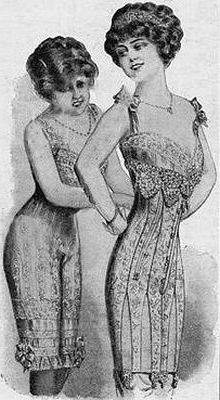
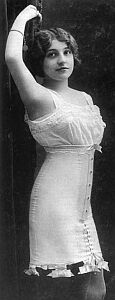
A century ago, as these photographs show, corsets could be very long
indeed. Above the waist, one wonders if the wearer could even bend, and
below the waist, some corset skirts were so extreme that sitting down
was surely a major problem. This is strongly
exaggerated in the French advertisement (far left). Casual observers of these Edwardian corsets have
commented, how on earth did women walk, sit or even attended to the calls
of nature? Observe the corset closely. The corset was only tight at the
waist. The bottom of the corset, still referred to today as the skirt, was
in fact simply a looser extension of the corset that allowed the clothes
to flow over the foundation without any lumps or bumps. The skirt didn't
need to be tight since its other purpose was to provide attachment for the
suspenders (garters). One of the primary functions of the corset or girdle
has always been to hold up one's stockings. In Edwardian times, stockings
barely came above the knees, however, as skirts became shorter, so the
stockings became longer and the corset shorter.
A
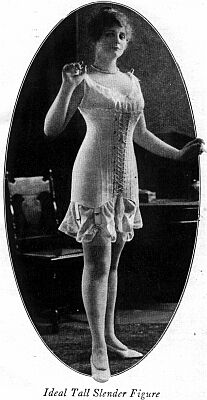
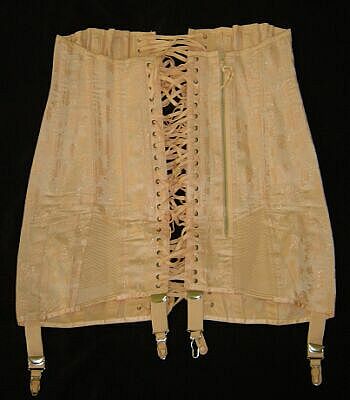
typical Gossard corset from 1920 Corsets in the earlier part of
the 20th century were habitually longer than those of our mothers'. Regard
the Gossard picture (left
middle). The lady is
tall, let us say (by the standards of those times) 5 foot
6 inches (1.68m). In
that case those corsets are about 20" long.
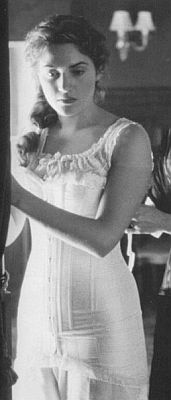
Rose Dewitt Bukator
(left) displays a typical Edwardian corset, although oddly with no
suspenders. It is a very long garment, but the horizontal creases show
where she has sat down. The busk length has to be carefully designed so
as not to injure the wearer!
|
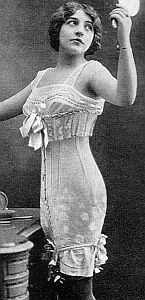 
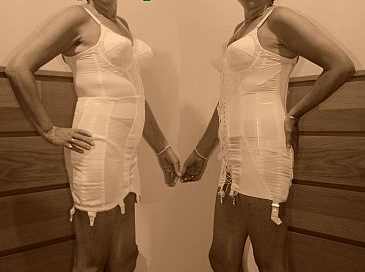
The lady
above appears in two very long Edwardian
corsets. Assuming her height is about 5 foot 4 inches (1.63 m), the corset on the
left would be a full 22" long and the one on the right an amazing
24", but
note that the extra length is in the skirt.
|
Corset length above the waist is simply a
requirement if the wearer wishes to achieve a 'waisted' silhouette, and in
post-war America, the girdle became the weapon of choice.
Far from being the preserve of
the Edwardian lady or the corseted elderly woman, length was a feature
beautifully demonstrate by these American models below for Poirette
and Smoothie. Some long-legged panty-girdles (the famous LLPG that never
quite crossed the Atlantic in all its glory) could measure an alarming 22"
(56 cm) in length.

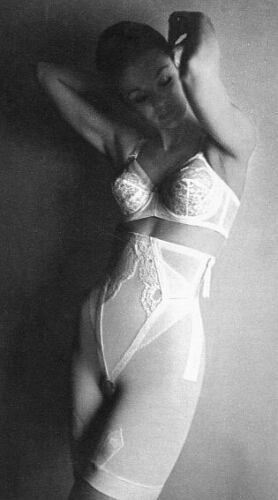

In Scandinavia, the tall girdle was very much in
demand in the 1950's and 60's. The high-waisted girdle was not without it
problems, as illustrated in the famous 'Mrs. Merrick bought a derrick' cartoon.
|
|

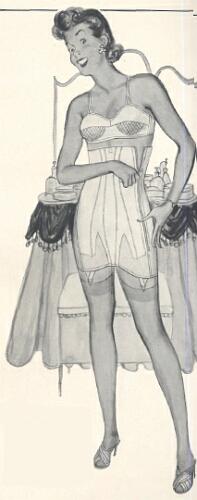
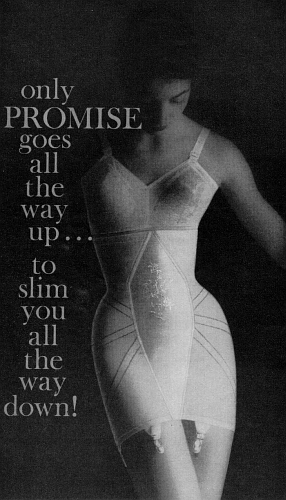
This unbelievably corny advertisement for Talon Zippers
illustrates a daily chore for millions of women in the 1950's and that
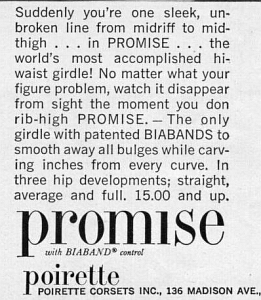
was getting in and out of one's girdle. Mind you, once ensconced in your
rib-high Promise Poirette, the resulting silhouette was undeniably
attractive.
|
 |
|
Long corsets are still with us.
Two of the corsets described below in the 'weighty' section are 53 cm (21") long in the
back. Spencer regularly advertised
corsets of this length and still makes them today and, of course, being a bespoke house, a taller
lady would have ordered proportionately longer corsets. I know of one very tall Danish lady whose corsets were an amazing
16" below the waist and 7 " above the waist at the back. That's
23 inches (58 cm) in total! We met this lady on a Nile cruise and, despite the searing
temperatures outside, she rigorously maintained her heavy stays, for
indeed, she needed them. An ailing back required all the support of the
corset if she was to participate in the interesting excursions; which she
enjoyed to the full. I mention this, since ultra-long corsets usually can
be classed as surgical supports.
We have added some notes on long corsets in the Corset
Detective page. Of course, what constitutes a long corset depends on the
relative height of the wearer. We met a bubbly barrel shaped woman many years
ago. Barely 5 feet tall (1.5 metres) she had no waist at all to the extent that
her corset required shoulder straps in case the strain of her stockings actually
pulled her corset off! The Spirella corset that she wore was only 18" long, but
it covered her from thighs to armpit. She certainly felt that she was wearing a
long corset. Sadly, having invested quite some money in this foundation, the
chafing of the shoulder straps against her bosom forced her to consign it to the
back of her drawers where her children rescued it years later after she had
passed away.
Our friend in these photographs wears one of the longest contemporary corsets in
our experience. The lady who is 5' 10" tall wears a front- and back-laced
Spencer posture corset purchased from Spencer of England in 2005 (the modern
equivalent of the Spirella 325). The corset is 23½"
long at the back! The satin back-laced brassiere (from Hunkemoller in Den Haag -
2000) contains any flesh that might escape over the top of the corset. When the
front-lacing is considered as well, there is over 50 inches of lacing to adjust!
We have seen and even possess some seriously long corsets in our collection, however, they pass
beyond the world of the conventional or even
surgical and enter a realm of fantasy. |

|
... and a Weighty
one too!
| How much did corsets
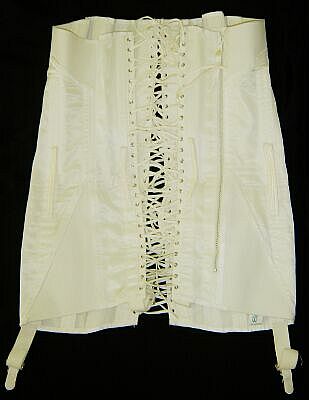
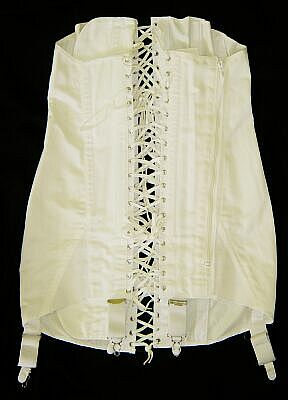
weigh? We put it to the test using three fairly substantial Spirella 325s
from both sides of the Atlantic and dating between 1960 to 2000.
A modern Spencer (ex-Spirella)
corset from Britain a few years ago weighs 500 gr (just over a pound). The corset on the right which came from the USA in the late
1960's weighs in at 660 gr (1lb 7oz); below left, the Canadian corset
from 1970 weighs an X-ray challenging 800 gm (nearly two pounds.) In
fairness, the Canadian garment carries four substantial back support
'steels' (made of Aluminium).
It was perfectly possible in the
late 1960's to have ordered a back-support corset with underbelt, in a
strong, yet fashionable material. Such a garment would have weighed well
over one kilogramme (two pounds).
One
of our new Spencer corsets ordered for a friend in 2005,
by virtue of its length (23") weighs in at 880 gr (just under two pounds),
and that is without spinal steels. Had such a corset been made 20 years
ago from heavy corset brocade, one feels that the three pound barrier
might well have been threatened!
For comparison, a M&S satin elastic girdle
weighs in at 350 gr (12 oz) |
 |
|
Such weighty foundations have all
but disappeared, indeed, from the 1960s onwards, the thrust was towards
lightness and comfort. I have no objection to comfort at all, however, a
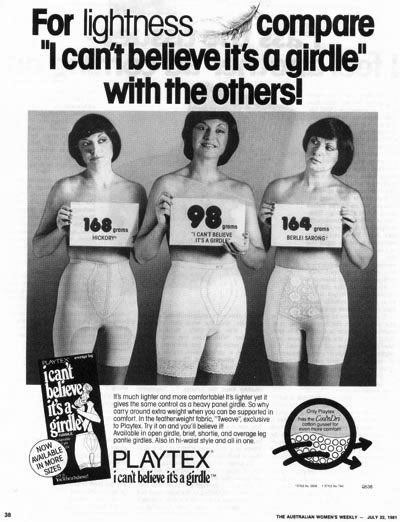
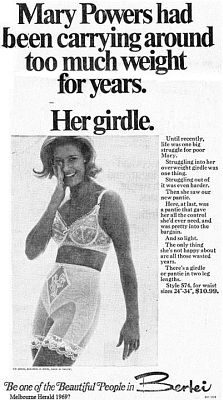
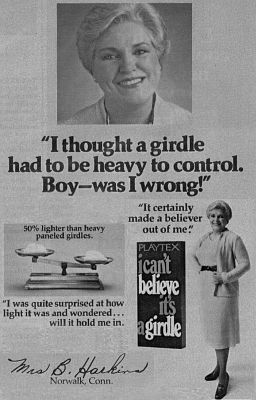
foundation is a foundation and should do its job. Did the Playtex girdle at 98
grams (right) really have any effect at all? Certainly not on the slim model in
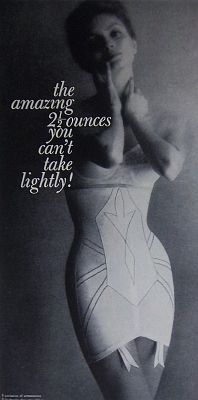
the advertisement! The 2½
oz (73 gr) full girdle by Warners is even lighter, including four suspenders. I
have come across such light girdles, Miss
Mary of Sweden's are surprisingly light, but there is no substitute for
weight.
|
'Au contraire' Madam,
you are actually right! |
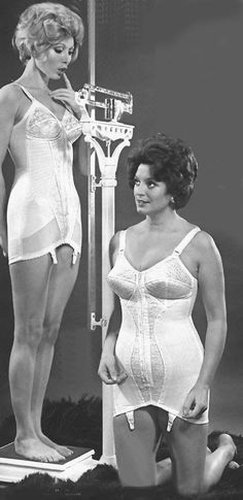
An old trick lies below; the subliminal connection
between tight underwear and weight loss!
Who wore what, when
?
The facts and figures of corsetry might be obvious to myself and
my female peers, but
my husband has a typically male approach to such problems and resorts to mathematics
and some basic assumptions to determine what is fact, and what is fiction. As he
often says "In these days of unsolicited and gratuitous misinformation, it
pains me, as a scientist, to see so much conjecture and political expedience
rendered under the banner of factual data. I would hate to be so cynical as my
old tutor at college who, quite candidly expostulated that "Most of what
you will learn is fiction. Use your brains; THINK. A minute's thought is
worth a day of effort"". Amazingly, my husband's agonising over the PC
and the following chart actually do explain rather a lot!
In this analysis, there are many sweeping assumptions and generalisations,
however, the end results explain much of what is observed.
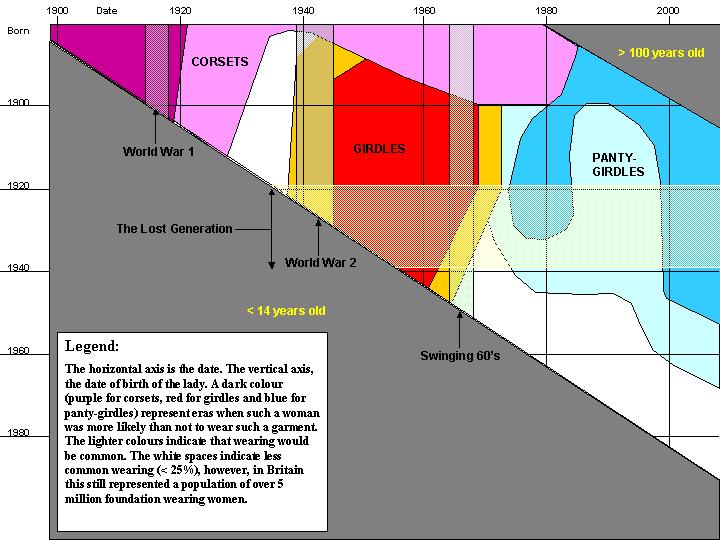
The graph says it all. It was constructed from basic
assumptions. Over 100 years old, the database is statistically non-existent.
Below 14, we're looking at relics from Victoriana (almost). I simply considered
when a woman was born, what was the chance of her wearing an appropriate
foundation for each particular year, and then relied upon the deluge of opinions
that Ivy and Bunts could reproduce! Let me help you by taking a few examples:-
1) A lady born in 1900 (vertical
axis - on the left), living in 1920
(horizontal axis). The colour is pale purple, close to dark purple. This young
lady would be likely to wear a corset if upper class, and less likely if lower
class. Her older contemporaries would almost certainly wear a corset.
2) A lady born in 1920 living in 1960 (my mother and her
friends). Definitely into girdles, but note the rapid decline after the 'Beatles
era', and the rapid uptake of the panty-girdle. Oddly, there is a dip in the
popularity of the panty-girdle that has only resurfaced in the last decade.
3) A lady born in 1950 living in 2004. The graph predicts a
reasonable chance that she wears a panty-girdle, but the chance the she wears a
corset is extremely small. Nevertheless, extremely small multiplied by the
potential 25 million eligible women in Britain is still a finite number. Ivy is
one of that finite number!
4) The corset appears to make a comeback at the end of the
1930's. This is simply the corset-wearing generation discarding such garments,
but soon reverting as older age took the upper hand.
5) Ivy's 'Lost Generation',
is represented by the horizontal yellow band, i.e. those women who are currently
aged 65 to 85 years old. Certainly, they were regular girdle-wearers, however,
you have to go back another 20 years to catch the corset-wearing Edwardians.
That's why genuine recollections are usually the preserve of the very elderly.
6) Note the rapid rise and fall of the girdle. The corset (as we
currently know it) has been around for half a millennium, and the Spirella 305
(still marketed today albeit by Spencer) for eight decades. The panty-girdle, invented well before WWII,
came to prominence in the late 1940's and is still effectively the only lower
foundation on offer today although it nearly passed away in the 1980's to 90's. It's future looks secure
even if women use the euphamism 'shaper'. That will be at least six
decades. The girdle came and went in three magnificent decades of style and
control. The corset it supplanted eventually would out-sell it. The
panty-girdle, took America by storm and then invaded Europe. The girdle, like
the Apollo missions, had been years incubating, still lingers on in reduced
form, but was at its zenith for a remarkably short period. We forget how long
ago that was. The Beatles, the culture of whom changed the world, and
incidentally terminated the girdle, are now eligible for pension. How did it all
pass so quickly?
These notes would have
been impossible to compile without the memories of my husband and myself, but
especially recollections and anecdotes from readers. Regard the observation
below and one can see the time lines of fashion change describe in apparently
trivial memories.
“I
used to visit my aunt several times each year in the late 1960’s. She must have
been about 65 then. She always kept her
cupboards open, and lying there were her M&S girdles. These garments were replaced by pantie-girdles in 1969. I remember the year since I
went off to university then, and she gave me five pounds”.
"I started wearing a
girdle when I was 15. Why not? My mum did and girls in those days dressed the
same way. Just before I went to training college (1971), she took me into
Guildford and bought me some panty-girdles that, hitherto, she had pooh-poohed.
I never wore my girdles again. Tights came almost immediately afterwards and the
daily chore of doing one's suspenders became history. When I say chore, I didn't
realise it was a chore until I stopped wearing stockings."
The History of Foundations from the Sears Catalogue
We have a number of Sears catalogues dating from
1918 to 1972. A quick walk through their pages is to take a trip down memory
lane, however, my husband decided to test the veracity of our article above. In
short order, a number of expected conclusions appeared and a few unexpected
ones. Of course, the Sears catalogue does not reveal what women wore, simply
what Sears expected them to buy; the relative sales figures are unknown to us.
Nevertheless, here are some observations:-
|
Corsets are present in
all the catalogues, however, from the late-1930, back-lacing steadily gives way
either to front-lacing or cluster-lacing. Basically, donning one's corset became
a task for oneself, not one's maid. From the late 1950's the number of pages
devoted to corsets decreases drastically, and the models for sale are more
'surgical corsets' or supports rather than fashion garments. Corselettes stand
the test of time as well evolving from complex under-belted creations to the
ultimate entrapment device, the long-leg panty-corselette. The garment was
extremely popular prior to the WWII mainly because independent brassieres
were not available. The corselette pre-WWII was really a corset extended to hold
the bosom. The word brassiere appears after WWI but their appearance in any
number does not happen until after WWII. Long-line brassieres never occupy much space
in the catalogue and steadily the conventional bra would dominate the pages,
and subsequently the floor space in the department stores.
Girdles arise and fall over a
three decade period, the shortest of any serious foundation garment. What might
have been a longer success was squashed in short order by the panty-girdle. This
garment first appears pre-WWII but dramatically dominates the catalogues as the
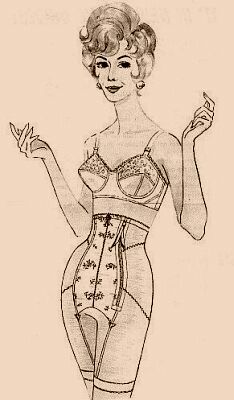
1950's come to an end having evolved into the long-leg panty-girdle. For two decades, American women wore a bra and
panty-girdle; it might as well have been a uniform (right).
Incidentally, Sears never used the term panty-girdle, simply panty or girdle.
Waspies and basques enjoy a
few pages during this period, oddly a decade after Dior's new look that required
such garments. Rubber is a mainline material for 10% of garments pre-WWII, but
the material requirements of this conflict precluded rubber for corsetry for the
best part of a decade. It returns during the 1950's and 1960's, latterly under
the championship of Playtex, only to die out in favour of what a friend
incorrectly called more natural fabrics (what is more natural than rubber?).
Oddly, we see a renaissance today of rubber corsetry in Latin America.
|
 |
|
That was the American
experience. Typically, before the internet generation, modes and customs from
America would cross the Atlantic about five to ten years later and, indeed, a
British history follows the same course, albeit delayed; the move into the
panty-girdle occurring at the end of the 1960's. One major difference however,
was that Europeans never embraced the long-leg panty-girdle with the fervour of
their American sisters, and whilst Americans wore some really elegant, sleek
foundations, the British were reduced to little more than elasticated
underpants. Amazingly,
spear-headed by the fashion-conscious Asian market, the panty-girdle (although not
called as such) once again fills the shelves of the stores.
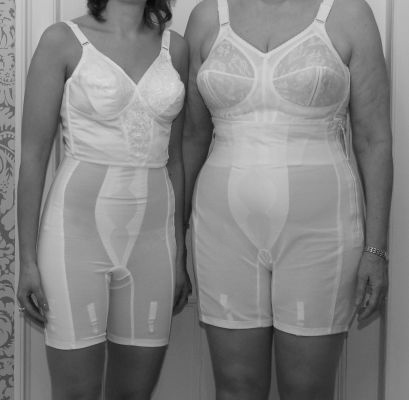
Although these pictures are
relatively recent, they illustrate the American dream era of the early 1960's
where mother and daughter could be wearing exactly the same foundation garments,
albeit in slightly different sizes!
We have expanded on this article
in the Sears pages.
|
|
An article by Susan G. Sawyer from the Pittsburg
Gazette of 1982 provides some interesting statistics:-
For American women, girdles are gradually going the way of
all flesh. For centuries, women accepted the stiff whalebone corset —and later
the girdle — as a fact of life. Although these garments sometimes made it
difficult to breathe, they helped trim one's figure and uphold a woman's honor.
Today, however, surveys suggest that the traditional girdle
has outstayed its welcome as a part of the American woman's wardrobe. For
example, only about 15 percent of the trendy New York women who shop in
Bloomingdale's buy heavyweight girdles, according to a store spokesman, and last
year the store changed the name of its department from "Girdles" to "Shapewear."
"The old days of the heavy-duty girdle are over," confirms
Jill Gerson, editor of Body Fashions/Intimate Apparel, a national monthly trade
publication. A recent survey conducted by International Playtex, Inc., shows
that over the past 10 years, girdle ownership among U.S. women has declined from
89 percent in 1970 to 50 percent to in 1980.
The U.S. Department of Commerce agrees that it wasn't a very
good decade for girdle sales. In 1970, U.S. girdle shipments totaled $254 6
million. By 1979 they had dwindled to $188.8 million. By 1980, they had risen
slightly, to $194.6 million, as manufacturers began to address women's changing
needs in what the industry calls "control bottoms."
Some say the physical fitness movement has contributed to the
slow demise of the heavy-duty, hard-to-wriggle-into, hold-your breath girdles.
Others cite the feminist movement, which has encouraged women to throw off
confinements of various sorts. Still others blame pantyhose for inching the
girdle closer and closer to the crinoline petticoat in the annals of fashion
history.
A Playtex spokesman admits the control-top pantyhose set the
girdle business back somewhat, but a further look at the company's nationwide
survey shows that the girdle has yet to breathe its last gasp. Most women over
50 still wear girdles, Playtex notes.
(Sue Collier, foundations buyer for Garfinckel's in
Washington, D.C., has noted that women over 55 still prefer four-way stretch
styles to the newer, lighter fabrics.)
The typical girdle owner is a woman age 50 or over, in a
low-income bracket and unemployed, who lives in the Northeast. Midwest or South,
the survey shows. The older the woman is, the more likely she is to own a
girdle.
According to Playtex, only 24 percent of women between ages
15 and 24 own girdles. Ownership increases to 33 percent for women ages 25 to
34; to 49 percent for ages35 to 49; and to 72 percent for women of 50 and older.
The trend is unmistakable: Young women aren't buying girdles. Are women simply
getting skinnier, or is there something else happening?
"Today's woman doesn't want to be confined, never had to be
confined and won't be confined," says Jill Gerson. "The customer for the girdle
of old with stays and bones is dying. A girdle is not something women are
wearing under jeans."
|
Compressibility
We have mentioned elsewhere
that the human body is virtually all fluid. Fluids are
incompressible, therefore a corset, cannot reduce the figure. Wearing a
corset does not cause instant weight loss so where does the body mass go. It
cannot go inwards; it cannot be compressed; it must go somewhere.
What a corset does is to refine one's shape or to change it. In the simplest
case, a loose corset will enlarge the figure due to the thickness of the
corset. We discovered this simple fact when dressing one of the models for
the 2012 calendar. The model was unable
to don a size 14 dress whilst corsetted, but without the corset we could,
with some effort, force the zipper of the dress to close. I'm sure that had
the corset been made-to-measure for the model, this problem would not have
occurred.
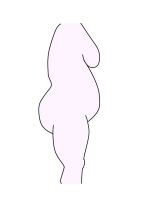
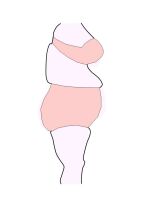
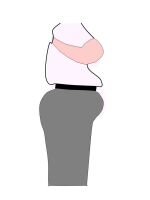
Regard the model on the right. In the left hand pose,
she wears a Miss Mary of Sweden
girdle. These girdles are beautiful but not very powerful and it fails
completely to control her figure. On the right, she wears a Canadian
Spirella 325 corset. It can be seen that there is no reduction in her waist
size or indeed volume, however, her shape and posture is so much better. Any
dress that she now wears (and it will be the same size as before) will hang
so much better. She will look better and feel better in herself. Isn't that
what corsetry is all about. |
|
Football Tummy
Corset Detective
(this page has been moved)