|
FRANGARD
Why there is "The Other Side"
I: Frangard's Corset Odyssey
II:
Establishing the Client - Corsetiere Relationship
III:
Two Years of Despair
IV:
My Efforts are Rewarded - The Future is Assured
V:
A
Meeting of "The Other Side"
VI:
Consolidation and
New Contacts
VII:
Horizons Widen
Notes on Black Corsets
Why there is "The Other Side"
This is written in the hope that it will assist readers of Ivy
Leaf's wonderful compilation in understanding the motivation of the men who wear
corsets out of choice, the people who constitute "The Other Side".
It is to be hoped that the more disapproving readers will accept
what is written is not meant to be sensational or intrusive. It is intended to
be a sincere effort to explain to your readers the motivations of another member
of the "Other Side".
Like Simon's story,
I believe you will find that my story,
“Frangard’s Odyssey” confirms that, even forty years ago, some corsetières
recognised that men such as ourselves, not only posed no threat to them or
society at large, but that they were actually were men who were worthy of their
help and wise counsel. My contribution is also intended to be posthumous "thank
you" to my own corsetière Iris, to Simon's Mary and to the others like them, who
understood who we were and who were able to help us to obtain the apparel we
find we must wear to feel "complete".
In a different way Ivy Leaf is a worthy heiress to those
wonderful women of yesteryear in that she has seen fit to add the "Other Side"
to her amazing website. That her site is possible, is thanks to modern
technology - the world wide web which allows others to see how far society has
advanced in its acceptance of behaviour that less than a generation ago would be
the subject of ridicule at best, and criminality at worst.
The presentation adopts the "three W" approach - an opinion as to
"Who" we are, "Why" we are like we are and "What" we are.
|
WHO WE ARE
Even today, amongst readers of Ivy Leaf's site there will be a
broad range of attitudes towards men such as myself and Simon who have chosen to
wear corsets and to anchor them down through their suspenders which are clipped
to "ladies" nylon stockings.
There have been many attempts to explain the underlying
psychological reasons for our behaviour. Amateur psychologists abound and very
few psychiatrists really understand why we are motivated as we are. Certainly
they understand less than the corsetières like "Mary" and Iris Norris of
Gardners to whom Simon refers. I have spent much of his life wondering why, and
have failed to find a real explanation.
To that end I set about trying to remember my boyhood to find out
if there were any "clues" The result is I have written my "life story"
concerning corsets, suspenders and stockings, Ivy leaf had agreed to present it
separately. I leave it to your readers to compare it to Simon's Story and assess
what they think of such men.
For most of our adult lives we have risked "being found out" with
the attendant general public approbation or ridicule. The problem is that, for
all the progress that has been made the public at large does not discriminate
between manifestations of our choice. Old perceptions die hard, so that for
every one who accepts them as they are there majority are rooted in old
attitudes. The range of perception ranges from being labelled gay, when most of
us are not all the way to being near criminal. The only certain place for
acceptance is to meet in locations frequented by those who openly cater for
"alternative lifestyles".
The one group which one would have hoped were understanding were
psychiatrists yet even today there is an over-riding tone of condemnation in
their attitude to our interest even today. The popular tendency is to lump all
shades of behaviour t be the same. It is not as bad as 40-50 years ago when we
were both taking our initial steps to respond to our feelings, but there remains
much professional misunderstanding of our motivations.
What is remarkable is that during the "dark ages", there were
rays of light. Both Simon and I were able to meet understanding women who became
our personal corsetières. Women who understood that our motivations were
harmless and were willing and ready to meet our requirements. Fortunately they
leave a positive legacy for their exemplary tolerance has helped to widen
tolerance in general society.
WHY WE ARE
Speaking from experience of having the mild condition, it
operates on three levels, the Aesthetic, Physical and Psychological , which are
"triggered" by our senses - Visual, Tactile and Acoustic. Almost every item of
women's clothing might be fixated on, either exclusively or in combination
including corsets, girdles, stockings, lingerie, boots, shoes, gloves, skirts,
dresses, belts etc. Most expect and want these items to be made out traditional
fabrics such as satins and broches, and yarns such as silk, cotton or nylon.
Others must have them made from leather, rubber or PVC.
Given that boys are largely nurtured by women, it is hardly
surprising that they are exposed from a very early age to the presence of
feminine under-apparel. They see it when it is put on, they see it being taken
off, they see it in the washing and in the drying, and they feel it through
women's outer attire when they embrace older relatives platonically. When they
pass through adolescence this infant "imprinting" is thus reinforced when they
see advertisements or when they embrace girl friends.
Add to that the fact that, until the 1950s some parents still put
infant boys in dresses- I have photos of my 15 month old brother in 1948 in such
attire - and that, in 1946, I was required to wear the a liberty bodices until I
rebelled upon finding that my friend’s sister wore them too!. Also recall that
male cut corsets were de rigueur for the officer class in the armed
forces of Europe up to 1918 and that retired military men continued to patronise
corsetières until the 1970s. Likewise hosiery for the masses only assumed a
gender typing after World War 1. Similarly sock suspenders were commonly worn by
middle class male adults until the late 1950s.
Given all that, it can hardly be surprising that some small
percentage of boys, or young men are at some time curious as to what it can feel
like "inside" apparel regarded as exclusively female. I believe such was the
underlying motivation of Simon when he tried on his grandmother's corsets.
Still others were required to wear corrective orthopaedic corsets
and suffered form withdrawal when they tried to go without them when “‘cured”
and sought out corsets from their old maker or elsewhere.
We might take Simon's as a case in point. He grew up in an era
when trying on women's clothes was at best regarded as abnormal, at worst as
perverted or deviant. What his mother did, was a common response to what she had
discovered and which probably "cured" some boys. In Simon's case, all it did was
introduce Simon to what it was like to wear items that fitted correctly! As it
happened, he liked the experience and was able to do so for several weeks. The
punishment actually reinforced Simon's desire though he had to repress it for
another 4-5 years when he became free of parental control and could do as he
wished. His mother's well intentioned attempt at aversion therapy had the
reverse result to what she intended because the motivation that led to Simon
being "found out" was beyond his control.
Yet he was happy to live as a man with his a "secret" of which
his mother believed him "cured" but which "Mary" his corsetière who obviously
had a kind and profound understanding that his motivation was harmless which she
was able to nurture.
WHAT WE ARE
What motivated the young men and boys to set out on such a course
of action? I suggest they have addressed an ill-understood compulsion and acted
upon it, despite the proscriptions of mores of a society which were they to ever
have been “found out” would have subject them to ridicule or worse. I believe
this strikes at the heart of why there is an "Other Side".
As I noted there are undoubtedly "triggers" of the senses which
act on the subconscious and start boys such as Simon or myself on such a course
of behaviour. In Simon's case it was the sense of touching the female corseted
form, a strange combination of feeling maternal warmth, offset by the hardness
or firmness of the corsets - rather than softness. He would get visual stimuli
on washing and ironing days - the colour and sheen of fabric, the glint of the
chrome plate on the busk clasp and the suspender fittings, the silhouette of the
belted, cinched waist and bosom. Finally he would sense the careful deportment,
modified by tight corseting and/or high heeled shoes.
I would also suggest that, among that minority who would go so
far as to try wearing such apparel the majority would immediately lose the
interest. Others would have found that the tactile sensations associated with
wearing the items pleased their psyche at some sub-or semi conscious level. It
might be one or a number of sensations. It might be the feel of the tensioned
stocking fabric on the leg, the stretch and unstretching of the elastic straps
of suspenders during walking, the constant hug of stretched girdle fabric or the
sense of "containment' or pressure provided by boned corset that is firmly or
tightly laced.
As to satisfying the new found pleasure, in all cases remember
that wearing these items of apparel during the day is not too difficult, since
they can are totally concealed by conventional man's apparel - trousers, socks,
pants vest and shirt.
Also it should be noted that, by and large, these men are neither
transvestites nor voyeurs, nor are they gay. Indeed most are quiet, inoffensive
heterosexual youths or men, many of whom marry with their "secret". Granted
there are variations in behaviour. In the men who exhibit some or all of these
tendencies. Yet for many years they were all branded with the label of either
"pervert", "deviant" terms replaced by "kinky" in the 1960s.
In truth, the psyche of each one has, in one of a myriad ways,
been sub-consciously imprinted with a fascination for these items of apparel. In
them the imprinting has made for an element of compulsion. It is my personal
experience that the individual is unable to do anything but pursue the matter.
Aversion therapy as tried was tried by Simon's mother may have while it appeared
to succeed, it only did so while he remained at home. In the long run, when he
was "free" unknown to his mother it proved had the reverse effect to what she
intended!
In taking such action some boys found that wearing the apparel
gave them strong stimuli of a sexual nature. In the case of Simon, it was being
forced to live in the corset bra and stockings for some weeks that allowed him
to reach an appreciation of them. This longer term satisfaction is what men and
women who wear corsets out of choice derive from being able to wear the items
all day, every day.
In contrast, in the case of girls of the 1950s, there was an
expectation that they wear such attire day in day out. Convention gave them no
choice. Some liked it enough to continue to were girdles or corsets. Those who
tolerated it for fashion and convention's sake were fortunate that the era of
women's liberation which gathered at the end of the 1960s, allowed them to
become truly free to choose what they wore.
Yet for all the condemnation of the corsets, suspenders and
stockings because of the restriction and discomfort, some women such as Alison,
and Ivy herself admit to finding that they came to appreciate the feelings that
wearing the apparel gave them. Well it is the same for the likes of Simon or
myself. We tolerate it because the positive aspects gained by of wearing them
outweigh the disadvantages and discomfort the result is positive.
In my case I like to feel the restraint on my movements caused by
the busk, boning and back steels of my corsets. I like to feel the pull of my
suspenders as transmitted into my stockings as I walk. Seated at my desk, during
the working day, I like to be able to touch the metal fittings of my suspenders
through my trousers or to locate and trace the outline of the finishing loops in
my stocking tops or the hard ridge of the stocking seams, etc. I like to hear my
suspender clips click as they dangle and knock on one another and to hear the
busk studs click into place. I would miss it all if I could not wear the apparel
that gives me this satisfaction.
SATISFYING THE COMPULSION
For much of the 20th Century there was strong prejudice against
men who like to wear certain items of what are commonly regarded as apparel for
women. Yet it was only in that century that many of those items of apparel were
ascribed as being for the exclusive wear by one sex or the other. Remember the
widespread prejudice against women in trousers until the 1960s?
Once a man recognised that his desires must be met, he had to
wrestle with the fact that he want to wear some, but not all items of women's
apparel. After that, such men, myself included, were faced with the challenge of
how to acquire them. The difficulties posed by convention did in some instances
lead to some unfortunates stealing the items of interest and rightly falling
foul of the law, but wrongly to public ridicule, as a result of sensational
press reporting. Such incidents contributed to give even the most law abiding
man a real sense of "guilt" about his compulsion.
Add to that the fact that it is not any years since a man could
not venture out wearing the items, even when concealed, without risking arrest
if detected. I read of it happening to someone who was sitting on a bus only for
the gap between his sock and trouser leg to expose t other people’s notice the
fact that he was wearing women's stockings, and to be arrested for "causing a
breach of the peace".
Following a course of acquisition was not easy, as Simon was to
find out when using those of his mother. Later in life, those who had Simon's
courage to enter a corset shop, found they were summarily rebutted by women who
were only being true to the conventional wisdom of the time. Ultimately,
acquisition was dependent on what was to prove his relatively rare good luck in
finding a woman like his Mary, possessed as she was of the attitude and
understanding of one who had accepted that some men had a need to wear corsets
and related apparel and that fact did not make them into monsters.
Happily since the 1970s there has been much more tolerance. For
sure there has been a change of what the general public regards as acceptable,
nevertheless some women contributors in the early days of "Girdles and more"
, gave more than a hint of supporting the condemnatory attitude of some
corsetières.
Since the 1970s too, a person can have anonymous access to the
things that might fulfil their needs be it mail order to acquire such clothes,
web sites providing the chat rooms, sources of information, supply or whatever,
and a climate that tolerates what they do or wear. And last but not least there
is E-Bay and Pay Pal.
While we have moved on, old attitudes die hard and over the years
of reading web sites, I was always distressed to read postings by former
corsetières rebutting the very idea that a man may wish to purchase a corset and
wear it himself.
I:
Frangard's
Corset Odyssey
INTRODUCTION
"Simon's Story", a sincere and frank account of his life long interest in
corsets, has inspired me to share with your readers the longer and more
tortuous path I followed to reach a similar ending. Like Simon, my path
eventually led me to the wonderful person who became, not just my personal
corsetière, but a true friend and confidante, for close to 25 years, which
only ended with her death. While the paths we followed were very different,
the motivation or compulsion that Simon and I felt was so strong that, in the
end our faith that we would find "someone who understood" was rewarded by
finding women who were not only wonderful corsetières, but fine human beings.
In my
case, it is more than 40 years since the compelling force caused me to first
wear my own stockings and suspenders. It is nearly 35 years since I started
wearing corsets. If anyone had said to me, when I was 14 years old, that by
the time I was 35, I would want to wear back lacing corsets out of choice for
the rest of my life, I would have said they were crazy. The very idea that one
day I would admire and wear something I had initially found almost repulsive
was an idea far beyond my imagination or desire.
In my
story I have sought to include reflections on how I felt at key points in my
odyssey. I hope that these albeit biased insights might help others to
understand the motivation of men like myself. Initially Simon and I were very
differently motivated. Simon found the fascination of corsets directly. Mine
grew out of a first fascination for fully-fashioned stockings, the "nylons"
which were almost universally worn by most women from the late 1940s and for
most of the 1950s, when I was growing up.
Yes,
stockings were the catalysts which eventually led me to discover my "corset
self". I trust readers who expect to read only about corsetry will be patient
with the first few pages, but what I say is very relevant to the path my
odyssey followed.
EARLY
IMPRINTING AND AVERSION
Psychologists talk of imprinting on the psyche of young people. It is my
experience that imprinting can be either positive or negative. On the positive
side of my imprinting were certain objects that fascinated me in that. Each
time I saw them reinforced the mental question I had as to how it must feel to
wear them. Among the items were the knee length shiny black or brown leather
gaiters that farmers wore to the animal market in my town, and sheer ladies stockings;
the nylons
that appeared after the end of the
second world war.
At that
age, I certainly had no need to wear any of these items but they did interest
me very much. If they were referred to in advertisements or in newspaper
articles or photos, my attention would be instantly drawn to them and I would
avidly read anything about them especially about stockings. I
was instantly aware of them if I saw them worn. The only item I had access to
were the gaiters. My great uncles wore them and there was an old pair of my
grandfather, which I tried on, but they were made for grown men and my preteen
legs were far too small. My interest in them died there and then. But the
inaccessibility of stockings heightened my fascination.
On the
negative side of my imprinting were liberty bodices, corsets and the shade of
pink generally used in the fabrics from which they were made and which
features so often in Ivy Leaf's website. I am also aware that psychologists
also try negative imprinting under the term aversion therapy. As he tells us,
Simon's mother tried it in an attempt to break his interest in corsets but of
course she failed. In my case I had no need of such therapy in that, from my
earliest years I had been all but repulsed by the shade of pink of the corsets
which both my grandmothers wore, and which I occasionally saw drying on a
clothes horse. As for the lady who had the black glass
"Spirella
Corsetière"
sign outside her house in our village, I assumed that she made pink corsets
too! The liberty bodice reinforced the negative when, one winter at the age of
six, after some resistance on my part, my mother persuaded me to wear a white
one. Within a few weeks I perceived
this to be "girls-attire". I rebelled and refused to wear it again.
STOCKINGS
While
Simon opted for corsets, I first became fascinated by stockings in 1947, I was
seven years old. I was standing with my mother who was chatting to a group of
women who, like herself, had recently had
boomer
babies. At one point, all were admiring the stockings one of the mothers was
wearing. I of course looked to see what they were talking about. I can still
recall what I saw. She was standing in black suede high heeled shoes, of the
type fashionable for the time, and above them were the square cut heels and
seams of pale sheer nylons. When asked where she got them, their wearer said "I
don't know, you'd better ask my husband". This was when such stockings were as
hard to find as old dust and on the "black market". In retrospect I realise
that it was the start of the "golden age" of fully-fashioned stockings. What I
saw were all so different from the lisle and art.silk stockings which every
female member of my family, my mother included, generally wore.
At
first "nylons" graced the legs of the more fashion conscious women in our
village but within a few years they were being worn at school, first by the
senior girls and gradually, as the prices came down, and availability
improved, by the girls in my form. After that I noticed the seams, and if they
were straight, as well as the various heel designs. I also developed a liking
for darker shades. My preference for black nylons began at the age of eleven
when I was thrilled to see the women of the Royal Family wear them at the
funeral of King George VI.
Nylons
were a key talking point in conversations, in magazines, and even in songs in
the 1950s. A close second were vital statistics and, of course, waist
measurements. I was also in my adolescence, and as a result my interest was
continually reinforced. I saw photo pin-ups of models posing with raised
skirts or in her lingerie showing their stocking tops and suspenders. Amongst
the most memorable were those of Gina Lollobrigida as a Can-Can dancer and
Sophia Loren, holding her skirt by her side and walking "with swaying
suspenders" in
"Picturegoer"
in 1955. It was also an era of the small waist. A starlet Sabrina had the
smallest waist at 19 inches and how she did it was the cause of speculation,
but that is for later in my story. Full-length satin slips and negligees edged
in lace were also popular items of attire for pin ups too. They looked
fetching but I had no desire to wear such items.
Unusual
styles of stockings and corsets such as the "Merry Widow" appeared in weekly
magazines like "Reveille". There were cartoons featuring skirts blown up to
show "frillies", corsets and stocking tops and seams, which appeared in "Blighty"
that my father read and on comic post cards. There was a plethora of
advertisements for nylons in magazines and I often sneaked a peep at the
women's magazines in the house just to look at the stocking and girdle
adverts. I learned about gauge and denier and about "tummy control", but was
perplexed by the fact that, though all the girdles had suspenders they were
always shown being worn without stockings. Nylons even featured in pop songs
of the days such as "Sisters" by the Beverly Sisters and "Long Black nylons"
was even sung on the "Goon
Show"
by Ray Ellington.
All
this was in the realm of fantasy, but in real life I also found the dark
shades of smoke and navy most appealing and especially black as worn by nurses
when walking too or from duty at the local hospital, and when I moved from home
I saw them worn by police women and WRNS. What was strange was that while
black was acceptable for the services
,it became considered "fast" for
fashionable women to wear. In about 1955 my interest was spiked again when the
"best dressed girl" from our village returned for Easter holidays with her
calves graced as usual
by a
neutral shade of nylons,
except that this time hers were complemented by seams and heels knitted in
contrasting black. I thought they looked wonderful. Shortly after one girl who
walked with me to catch the school train wore a style
that
had partially black seams, ending with
black arrows at mid-calf.
CORSET
GLAMOUR
|
 |
|
As for
the corset connection, in my teens I had a sudden change of heart about
certain foundation garments - but not pink corsets. For the first time I saw
that corsets could be glamorous, when in 1955 I was entranced to see Dawn
Addams posing in a busk-fronted, closely boned corset faced in red satin, as
the centre fold of "Picture
Post". I was entranced by her corset, but was disappointed that she wore
fishnet tights under it instead of suspenders and stockings. I now knew how
the small waist was achieved.
This
image must have reacted on my subconscious because I suddenly became aware of
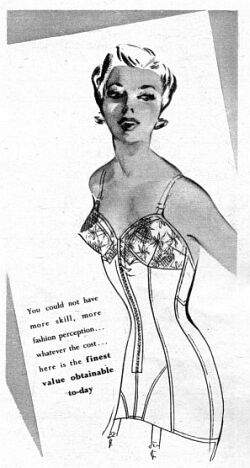
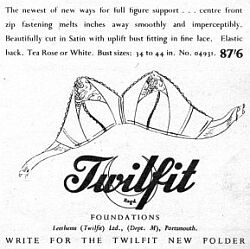
the drawings of elegant women - wearing wonderful corselettes, in the
advertisements that "Marshall and Snelgrove" placed usually in one of
the bottom corners of the front page of the Sunday newspaper "Observer". I
imagined those corselettes would be worn by the likes of Barbara Goalen, one
of the top high fashion models of the time, and I thought they were the height
of women's under-glamour appeal, and a far cry from what was worn by my
grandmothers.
|
|
On my
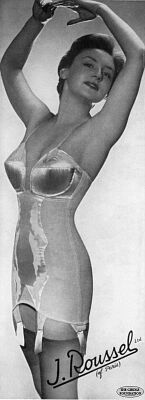
first trip to London in 1955 my interest was tweaked when I saw girdles and
corselettes in the escalator adverts. Those adverts were the first germ of an
urge to experience how it felt like to be "inside" a girdle, as well as in
stockings. I never imagined that, one day I would wear my own male cut
military high top corset, not unlike those corselettes but without the bra
cups, and real corsets, busk fronted and much more heavily boned than those
dreamy feminine creations of lycra, lace, ribbon and satin.
All
this happened to the backdrop of another development in my life. At the age of
14, I was first called upon from time to time, by my aged Grandmother to help
her wrap her corsets around her form as she sat in the chair in her bedroom,
in which she spent her day and which she never left for five years. Overweight
for most of her life, she had first worn them as a girl in the 1890s, and was
a proud woman. Clearly, she had a dependency for corsets because, although had
been humbled by a mild stroke, she still insisted that she wore them all day
every day. Usually the daily visiting nurse or my mother helped her with them,
but on Saturdays and Sundays, when I was not at school, the lot sometimes fell
to me. |
.
I would
take her the morning paper and she would call upon me, her teenage grandson,
for help. Usually I simply had to take the stiff pink corsets, open them out
and slide them down between her body and the back and sides of the chair. I
would then pass, what I know to be the busk ends, around to her front. Doing
so wasn't easy for either of us as she had to struggle just to lean either
forward or to the left or to the right for me to slide them down as close to
the seat of the chair, as I could, so that they could be as effective as she
desired. On her "bad days", she also called on me to help her to hook its busk
front, something I had never seen before. I noticed that she could deal with
the hooks and eyes above and below. She wore what I now know to be a
busk-fronted, front lacer and I would leave her to huff and puff as she
manipulated the laces to get to the desired level of support. It was then I
learned to be tactful, for the fitting it often made her grumpy but once laced
she was clearly felt happier.
This
ritual went on for the following three years until I left home and continued
for two more years when she was transferred to a long term care residence for
the last year of her life. If my ministrations with her corsets did anything,
it was to reinforce my distaste for the very idea of the colour pink and for
the kind of corsets and the wide pink elastic suspenders associated with them.
But on reflection I do recall wondering what it must feel like to be "inside"
those corsets after she had laced them on. Subconsciously those thoughts must
have added to my growing fascination with corsets.
THE
MAGIC MOMENT
The
"magical moment", that was the pivotal event, which was to ultimately to
change my life forever, came in the winter of 1956. It was a "forfeit" dance
in our local Church Hall. At one point I had to remove my tie and tie it
around the ankle of my partner who was also my girl friend. She was wearing
pale mesh stockings and the very act of touching one of them as I tied on my
tie - something that was at once so delicate yet so tautly stretched - caused
me to wonder what it could feel like to be wearing them. Understand I was not
interested in how the stockings might look on me but only in how I would feel
when wearing them.
It
reinforced my early imprinting, and to this day I cannot explain, what kept
causing me to want to put myself in the place of the people wearing the things
that fascinated me in order experience what it felt like to wear them. Some
might say it was because stockings were "forbidden" to a young man but that
would not be the truth. I did not need any one of them. I did not need a
hearing aid - I was not deaf - but for years I had wanted to try wearing both
items.
EXPERIMENTATION
More
than ever, like Simon did, I now felt compelled to act out my new desire to
try on stockings. I found where my mother kept her stockings and identified a
pair she appeared to have forgotten about. One day when the opportunity arose
I secreted them away until I had the chance to try them on.
To call
the experience an anticlimax would be an understatement. My rough skin and
nails were constantly snagging them on a hangnail or my nails themselves, even
before I had one ready to put over my foot. I should have had a manicure
before I tried to put them on. I then had trouble passing one over my toes and
foot - only to discover my foot was too big for the size my mother wore. I
persevered and pulled one up over my knee to my lower thigh - which it just
reached. I then realised they needed holding up and of course I had no thigh
garters and certainly no suspenders on a suspender belt or corset.
I gave
up but vowed to find some large elastic bands to hold them up next time I
tried them on which, when I did use them proved to be no real answer.
Stockings need suspenders to fit properly. I had learned how flimsy sheer
nylon was and being far from the anonymity of a city store where I might buy a
pair, my interest died - or more accurately - it went dormant -or did it?
The
idea that I might like to try wearing stockings myself, was reinforced when I
saw a photo of Lawrence Olivier in drag, suspendering a stocking on an inside
cover of "Photoplay" magazine of 1955-6. It caused me to think if he could get
a size to fit him, maybe I could too. From then on I priced stockings in
adverts but where I lived it was impossible to do buy them anonymously.
Instead I sought solace in the pin up photos of models showing stocking tops
and suspenders in the men’s magazines of the 1950s. I liked the models in
girdles which pulled on their stockings so well, best of all.
As for
my girl friend, she talked frankly about her girdles, stockings and suspenders
and clearly she liked to wear them, but only after school when she changed
from her gymslip and ankle socks - nylons were too expensive to be ruined at
school. She never complained except to say on occasion "Ouch, I'm sitting on a
suspender!". I was also pleased when she asked me to look at her seams and
tell her if were straight or not. She even told me that the way to keep one's
seams straight was to secure the back suspender clip right on the seam,
something I would remember when I started wearing stockings myself. She also
told me that one of the girdles that her mother wore for best had six
suspenders on it and that was a really serious thing to wear and that it
helped to keep her seams straight. I marvelled at the idea which added to the
mystique of what it must "feel like inside one."
In
those days, a relationship never developed much beyond "mild petting". In my
case I was fascinated just to embrace her and feel her girdled derriere and
her taut suspenders through her dress or skirt. The height of excitement was
to caress her leg as far up as I was allowed to go. Yes her suspender clips
were the agreed limit and I lovingly explored their contours with my finger
tips and marvelled at the tension in the back suspender elastics which
indented her flesh. On every occasion I was left wondering what could it felt
like to wear such things, but I was powerless to do anything about it.
IN
ABEYANCE
|
Then
all changed, I left home and went to university in London and forgot about it
for several years. I had enough exposure to the girdles and stockings that my
girl friend wore and regularly seeing the adverts when riding on the tube
escalators. At Xmas 1958 I went into a department store and bought her
stockings for a present, probably the last seamed stockings she ever wore as
she was glad not to have the chore of seam monitoring. I pleaded for her to
stay with seams them but had to accept the evidence all around. By about
mid-1959 younger women had all but given up wearing seamed stockings which
disappointed me, though my girl friend happily still wore girdles and not a
suspender belt. I remained envious of her being "free"
to wear stockings when I could not, though strangely in those days, I never
had a feeling of wondering how it must feel in the girdle. The memory of
"Granny Pink" remained too strong, I suppose. I regretted the much reduced
sighting of seams and came to admire older women whose legs they still graced
and who were very obviously well corseted as well.
By way
of substitute, I also started to pay attention to adverts featuring mature
women in corsets, including styles which I had previously disliked. My bus
stop, in S.W. London, was directly outside W. Adams and Co., corset makers. They
had miniature corsets on stands in the window which I thought was very clever
but at that time. Only a white corselette offered any appeal to me. But the
image that finally pushed me over the top was when I saw the poster for the
film "The Millionairess", in which Sophia Loren had stripped to down to a
black, busk-fronted corselette, long black suspenders and black nylons for
her doctor Peter Sellers. The image will be burned on my memory till I die. To
me she was perfection and again the image caused me to wonder how it would
feel to be dressed like that.
How many men were influenced by Sophie Loren
in the film "The Millionairess". It is well documented that Peter Sellers
had a direct influence on the costume, and was strongly influenced by the
result! - Ivy |

|
From
the moment I saw the image corsets looked different. The desire to possess my
own corset grew more quickly and as I noticed more and more photos of
glamorous women posing in basques and girdles. But how could I, lacking as I
did, Simon's courage? It took all of five years before I resolved to do
something about it. I knew I could how to buy stockings and as I had several
years experience of buying for girl friends in big department stores. I was
too shy to buy a suspender belt let alone a girdle or corset. However for
several years my various girl friends agreed to wear the kind of suspender
belts I liked - if I paid for them. So, I accompanied them into the less
formidable boutique stores and we jointly chose. This experience helped me to
"know the drill", so to speak.
I BUY A
SUSPENDER BELT AND STOCKINGS
Eventually I felt the overriding need to buy my own stockings and finally, I
was ready to brave the issue. It had taken several years but now I had to do
it. But what was I to get to hold them up, a suspender belt or a girdle? I
quickly ruled out a girdle as my instinct told me that they were purchased by
the wearer and I could not explain that away. Corsets I thought were sold in
the inner pink and white depths of large stores that I judged to be "women
only". Besides I didn't know "my size".
In the
end I bought the stockings in the Army and Navy Stores on Victoria Street. My
story was that I was buying them in black for my mother who was a nurse. I had
found out the biggest size was 11, which was also my sock size. I thought
that, even if she doubted me, she would see that size 102
was unlikely to fit me. As for the suspender belt I went to a small boutique
called "Neatawear" in the concourse of Victoria Station where I had once
shopped for one with a girl friend. I thought that if I'd
bought the stockings in a large size at the same time the sales lady would
think I was buying for myself and I would blush.
From
the early 1960s "ribbon" suspender belts had become quite popular and as I
didn't know what size "my girl friend took."
The salesgirl suggested I took a
ribbon type as she said "one size fits all", and I settled on that. I slunk
home with my prizes. But where was I to put them on? I still shared a room and
couldn't do it there, so I settled on the toilet at work when a few of us had
to work on a Saturday.
I put
on the suspender belt and then the first stocking. Apart from snagging it on
my rough hands I was not disappointed. After I had suspendered one stocking, I
flexed my leg and was overwhelmed by the "feeling". When I got both stockings
on, it felt wonderful. I dressed again and walked out and all the time felt my
colleagues were looking at me. I liked the feel of taut nylon on my leg, I
liked the pull I felt in the elastic of suspenders alternating on my thigh as
I walked. But after about an hour I retreated to take them off. But I was
addicted.
DISCOVERY AND EDUCATION
My new
found delight was dulled by the discovery that I had a lot to learn, and I had
many questions but my "secret" was such I could not ask for advice from
anyone. The equivalent of Simon's Mary would not enter my life for another
seven years. I had to learn by trial and error, whereas women and girls
wearing the same things would exchange ideas. In retrospect the process helped
because I came to understood how to integrate wearing stockings and suspenders
with my daily life. I came to realise that a corset or girdle would make a
better support for suspenders which all helped prepare me for when the time
came to look for my first corsets.
I was
reminded that it was all too easy to snag and ladder stockings and quickly
discovered that those knitted with 30 denier yarn were much more forgiving of
my efforts. Not only did I like the feel of wearing stockings with suspenders,
I liked to feel them being pulled hard by the suspenders and I quickly ruled
out stretch stockings as an option. Moreover as I had large calves, I found
that fully-fashioned type fitted better than seam-free. I also found that if I
wore two suspender belts - one back to front which gave four suspenders per
stocking with true back suspenders - I got something like the "pull" I wanted
on my stockings. I learned it was easier to hook up a belt back-to-front,
that is doing up the waist hook in front and then rotate the whole thing until
it was in the right position to clip my back suspenders on my stockings. I
discovered several means of fastening them and found out that doing up hooks
and eyes when pulling on both sides of the belt at once is not so easy until
one learns the knack.
I soon
realised that quite quickly what is at first is just tight can become
uncomfortable if the creases dig into the skin especially if one kept one's
suspenders taut as I had come to like which meant that they pulled hard on the
waist of the belt. It was to teach me how important it was to monitor oneself
in belt or corset to prevent skin breakdown.
With
the back suspenders I discovered what it felt like to sit on a suspender clip
or length adjuster. I liked all these sensations and I got a strange pleasure
out of having this "secret" no one knew of and of having to "put things
right". Without realising it then I had made my decisions on the debate of
"Inside or out" which appears on Ivy Leaf's site. For work I wore my suspender
belt over my vest, but under my underpants. From being all fingers and thumbs
I became very adept at clipping my stockings to my suspenders and in taking
them off. Though after a while I always wore gloves with 15 denier - the silk
inner gloves used by rear gunners ex army surplus. Even then I found it hard
to actually clip the stocking top to a suspender when wearing gloves. On
reflection, I see that all this served as an apprenticeship for my odyssey
towards full time corseting.
STOCKING TYPES
With
time I tried all kinds of stockings - seamed plain knit, seamed mesh, seamed
plain knit, seamed stretch, seam-free mesh, seam-free stretch, patterned,
textured, fishnet, I tried them all. As I had decided on strong pulling
suspenders I found in the non-stretch yarn styles better than the seam-free
type tended to cramp my toes more than fully-fashioned and found I liked plain
knit more than mesh,
though I rarely wore the sheerer ones as strong pull made
snags into ladders very easily. I preferred the darker shades though it meant
keeping one socks up to hide them. I also preferred the non-stretch styles as
one could actually move one's
toes around inside the nylon.
I liked
feeling the stocking tops and suspender clips around my thighs all the time. I
especially liked to be reminded of their presence and feel the alternating
pull, when the action of walking sitting down or standing up stretched the
front and back suspender elastics in turn. I did like to feel the elastic
stretch and as I sat I like to feel the resistance of the taut stocking on the
front of my knees. Conversely, I liked to feel the bagged knees pulled taut
again when I stood up. I tied wearing them right side out or inside out. I
liked them inside out, though I'm
told it makes them more snag-prone. Like this it accentuates the ridge of the
seam especially on the most stretched areas like the calf and heel. Years
later I was to find that was how my personal corsetière liked to wear them too
- another bond between us.
Of
course I found that if the stockings were not pulled tight by the suspenders,
they twisted out of position and then I could not feel my seams when I tried
to locate them through my trousers. I also remembered what my then girl friend
had said, 10 years earlier about securing one clip on the seam to keep the
seam straight.
Since
most women had switched to seamless stockings, by 1970 not only was the number
of fully fashioned styles reducing but I found the choice of colours was
reducing too and I lamented the loss of navy, which I had always admired.
STOCKING MAKES
When I
began regular stocking wearing the major makers of stockings were Charnos,
Aristoc, Bear Brand, Ballito and Wolsey. The first stockings I ever bought
were Charnos "Moonbeams". I had no idea what I had bought until I took the
first stocking out of the packet and slid my hand in the first stocking top. I
will never forget how delighted I was to find that its diamond after (shadow)
welt pattern below the tops was the very same as I had most admired when worn
by pin-up models.
In
addition in the 1950s makers used to print a signature label on the welts
(tops) and in pin-up photos I noted several makes, like Charnos, Aristoc and
Morley in UK photos and Albert's "Classic" or "Walking Sheers" and Triumph
"Ease Top" in those from the USA. In 1967, when I started, the Charnos range
still used them, but not many other makes I bought did.
DENIER
I
quickly confirmed my experience of eight years earlier and found that I was
too clumsy to handle 15 denier stockings and by chance came upon Charnos
"Commonsense" in 30 Denier. A phone call to the Aristoc office in London
elicited the fact that Aristoc still made a 30 Denier seamed stocking too,
called "Oxford". Yet by 1971 both makers had "phased them out" before I knew
it and was able to build up a "reserve stock". About that time out came
Aristoc "222", later to be known as "Harmony" which, at 20 denier was more
forgiving than 15 denier and since they were widely available I wore them
regularly. At the time I first bought them decimalization had just happened
and they were 25p a pair. When they stopped production in 1993 I was paying
,
GBP 3.50
a pair, a 14 times rise in 22 years!
With
the loss of the other makes I made it a policy to wear stockings still in the
shops and to keep the "rarer" brands for special occasions. In this way before
"Harmony" were phased out in 1993 by which time I had built up a reserve of
100 pairs, and before Albert's "walking Sheers" were phased out I had another
50 pairs which I estimate will last the rest of my life.
STOCKING DETAILS
I found
the details were a fascinating part of the hosier's art. I liked the finishing
holes in the stocking tops, the ladder stops in the afterwelts to which I have
referred, but found the heel design to be the most appealing part of stockings
and I found the longer narrower cuban heel of Charnos "Moonbeams" and Aristoc
"Ascot" and Bear Brand "Arizona" to be my visual preference. The only problem
was they were all 15
denier
that snagged and laddered all to easily. Hence, I
settled on wider shorter "chunky" heels of the 30 denier Charnos
"Commonsense", Aristoc "Oxford" and from the USA Alberts "Walking Sheers".
Having been imprinted with cuban heels I never found the point heels which
supplanted them in the late 1960s on the Charnos "Orchids" or Aristoc
"Harmony" styles, to be so appealing.
SUSPENDER BELTS AND SUSPENDERS
The
range of designs of suspender belts amazed me. I bought first a ribbon style,
then a "gartee" before finding a store that sold the classic style. Naturally
all came with four suspenders, which had been the fashion. Later in my odyssey
I was to reflect on whether espousal of the suspender belt by younger women
had added to the problem of keeping their seams straight, speeded the research
and ultimate dominance of first seam-free hose and then tights and to the near
demise of the fully -fashioned hose. Whilst I found the glint of the chrome
strap fitting very appealing in photos in the late 1960s they were harder to
find as makers were responding to the chrome allergy scare and most came with
enamel clips. My preference for very taut suspendering revealed that the
certain combinations of elastic and that the length adjuster clip (regulator)
which had sharp teeth which bit into the elastic, when it was closed in the
"working" position, performed better than those which had a raised pattern
which pressed on the elastic and slipped under the level of tension I liked. I
came to appreciate the slogan on the packet of "Sphere"
suspenders I bought in the haberdashery department which said "fit Sphere and
be safe"! I found that woven elastic best, while the sharp teeth were much
harder on certain types of suspender elastic than others. I found I had to
change elastic quite often. I found plastic clips and adjusters to be quite
unreliable. As for the detachable style that came with corset clips, I had no
use of them because as yet I was not thinking of corsets, that style is for
later in my story.
So I
began to experiment with making my own. I bought extra suspenders "Winfield"
brand in Woolworths, all with white clips and elastic and with several designs
of stocking clips and thicknesses and diameters of clip buttons ("nobs"). For
the first time in my life I bought needles and thread and learned to sew. I
could now unpick the elastic from the suspender belt itself, change the
elastic and even to dye them. In my quest for strength I even cut up the
webbing of an elasticised belt and made suspenders from it. It wasn't that
good a solution as the elastic didn't fold flat around the clip link though
the pull was amazing to feel. As for the length adjusters I found two types.
One type which relied on folded metal to crimp the end of the elastic was very
hard to deal whilst another design allowed the elastic end to be folded over
the loop and sewn in place. It added a little to the bulk but on balance I
liked that better.
Suspenders were always the but of masculine jokes, yet I now know that almost
every detail of corsets were patented by men to meet the needs of women. I was
coming to appreciate this. I marvelled at the technological skill that created
stockings. Likewise I quickly came to marvel at how dependent the whole thing
was on the humble suspender and secretly I prided myself on my expertise
in suspender design and performance. Even now in 2006, the agony columns of
web sites are peppered with questions about suspenders, which I think are a
very under appreciated thing. They are essential to hold up stockings and for
all girdles and many corsets they, along with their stocking charges are the
bedrock anchorage. Throughout my odyssey, I realised this and the more of Ivy
leaf's
comments that I read, it is clear that she and other corsetières share this
view. Confirmation if needed was given in mid-2005 on the content page of her
web site and that she chose to place it below the contents list of the
original and still most important section on the site
"Spirella
corsetières"
. The image is small and might easily be passed over as simply a section of
vintage suspender elastic and its length adjuster clip, (regulator). However
look more closely, and take time to appreciate the beauty woven into the
ribbed suspender strap and the combination of functionality and attention to
detail on the flap of the regulator. Notice firstly how trouble was taken to
design that pattern and then to make the die to stamp it on the metal and
secondly how the charmingly shaped metal tab to help its wearer lift the flap
to alter the length of the elastic in its charge has been integrated into the
stamping process. It is sad that for generations such things had to be covered
up. Looking back on the history here can have been no more sumptuous display
of corsets and suspenders than in the Edwardian era. Sadly stocking technology
had not then advanced, but it is encouraging that corset revivalists have
married them to fully-fashioned stockings and - thanks partly to none other
than Madonna herself have made such attire acceptable as outer wear.
What a
change there has been in one generation. I learned by trial and error. What I
would have given to have the advice given today in web sites, such as that of
Ivy Leaf and "Girdles and More". Today, I know from personal experience, the
answer to almost every question posed, but in the 1960s, secrets had to stay
well concealed. The irony being that as society's mores have changed so as to
accepted people like Simon and myself, the availability of the very things we
want to wear had all but absent. Moreover it is in the hands of well meaning
new generation, who lack the insights of women like Ivy Leaf, Alison, Isobel
and Marianne on one side and Simon and myself on the other.
FEAR OF
DETECTION
At
first I wore stockings and suspenders alone at home in the evening or at
weekends. Slowly gained courage to wear them under my trousers to outdoors. At
first, going outside while wearing them made me feel guarded. I was always
afraid of someone noticing and learned to take care. Suddenly I realised that
it had never occurred to me that to question whether any man I saw on a train
or bus, or in the office, might have suspenders and stockings on under his
male clothes. This realisation helped me to relax about my concern that my
secret might be accidentally found out.
I
learnt by trial and error what it was possible for a man to wear under his day
clothes. I had settled on black, fully fashioned nylons with seams and four
suspenders per stocking (I sewed on the second two pairs myself). I was now
ready to wear them to work for the first time. However, I was afraid the waist
band would be so uncomfortable that I would have to take them off in the
office toilet. My fears proved unfounded if I found out at weekends that if I
wore the belt over my vest there was never any discomfort and within days I
wore stockings to work all day every day and have done ever since initially
with suspender belts but as I will later recount, for the last 30 years with
corsets.
I also
learned new pitfalls, but with care I learned to disguise evidence of the
suspenders showing through the thighs of my trousers, not always easy
especially if one wore the fashionable tighter fitting trousers worn by
younger men in the 1960s. It became second nature to make sure my socks were
always pulled up so that I never showed that my legs were covered by sheer
black nylon. In meetings I learned to spot the chairs with plastic-covered
seats as on one occasion I got up and as I pushed the chair under the table,
saw the imprints of the clips, straps and length adjusters of both of my back
suspenders in the plastic! Likewise I was careful not to leave such imprints
on the seat of a bus.
Having
acted on what was compelling me, I read several popular psychology books in an
effort to understand what had motivated me. I read widely and read a million
contradictory opinions. I eventually concluded that I did not fit any pattern,
but I was not alone - regrettably graffiti in public toilet walls had told me
that. All I knew was that I felt more "complete" when I wore stockings with,
at that time, a suspender belt. I had no desire to display myself nor wear any
other items of female apparel except that I continued to enjoy seeing how good
women looked when wearing them.
THE
DESIRE FOR A CORSET GROWS
Over
the next year or two I bought more stockings and suspender belts in shops
until at one count I had bought 36 pairs of stockings and had most of them and
15 suspender belts all in a dedicated drawer. But I was becoming more
demanding. By mail order I bought a "large" size, (28 inch waist), 6 inch deep
waspie with plastic bones and long detachable suspenders from Kesman. From the
B. Cligman (Estelle) mail order store in Walthamstow, London E 17, I bought a
30-inch waist, 8 inch deep suspender belt, also with plastic bones.
What a
revelation it was to wear each of them. I learned a lot -both positive and
negative. It was my first experience of boning - "light" meaning plastic that
kinked in time. I found out that the hooks of detachable suspenders would move
along the metal loops and suddenly pull off the elastic loops sewn on the hem
of the waspie if the elastic got really taut especially if I sat down. The
deep suspender belt gave me my first taste of mild hip control as well as
allowing me to feel what the pull of real "back" suspenders might feet like on
a girdle or corset. It is interesting to read in Ivy Leaf's site how much
opinion differs on back suspenders. I liked the new dimension they gave to
stocking wearing and was more determined than ever to get the "real thing". I
experimented more and found that wearing the waspie and deep belt together
approximated to a real corset, which was the germ of an idea to get one. But
where was I to do so? The "Clothing and Dress" section of
"Exchange
and Mart"
still concentrated on other items.
A
BREAKTHROUGH
Meanwhile, while I was thinking about "where?", two other events happened at
the same time to reinforce my desire, they were:-
An advert for foundation garments featuring a photograph of a woman in a white
corselette. She looked so relaxed it renewed my feeling of what it must be
like to be "inside" such a garment with its shoulder straps, hip control and
tautly suspendered stockings.
An article in the "Guardian" newspaper weekly fashion page of
Mar 9th, 1971,
ran a piece on hosiery and whether stockings would make a "come back" after
every woman had tried the new fangled tights. In it the writer Alison Adburgham, said
"there's no doubt many women feel
trimmer when girded by a girdle and are tightly suspendered."
That
phrase, combined with the image I'd
seen in the advert, made a great impression on me. Now I had to get a corset,
but "how?". However even in 1971 it wasn't as easy for a man to buy a corset
to fit him as it is today unless he was possessed of Simon's undoubted
courage. For me, mail order was the only way to avoid real embarrassment!
There
were still a myriad mail order adverts for ladies' corsets in pink like the
ones my grandmothers had worn. I still thought that they were awful and I
still saw them in the windows of what had become evident was the declining
number of dedicated corset shops and control top pantyhose began their
onslaught on women's figures.
MY
FIRST CORSET
|
Suddenly things brightened for me in August 1971 when I saw Estelle's advert
for a "black satin corset" in the "Clothing and Dress" section of "Exchange
and Mart". I had to get it and I did not hesitate. But first, "What size was
I? I knew I could get by with 28 inch or "large" suspender belts but from what
I'd read in the adverts, corsets were sized on waist and hips.
The
first pair I ordered had a 32-inch waist not realizing that the average woman
has a much bigger hip spring than a man. I couldn't wait for it to arrive and
when it did my heart leapt when I saw the brown paper parcel in the form a
long narrow rectangular box. I nervously opened up the long narrow white
cardboard box and saw the black satin corset neatly rolled in the box. I
lifted it out, the suspender straps jiggled and the chrome fittings glinted as
I unrolled it and then held it by the waist.
I
opened it out to look at it in more detail. I saw the label which said "Contessa",
32/40, which I took to be waist and hips. It had full length bones - actually,
I later learned to be light spiral steels. I quickly wrapped it around myself.
I was then faced with having to do up no fewer than 15 pairs of hooks and eyes
at the side. Starting the process over the hips was easy, but the nearer I got
to my waist the hooking up proved to be more and more difficult. By the time I
was engaging the last hooks in their eyes I was pulling with all my might, not
to mention that I'd been forced to make several repeats as I was over adept at
getting a hook on an eye that was one too high!
An original Contessa modelled by
"Girdle Girl" and
reproduced with permission gratefully received |
 |
Pulling
on the front lacing was a completely new experience. Though it was located in
front I found it quite hard to pull the top edges close to one another. Later
I came to find that paradoxically corsets with back lacing were much easier to
manipulate. With the front lacing closed up and found it was OK on my waist
but it didn't touch my hips - anywhere!
I had
found out that buying by mail order was hit and miss. I measured my hips -
something I'd
never done before - and found they were 37 inch while the corset hip was 40
inches. So I sent them back to exchange them for a 30-inch waist, This came a
week later and, while it was still slightly too big on the hips and very tight
on the waist, I could manage it. I also found it was so low cut that the
suspenders couldn't be shortened enough for all but my shortest pair of
stockings. You see, by the late 1960s because of short skirts, stockings were
longer than in the 1950s. The length of my stockings meant the "gap" between
them and the corset hem simply wasn't enough! In fact, I had to fold over the
stockings tops to get any tension in the suspender elastic. I had learned
enough about my tastes to know that when taut they gave me a very rewarding
feeling and that there was nothing worse than slack suspenders between a
girdle or corset and one's stockings.
MY LIFE
IS CHANGED FOREVER
I hope
you will believe when I say that wearing it changed my life for ever. I
thought I had found out what it felt like to be corseted, but later experience
taught me this was nothing the real thing.
I still have it in my corset
drawer - though, not to wear any more - only for old times sake. I could never
throw it away. It was the first time I had used wide suspenders which
surprisingly were not really as strong as the elastic in the suspenders I had
got used to on my suspender belts. The elastic was ribbed and I found it too
stretchy. I liked the fact they were black elastic - I hated the sight of my
Gran's pink ones! - As for the chrome stocking clips they had the unusual clip
frame wire bent in angles rather than curves. However they did have the chrome
plated central rivets in the suspender button (nob).
For me
that type of suspender nob - with the central rivet - are far and away the
best and my corsetière managed to find me about 50 unused ones for wide
elastic, when they were discontinued in the late 1970s. The older idea is the
answer to slipped clips, but of course its button or
Anob@
is thicker and it betrays its presence more under a dress or, in my case, a
trouser leg. Now I keep what I have left of that type especially for my back
suspenders. (The worst thing about a suspender slipping off a stocking top is
that it usually happens at to the back ones and is impossible to clip back on
without undoing them all and starting again unless one can call on the help of
an understanding partner or friend.
The
position of the front pair of suspenders was very close to the centre line
more suitable for a woman than a man..... However, I could never understand
they didn't put a third pair of suspenders at the sides. It wasn't long before
the lightly rubbered elastics got overstretched under my ministrations of
shortening, in an effort to get my stockings taut and pulled up as much as I'd
come to like to wear them. I also found I liked the elastic front gussets
which helped one to sit in something so deep and was intrigued by an elastic
band across the back panel at hem level.
The
feel of corsets containing me and their tightness and the feeling of tension
in my suspenders and their pull on my stockings all gave me a sense of
"reassurance" and "tranquillity". What I read of what Ivy says and what Alison
said of her "Spenall" the feeling of being "contained" becomes addictive if
one can "pass over" the threshold of discomfort.
In
retrospect what it really taught me was that the secret of correct corset and
girdle wearing is to wear the correct size and to have it anchored through
very taut suspenders, with strong elastics, to ideally to FF stockings knitted
from non-stretch nylon yarn. It also told me that I should find someone to
make for me personally, but how?
A
SEARCH FOR THE "REAL THING"
I felt
very alone with my secret. Many times I thought I might tell someone I thought
I trusted about what I did, but always thought better of it. I tried to read
up to find out why I had the compulsion. At the end I think I knew everything
there was to know and to realise some of the experts didn't understand what
motivated me. It bothered me that many would call me a transvestite. I didn't
think I was one and I certainly had no desire to be a woman or to dress as
one. I simply wanted to wear stockings pulled by taut suspenders attached to a
suspender belt or corset, no more - no less!
The late 1960s saw a
revolution in how openly matters related to corsets, etc. were discussed. New
magazines featuring readers'
letters such as "Forum" and "Mentor" and "Search" appeared. I was pleased to
find letters from other men wore simply liked to
wear stockings and corsets which
confirmed that I was not alone. One man wrote that both he and his wife wore
corsets and how he liked to be very stiffly corseted with up to eight
suspenders clipped to each of his stockings.
At the
same time, items like lingerie were being advertised by mail order companies in
the personal columns and small display adverts of newspapers and magazines.
None of them offered anything more than the basque and waspie I had tried,
there were never any for corsets. My search was getting no where, then in
1971, I saw an advert for high-heeled shoes in large sizes in the Observer
Personals and wondered if they sold corsets. Out of desperation I now became a
detective and elicited the advertiser's phone number using Kelly's London
directory. I was nervous when I phoned but was put at ease by a friendly woman
who answered and confirmed that did sell corsets for men and women. They could
even get me them made to measure and, as she said they could fit all the bones
and steels one wanted, so it sounded like "the real thing" to me. She
recommended I sent for their catalogue which I did. What they offered was a
revelation - not just one but seven styles of corset in various lengths with
mention of busks, steels, double boning and back lacing. It was then I
realized what a busk was. Several times I was tempted to order one by mail
order but held back. I thought and thought and the more I thought the more I
knew I had to talk to someone. The lady had seemed very approachable, so I
phoned again and to my pleasant surprise she said I should make an appointment
and so I met her one June day in 1972.
I
wondered whether I should wear my black satin front lacer for the occasion
but, in the event, I was afraid to do so and went wearing my suspender belt
and stockings. I took along the black front lacer in my briefcase. She proved
to be as open and natural about what I wore and I quickly felt at ease. I
showed her the corset I had brought along and explained that I wasn't
satisfied with suspender belts and that, more than anything, I wanted a corset
that didn't move under the pull of suspenders but that had enough of a "gap"
between its hem and my stocking tops so that the suspender straps could be
shortened enough to let them pull my stockings as taut as I liked them to be.
In the
end she understood my problem, she measured me and produced from a deep chest
of drawers several styles of deep boned suspender belt and two corsets she had
in stock. The belts were too big but the corset seemed right so she let me
hook up the busk -the first time I had ever done so - and I wrapped it over my
shirt and trousers with its suspenders dangling and she proceeded to pull on
the laces till it was tight. By now I had lost my shyness which was due to the
way she accepted me, man as I was. She asked me to look in the mirror and said
the big gap would go when I wore it properly. I questioned her about the back
lacing and she said, it was easier than front lacer, I was sceptical but when
I tried it later I found she was right So I bought my first busk fronted back
lacing corset, complete with suspenders made with wide chrome clips and wide
black elastic. The straps were short and I needed to wear the longest
stockings I had to get them clipped on. It was the reverse problem to the
black front lacer. I needed longer elastic so I went back and she got me three
pairs of long suspenders. I sewed them on myself and finally was wearing what
I wanted for the first time - a corset which fitted with three pairs of long
suspenders that could be adjusted to pull every length of stocking taut. At
first I found it tight with it two inches open but within a month I could lace
it closed for several hours at a time. I learned a lot and occasionally wore
it to work.
Slowly
more adverts for corsets appeared. I bought more items to experiment including
a basque, with detachable suspenders from Kesmans. It hooked up the front and
had back lacing and light boning. Having worn the "real thing" this was worse
than useless in providing what I had come to appreciate and I got rid of it
very quickly.
In
desperation I ordered a made to measure corset by mail order from the store
where I bought the waspie. It was what I would now call a man's corselette
which took on the hips and most of my chest and had shoulder straps and had
three pairs of suspenders. It was 22 inches long with a 13-inch busk and hooks
and eyes above and below the busk. I went to collect it. Given the way she had
laced the waspie on me before I asked if I could try it on, only to get the
kind of response I dreaded I might hear during my odyssey. Although I'd paid a
princely sum for it, I was effectively shown the door.
When I
put it on it was a little too small and didn't have enough lacing for me to
open it out enough. But where was I to buy suitable lacing? First I found the
proper name was "Russia Braid", but none of the haberdashery stores or
departments that I contacted sold it. In the end I bought a length of nylon
cord. That taught me that nylon is unsuitable as corset lacing because it
stretches more than cotton and that is too much for effective lacing in. I was
learning all the time. Fine cotton curtain cord proved best.
By now
I had bought 85 pairs of stockings, 19 suspender belts, one waspie, one basque
and three corsets. I had bought both made to measure and ready-made corsets,
but knew I had more to learn.
By now
letters from men who wore corsets and wrote about wearing them appeared fairly
regularly in magazine correspondence. One mentioned one Overett who made
corsets for men and women before the war. Clearly, out there somewhere were
other men who were already able to buy and wear the same kind of corset as I
wanted to wear. All this, the letters and photos spurred me to continue my
odyssey.
A BREAK
THROUGH AT LAST
In the
mid 1970s interest in corsets seemed to revive. A lady in Stockport, Cheshire
began advertising corsets in the Guardian Personals. We spoke on the phone,
but it was 200 miles to her salon and I felt there had to be such a person
nearer where I lived. Wilbro of Manchester began advertising in the "Sunday
Times" personals, as did Fanny Copère of Richmond Surrey, and I saw an advert
by a firm in London, A. Gardner. These last two Simon knew. Wilbro aimed at
those interested in tight lacing with statements like "EXPERIENCED CORSET
WEARERS enjoy the pull of the Stay-lace!"
(Sunday Times, Feb 1977) and
"YOUR
CORSET-CONTROLLED FIGURE will be the envy of all!",
(ST, May 1, 1977)
I wrote
to all three companies for catalogues. Wilbro and Copère sent theirs by return
of post but I was disappointed that I never got an answer from Gardners. The
catalogues were very different in their production and presentation but they
were both fascinating to read and I have kept them both to this day.
THE
WILBRO CATALOGUE
|

|
The
Wilbro catalogue, produced as it was at what proved to be the end of the
traditional corset era offered probably the last comprehensive range offered
by any firm. The pages were run off on by the stencil process and had simple
but clear line drawings that had been made straight onto the stencil wax. The
busk, bones and suspenders were clearly shown and conveyed what the style was.
Separate order forms were provided to order men’s' or women's corsets.
It was
an Aladdin's cave with 18 different styles and up twelve alternatives for any
style, - about 120 designs in all. There were corsets, corselettes, girdles
and panty girdles in every imaginable material all off the peg and there was a
separate section of made-to-measure styles - period corsets, ladies' corsets
and gentlemen's no less than seven designs were offered, I was very tempted to
buy one but with my lack of experience with my corselette I judged the cost of
six times that of ready made to be too much for a novice to risk. I knew I
needed to gain more of an understanding.
|
Like
Spirella, Wilbro used letters or numbers to distinguish each model. Terms like
PCRW - Period corset ready to Wear and BLBU, Back Lacing, Busk-front
Corset with Under-belt. There were maybe 20 or more acronyms followed
by sequential numbers.
COPERE'S CATALOGUE
|
In
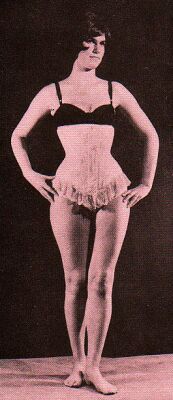
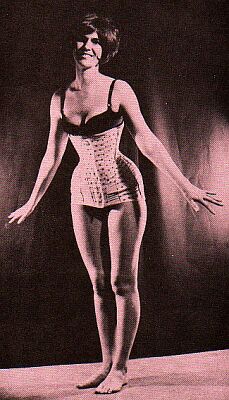
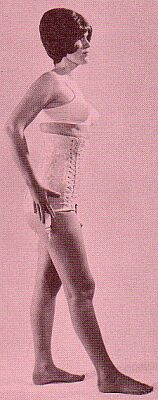
contrast Copère produced a much smaller, 12 page catalogue on glossy paper and
had just eight made to measure corset styles. A page was devoted to each
corset style with four quarter page photos of live models wearing them taken
from four positions - front, back, side and at 45E
on each page. I found it slightly strange that while all had suspenders, they
were not attached to stockings since all the models wore "cat suits" under
all.
I
immediately classified them by eyelet count above and below the waist loops. I
absorbed all I could of the very detailed descriptions such as "boned on the
cross", "underbusk",
"wedge
busk", "lined
and interlined",
"double
boned",
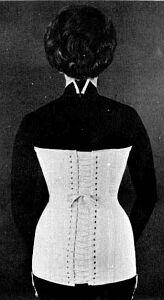
etc. I was especially taken with the very high cut styles that flared in front
and cut to contain the bosom and to be worn without a bra, but covering the
nipples. To me the "Isabella" with
"reinforced
eyelets for tight-lacing"
and in "the
heavier version lined, interlined and double boned with flat steels"
sounded a truly exciting corset to wear,
and one I hoped to aspire to wear in the
course of time. Both it and the "Margarita" styles were very long and came
up from the lower hip, over the bosom reaching right up under the arm pit,
just like the one "The Millionairess" wore!
I was
later to learn that six of the designs were actually Gardner's designs and two
of them were those of Vollers of Portsmouth, a competitor of Gardners.
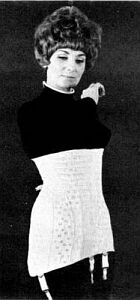
Corset styles
Isabella (above) and Jean (below) |
 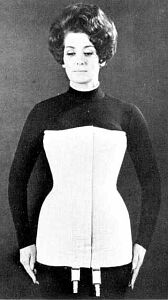 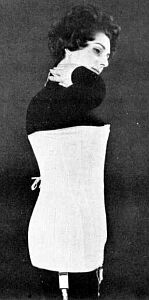
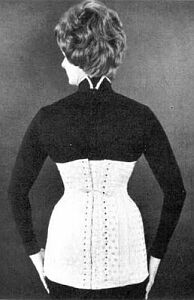 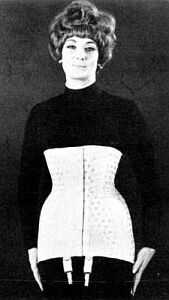  |
 |
Fanny
Copere's corsets
were
usually copies, or re-
sold
versions of Gardners
and
Vollers corsets.
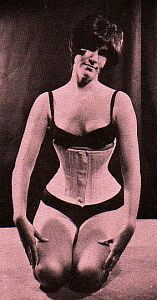 |
Styles 'La Taille', 'Godet',
'Hook-side, lace-side' (couldn't they think of a name?), and the 'Modern
Waspie Mini'.
A
MYSTERY WOMAN WITH A CINCHED WAIST
|
With
its catalogue Copère included a one page advert and one side of it reproduced
what proved to be the cover of a book they published called "The Corset
Question". The sheet included a front view photo of a smiling middle-aged
woman, hands on her hips wearing a tightly belted black dress. Her waist was
cinched in so much it could only have been achieved with a corset. Below was
the caption "A wasp-waist of the Nineteen Seventies. Bust 38 inches, hips
40 inches, waist laced to 19 inches"
Iris
Norris writes on the back of an A. Gardner business card > |
|
|
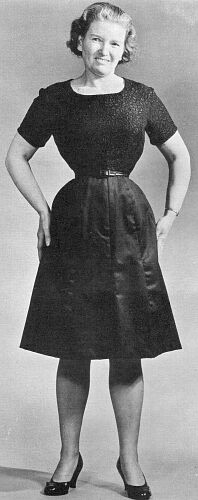
Note the waist and the satin skirt.
Mrs. Norris knew just how to dress to please a man in
the nicest possible way. |
I got
the book and was very pleased to find a second photo of the wasp-waisted lady,
this time photographed from the rear, in a centre section which featured
several other photos of women in corsets. It added the information that she
was a "grandmother aged 50", who had been making corsets all her life" and
that her 19" waist which she had achieved by achieved by wearing a corset
which Copère sold as their style "Jean".
|

The legendary corsetiere
Iris Norris
and examples of Copere's "Jean" or Godet corset style
|
When I got eventually
got Gardner's
catalogue, I found out it was actually
their style
L267,
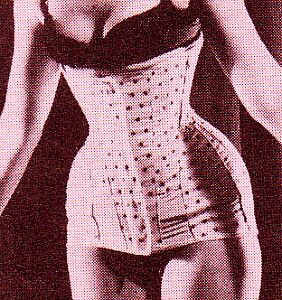
while Wilbro sold it
as MMCL5.
Both firms had them
made to measure
by Gardner. |
|
The
"Godet"
corset is specially designed to give the wearer the glamour of a small waist.
It has a busk-front fastening, and is back laced with a strong lace to really
pull in the waist. The incorporation of special fluted hip panels into the
design of the corset will accentuate the hip line and allow free hip movement.
Heavy boning ensures good figure control. The top of the corset coves 3" to 4"
above the waist and gives a really superb line. For maximum effect of this
corset on the wearer's figure there must be at least 10" between the wearer's
waist and hip sizes - 4 suspenders. Minimum back length 14".
|

"Jean' an Iris favourite |
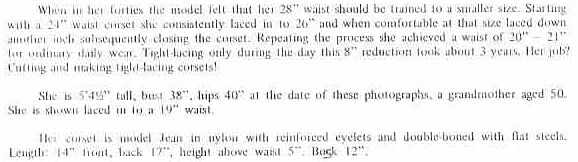
Here
was real live woman who actually wore corsets out of choice. Not just any
corset but a truly formidable corset made to cultivate a small waist, and had
worn them all her life and what is more made them for a living. She was
obviously almost old enough to be my mother but I did stop to marvel at what
it might be like to be married to a woman such as her who wore such corsets as
"Jean" all day every day!
What I
was to find out later was that she made up her own Godet style with the
ultimate in busk design - the
"spoon"
busk, A vigorous woman who even painted the outside of the window frames of
her house all by herself, and did so while tightly laced in a spoon-busked,
Jean, L271 corset wearing real seamed nylons! Not surprisingly she regularly
broke those priceless busks. As their availability became difficult in the
early 1990s, somehow she managed to find a few recycled ones to keep in
reserve.
It all
made me more determined than ever to continue with my corseting and to get
more experience. Little did I know that within the year I would meet my
mystery woman. |
BUYING
CORSETS BY MAIL ORDER
In the
meantime, how was I to continue? What corsets should I buy next? I spent weeks
comparing the catalogues and thinking about and made tables of what was
offered by the two makers. Both gave very detailed instructions on how to
measure oneself and I read and reread that information till I thought I
understood.
I could
either economise and learn with off the shelf corsets or spend much more on
another mail order made to measure and risk being disappointed and seriously
out of pocket as I'd
been before, so that ruled out Copère.
In the
end I realised that I had more to learn more before I went back to mail order
made to measure. However I really wanted a corset for a man - made to measure
so I wrote to both for clarification and got a very helpful reply from "M
Beck" on behalf of Wilbro and also one from Copère which confirmed my
suspicion that they were actually an agency selling corsets made elsewhere.
Economics won out, at least I rationalised it by thinking I needed to learn
some more. I finally decided to buy from Wilbro in Manchester, but which ones
to get and which size? . By now I had the experience of the three real corsets
plus the basque deep suspender belts and waspie, the black "Contessa", the
8-inch deep waspie and the 22-inch male corselette.
I now
knew my hip spring was only about 4 inches without a corset or 6-7 inches if I
cinched my waist, In contrast most of the Wilbro ready to wear range of
designs had 8-10 inch hip spring, cut for the average woman, not for men.
Selecting thus became a process of elimination.
I had
learned from the Contessa that didn't want hooks and eyes, nor did I want
front lacing. I wanted a longer busk front and I wanted back lacing. The male
corselette was too tight and too long to be practicable with stockings. Some
styles came with two and others with three, pairs of suspenders, so I'd choose
a style with three pairs and the least hip spring. Wilbro featured under-belts
on some styles, so I decided to get one that included that feature. I did not
want pink, if I could be avoided, but in my zeal to learn I would take it if
it best met my needs.
With a
hundred designs to choose from I made my choice not so much on the basis of
getting two very different styles from which to learn even more about the
different types of corsets one could wear, styles which I thought would
educate me most. I decided on one that was a classical tight lacer and one
with under-belts. The choice wasn't easy bearing in mind they all said they
were cut for a 11-inch hip spring and mine was only 6". How could I
accommodate that in my choice?
Many
styles were made with waists at 2 inch intervals. Fewer styles offered waists
at one inch interval. I was 33 inch natural waist - maybe 30 inch if tightly
corseted. If I got that size it would mean 40 inch hips and mine were 38
inches. I'd have the same trouble as the black Contessa gave me. So I settled
on a 29-inch waist for each of them which I realised would have to gape at the
top of the lacing when it fitted tight on my hips. If the waist was correct,
the corset might not touch my hips at any point, while with the right hips it
would gape and be very tight on the waist. As with the black Contessa, I
decided that this was the lesser of two evils. This was the description of the
ones I chose:
BLBU
4 under-belted back lacing, medium boned corset made in strong cotton material
with covered busk. Uplift under-belt with hookside fastening. 6 suspenders.
Depth 15". hip Spring 11"to 12". Waist sizes 26" to 42 ", every inch. Tea
Rose. Price £7.70.
Yes, it was tea rose -
pink, but I swallowed my old aversion and resolved to dye it
and feeling curious,
I decided to
get one with under belts.
PCRW
2 Traditional Victorian style figure-forming tight-lacing corset. Well boned,
and flat steels at the back for support. Designed to fit seven inches above
the waistline. Total front depth 15". Front fastening with 13' busk reinforced
with an underbusk. Back lacing with strong lace, and waist tape reinforced for
tight lacing. Superior striped pattern cloth. 4 suspenders. Waist sizes 24" to
36" (even sizes only). White. £9.50.
This
was a PCRW (period corset ready to wear) which fascinated me and a longer
version of my waspie and would come well up above the waist I thought it might
deal with my spare tyre which developed above the top of my short corset if I
laced tight. There was no mention of hip spring. I was ready to take a chance.
I accepted that it had just four suspenders - I could sew some more on.
Moreover, it came in white, not pink. When it came, I found it was unlined
with spiral steels, stiff back steels, a 13" five stud busk, and a formidable
under-busk.
Wilbro
also sold "Elbeo" brand "Supphose" and so, as I had never tried them I order a
pair for shoe size 9-10, broad leg, colour "Haze" for £2.00.
TRYING
THEM ON - "CORSET TAKEOVER"
The
corsets came very quickly and I spend the weekend trying them on. I was glad
to find they both came with chrome suspender fittings and wide elastic.
I
quickly examined the PCRW2 and found it had a full length under busk, single
spiral steels in the side panels and I liked to feel the strong back spring
steels. I'd never had a corset with them before. I decided it on first and
what surprises it yielded from its inert self. I was unable to get the busk
slotted because it distorted so much on account of the cut, even with the
lacings provided fully open. There was not enough lace to let me do it so I
took the black lace out of my basque and added it on. Like this I was able to
get one stud on, and with great effort and much sucking in of my stomach and
struggling for about 10 minutes I finally I got all the busk studs hooked. I
was out of breath and had to stop.
When I
took stock, I was thrilled to feel how well the corset fitted around me. I
reached back and finally located the ends of the lacing loops and gradually
pulled in on them I felt the corset hugging me tighter and tighter. Then I
started to lace in and the effect was electrifying. Very quickly I felt the
busk and underbusk appear to be propelled right into my midriff curving as
they did as if the whole corset would overwhelm and crush me. It took a few
moments to realise that it was my pulling on the lacings that did this.
This
was one of the "corset moments" that I will never forget. I realised that once
I knotted the lace, I would be subject to the effect of how I had laced myself
in, until I unloosened it. What I experienced I now understand is described by
the term "corset takeover". If the corset tightening stops before this point,
one remains in control of one's movements but, beyond this point, one really
is only able to move as much as the corset will allow one to do.
Years
later I realised that when my corsetière was lacing me in the fitting room she
would sense when she reached the takeover point, pull a little more and would
then knot the lacings. I came to realise that she knew what she was doing and
how it should be. I hesitate to use the word "discipline"
because of the associations the word has, but in reality beyond this point the
wearer's life is disciplined by the corset.
Laced
in properly, the PCRW2 corset fitted very well over the hips but there was too
much at the top. Then came another surprise. I was so stiffly corseted I could
hardly bend enough to put on my stockings let alone twist to do up the back
pair of suspenders. Added to that was the fact that I now found the suspenders
were too short and had to stop and had to change into my longest stockings in
order to get them on the suspenders!
Time
was going on and I was anxious to try on my other selection, the BLBU4. When
it came to taking off the white corset I almost regretted, but I was eager to
find out what the under-belted style felt like.
First I
examined it and it was exactly as described and noted additional details not
given in the catalogue description. For example, "medium
boning"
meant spiral steels, but no flat back steels like the white one had. It too
was unlined. It had a rather short, 8 inch long front busk with four or five
hook and eyes below it. The under-belt was six inches deep and boned with
spiral steels. The six suspenders were made with reasonably strong 1
inch width pink elastic, all sewn to the outer skirt of the corset. Years
later I saw that sometimes suspenders were attached at one end to the corset
with trolley suspenders and with the other end of the elastic sewn to the
under-belt.
But
before I began with the stocking and suspender problems of the PCRW fresh in
my mind, I decided to put on the new Supphose on before fitting the pink
corset.
LACING
ON PINK CORSETS
I put
on my new pink under-belted pink corset. No two corsets could have been more
different to put on. Since I wanted to learn more, I had selected well. The
under-belts were a great help in holding it in place to hook the short busk.
The back pair of suspenders were sewn on really far towards the back lacing
and for the first time I had to reach between my legs to clip them on my
stocking tops which, being Supphose, really needed pulling up to do it. What I
learned from that was that I'd have to clip them on my suspenders before
hooking up the busk. Lacing in was strange as it came very tight on my waist -
like the black Contessa had but it was only just touching my form on my hips
while the under-belts were tight.
When I
got the Supphose tautly suspendered they pulled the corset hem taut as well
and I felt more contained in corsets and stockings than I ever had done
before. Although it was pink, I didn't care, I enjoyed the feeling. Ironically
I was wearing the antithesis of what I thought I wanted - a pink corset and
brown seamless Supphose with pink six suspenders but the feeling was
wonderful. I had reached a new milestone the experience confirmed that I cared
more for the tactile feeling than the visual factor, though perversely, for
me, the new pink corsets started to had their own beauty......
I no
longer just wondered how the corseted and stockinged women, I had admired down
the years, must have felt inside their tautly suspendered stockings and tight
corsets or girdles. I believed that I was now experiencing it what they did. I
was certainly not disappointed and something told me that while many women
complained about having to dress like that, there must have been some who
secretly enjoyed what I was enjoying. Above all I wanted confirmation for my
belief that such things could be enjoyed equally by men as by women and that
men should not be judged negatively for doing so. Little did I know as you
will soon read, that within a few months my faith would be rewarded. In fact I
felt strangely complete for the first time in my life. I resolved to find
someone who would make me the kind of corset I could wear under my male
clothes for the rest of my life.
What
amazes me, when I write in 2006 about how I felt in 1976, is how much I
identify with what Alison Perry, writing in 2001, about her experiences as a
Spencer corsetière in the 1950s. I believe that my experience parallels some
of that of which Alison writes about her early days of wearing her "Spenall".
There are the quotes which touched a chord in me:
.....When it was on me and completely done up with my stockings attached (to
six garters instead of the four I was used to, an extra set at the back) she
had me try walking around. Not only did it look different from girdles I
normally wore, it felt different. It was heavier and stiffer and had a longer
skirt than I was used to. This longer skirt made walking a little more
restricted and she had also made the garters shorter so they pulled hard on my
stockings at every step.......
.....Then, strangely enough, after a few months, I began to need it. In fact I
felt lost without it. I am not saying I particularly liked it, but after the
first few months I started to look forward to the feel of its firm support and
put it on as soon as I got up in the morning.......
........ So when I was hooked up into my first Spencer it felt so different.
My initial feeling was definitely one of pleasure and well being at being so
tightly caressed......
I felt
many of the same things, yet I was a man. So putting my experience against
that of Alison I think if anything the comparison confirms my belief that the
tactile sensations that a wearer gets from a corset worn with tautly
suspendered stockings transcends gender. It also confirms what the other
Alison comments "there's no doubt many women feel trimmer
when girded by a girdle and are tightly suspendered."
THE
QUEST FOR A PERSONAL CORSETIERE
It was
time to take stock and think where I was going. I had now worn stockings with
a suspender belt to work for about five years. Although I had now got five
corsets, none of them was suitable to wear under my clothes to work. At the
same time I was educating myself and had passed over a number of key events
which were, firstly - the moment I touched the stocking at the dance, secondly
- wearing my own stockings and suspenders for the first time, thirdly - lacing
on my first laced corset, the black Contessa and fourthly - hooking up my
first busk front.
Each
step was taking me to a new level of corset and stocking experience. I had
experienced most types of corset. I knew the difference between flat and
spiral steels, I could manipulate a busk, hooks and eyes, I knew where to clip
suspenders on stocking tops, depending on how many there were on a belt or
corset and what lengths of stockings went best with which corset. I was no
longer a novitiate but I still had doubts. I also knew that I was ready to
discuss what I wanted in person with someone who made them - a corsetière.
But how
was I to find one? How would my quest continue? Gardners seemed possible but
how could I get in touch? I again resorted to Kelly's London Directory. Two
months later I had my first appointment with Mrs. Norris who was to be my corsetière for the next twenty years.
I MEET
MY LIFETIME CORSETIERE
With a
little concern, I dialled the number that I was to commit to memory for years
to come. The phone seemed to ring for ages. I was about to give up when a lady
with a flat but very friendly cockney accent answered, "603-2001". I asked if
it was Gardners and she said yes. I asked if they made corsets for men and she
again said yes. I nervously explained that I wanted a corset and realized I
was talking to the corsetière who obviously was quite used to dealing with
men. In a few seconds I was completely relaxed.
I was
amazed how easy it was to discuss everything. She said that the owner Mr
Gardner was on holiday. She said she was Mrs Norris and could see me that day
whenever I wished to call and discuss my requirements and she could measure
that day. I felt 10 feet tall. I had arranged an appointment with a corsetière!
Coincidentally that same day I bought a magazine that included photos
submitted by a "Berkshire Reader", entitled "The Appeal of the well-corseted
Figure" which included three photos - front, side and rear views - of what
appeared to be a busk-fronted, back-lacing, full hip controlling design of
corset, worn over a corselette to which the stockings were suspendered. The
corset had full length heavy boning and I was sure they were being worn by a
man. Many years later I found out that both garments had been made by True
Grace Foundations of Wokingham, Berks.
I
arrived in Barnsbury Square at around three o'clock. I parked the car, and
walked towards No 28. As I did, I wondered if any neighbours were watching and
if they knew what my business was. Below the bell was a sign "A Gardner and
sons Ltd. When I got to the door, The bell was really loud and I waited
nervously. Eventually through the frosted glass I saw someone approach. The
door was opened by a woman wearing heavy framed black glasses, who I guessed
to be in her mid-fifties. I introduced myself as the man who had phoned
earlier and she warmly asked me in, saying "Follow me this way".
I
followed her along the corridor and couldn't help but noticing she was wearing
seamed stockings on her shapely calves. They were dark brown and had long
point heels, like the Aristoc 222s I was wearing myself. She took me along to
the back of the house opened the basement door and led me down the stairs
after asking me to close the door because of the baby. We entered a large
basement room with a wide long table covered in bolts of corset fabric and cut
corset panels waiting to be sewn up by the machines at the end of the room.
I
started to explain what I wanted and to cut the questions I showed her the
photos from the magazine I had just bought. I said I wanted a corset like
that, but in black and with shoulder straps. She looked at the photo
carefully. As she did so, I now noticed her waist was cinched by a tight belt
and was so small that she had to be tightly corseted. She understood at once
what I wanted and said "You'd better come to the fitting room and I'll measure
you".
IN THE
FITTING ROOM
Every
time she moved away my eyes were drawn to her seams and I was amazed to see
how straight and central they were on her calves. Here was a woman who was not
only wearing the seamed stockings I so admired, but she was tightly corseted
to.
As she
measured me, I told her I wanted it to be 2 inches open when it was fully
laced in and I opened my shirt to show her the white PCRW2 that I was wearing.
She measured me taking a measurement at the chest, waist and hips and writing
it down.
She
asked what I wanted in front a busk or what. She said some people liked a full
length front lacing but she didn’t recommend it. She would make me a long busk
fronted, back lacing corset faced in black leatherette, lined in twill
with rigid shoulder straps and buckle adjustment and would put on the
three
pairs of suspenders with the strong wide black elastic that I wanted.
Suddenly the phone rang and she left the fitting room, to answer it. I took
the opportunity to look around. There were several copies of the magazine
"Corsetry and Underwear" on the table and which I looked at. On the wall were
leaflets showing, on blue paper, the styles of men's corsets - complete with
sketch drawings while the pink women's leaflet featured photos of corsets
being modelled by a young woman. Years later I found out she was a client who
had married one of Gardners male clients.
On the
wall were two diplomas that attested that a Mr Frank Gardner had received for
courses in corset making and corset design at a college in Holborn, I think,
in about 1950. Also on the wall was a large sheet of information on wages put
out by I think a Wages council.
|
Also on
the wall was a 10 inch by 8 inch size photo - the same one that was
reproduced on the cover of "Corset Question". I had a feeling that it was the
woman who was attending to me, except she wasn't wearing glasses. When she
came back I asked her if the photo was of her and she confirmed that it was
and that it had been taken a few years before. Mrs Norris was the mystery
woman.
I
PHILOSOPHISE
I put
two and two together and noted that not only was she a corset wearer but that
she also wore fully fashioned stockings. Given how straight her seams were I
guessed that she was also tautly suspendered too. I then realized that
together in that room were a man and a woman, each of whom was wearing busk
fronted, back lacing corsets with tautly suspendered seamed stockings. I drew
comfort from this fact and from realising that, though I was a man and she was
a woman and that she knew my secret, she obviously accepted me as I wearing
corsets and stockings. I also realized that she probably had a number of male
clients like me and it all meant a lot to me, though each time I met her I was
always surprised and cheered by the fact that I could actually talk to someone
about problems with stockings and corsets and that she too had experienced,
and what is more do so on an equal basis.
We
finished our business and she could have it ready in a week. I said I would be
back on a Friday to which she said that she only worked mid-week - Tuesday,
Wednesday and Thursday - because she had moved out of London and lived in
Bucks. This meant a long train journey and so she came in very early and
worked three very long days. She said she would leave the corset with a woman
down the road, but in the end I changed the day of collection in order to see
her again. Before I left she gave me copies of their catalogue and order form
and price lists. On the men’s leaflet was this slogan.
"Remember. Clothes maketh a Man, Corsets maketh the Figure"
I SEE
THE FUTURE AT LAST
I
returned as planned, having phoned ahead to confirm she was there and yes the
corsets were ready. I called around and was thrilled to see the long brown
paper roll containing the rolled high top corset. She opened it out and showed
me her craftsmanship. Although she was quite friendly, I suddenly felt
overcome with embarrassment as the suspenders dropped down and glinted. She
even asked if I wanted to try it on but I felt filled with shame and guilt as
to what I was doing. The corset I was wearing felt impossibly tight. So I said
"No thank you", that I was sure it would be fine. She wrapped it and escorted
me to the front door and feeling every neighbour was watching me out of their
window and seeing the long package would know where I had been and what I did,
as I carried it with me to the car.
The
back leatherette high top proved to be too tight to wear, except for short
periods, but the four pairs of suspenders were wonderful. Within weeks I had
phoned Mrs Norris again. I had perused the catalogue and wanted the style G78
"Casual", a 12-inch long corset rather like a longer version of my waspie. My
odyssey was over. I had found my dream. I was to have 23 years with Iris as
my personal corsetière and confidante - but that's another story.
Frangard 2
Black corsets and why do they tear so often?
Observations
by Frangard 2
BLACK DYEING AND COTTON YARN
In the January entry to her Diary, Ivy Leaf notes that at one period of time,
corsets made or faced with black fabric tore more easily than those made up
using fabrics of other colours. However, whilst the end result is tearing or
ripping of the corset body, the cause of the weakness is more likely to be
related to the fact that, until relatively recently, the dyes, and especially
those used in the 1980s, had and may still have a continuous and progressively
deleterious effect on the cotton yarn in the material they had dyed.
In times ranging between just a few months to many years, the yarn is steadily
rendered rotten. In due course, the material might then suddenly tear because it
was being strained, as the corset as a whole was being laced tight, or it tried
to resist expansion when the wearer moved - to bend or sit down - in such a way
as to overstrain any of the weakened yarn in the material.
It is suggested that the type of dyes used in the late 1970s to mid 1980s was
the culprit in the matter. It has been suggested that because the dyeing process
calls for boiling liquids to fix the dye in the yarn and that this intrinsically
weakens cotton yarn. In this regard the evidence is to the contrary, in that for
centuries, cotton yarns have been repeatedly boiled without loss of strength or
rotting of the yarn.
In point of fact, the problem of tearing and failure of black cotton fabric is
not limited to black fabric in corsets. If a matching shade of cotton-based
elastic was used for its suspenders then they would fail more quickly than those
made up from elastics of other colours. No less an expert than Iris Norris, when
working at Gardners and later as an independent corsetiere, would counsel
clients that failure of suspender elastic occurred more frequently with elastic
that was dyed black.
Other evidence of the way black dye can rot cotton was found in the early 1990s
when American-made "vintage", fully fashioned nylon stockings were being sold as
being '60 Denier’ nylon. In fact only the legs and feet were knitted with the
60D, shiny (non-delustered), nylon yarn. The after-welts and true welts (folded
stocking tops), were knitted of another material, almost certainly cotton. It is
thus probable that the original stockings dated back to a time when nylon was
still in short supply and there was evidence that the black colour was the
result of later dyeing, since the cards on which the stockings were wrapped
prior to being placed in the packet were stained with black dye, which probably
betrayed the fact that the stockings were initially of another colour and had
been dyed black for resale many years later.
When worn, even for the first time, it was found that the welt material was
close to rotten whilst at 60D the nylon yarn used to knit the legs and feet was
almost completely snag resistant. Upon closer study of the damaged welts it was
found that, wherever and whenever a welt-covered suspender knob/button was slid
into the frame of its suspender clip, the gripping pressure was sufficient to
break the yarn almost immediately and as likely as not a hole would develop.
Within a few wearings the holes that formed all around the welts would become so
prevalent as to make it almost impossible to clip suspenders to them.
Again it is suggested that the chemicals comprising the black dye had rotted the
cotton in the welts. Since the dyeing which appears to have caused these
problems was in the same era when Spirella suffered from a poor batch of black
orchid material (mid-1980-s) that the cause was the same.
TEARING OR RIPPING - A PROBLEM OF CONSTRUCTION NOT MATERIAL
Moving now to the observations on the failures occurring at stitching. It is
considered that most experienced corset wearers will have examined or worn many
styles of corset over time. Essentially a corset comprises several individually
shaped panels sewn to form the corset body that was then hemmed and the bones
strapped in their casings directly onto the panels. Within this basic
requirement there are various combinations of:
-
the
number of panels, flutes and "Godets." Each "half corset", typically lighter,
mass market corsets, had three or four panels making eight in all, while in
custom-made corsets by Spirella or for tight-lacing waists between 15 and 30
inches, a "half" would usually have five or six panels. To accommodate the
figure with a large hip spring of 12-20 or more inches, tight-lacing corsets
would usually include a fluted panel insert below the hips. Full hip control,
may well include an inverted V gussets of woven elastic sewn with the
un-stretched base of two to three inches at the hem level and set about four
to six inches from the busk edge or centre front. This is close to the zone
where extreme stress is imposed on the fabric of a rigid corset and frequently
is where rips or tears originate if the wearer tries to sit down.
-
the
number of fabric layers. Each panel can be either a single layer of fabric or
it can be two ply, that is lined, like Spirella, or they can be three ply
(lined and interlined). This was usual for corsets made for tight-lacing for
clients of such firms as Gardners and on-sold by the firms they supplied, such
as Wilbro and Fanny Copere in the UK and Finecraft and Caprice in the USA. It
is reasonable to say that the more layers, the stronger the corset and the
less likely they are to rip. Lighter designs first rip along the very seams
between the panels and the very perforations created by the sewing needle act
like perforations on stamps to cause and accentuate the tendency to tear or
rip.
-
the
number of bones - either single or in pairs and the type of bones - flat or
spiral steels are possible. As Ivy Leaf points out "The result is usually a
rip, and particularly at the stitching where the material joins the bone
casings." However their problem is usually obviated if the boning practice
for tight lacing corsets used by Gardners and Iris Norris which was as
follows. The busk would be inserted and sewn in place in the edge panels. The
panels comprising the facing, the lining and the interlining would be sewn up
to form each "half corset". Before putting on the edge/hem piping the bones -
flat or spiral steels - using a special tool to slot into the bone tip end
would be pushed down between the facing and interlining. The bones would then
be sewn into the position in which they were placed. If there was room - not
always easy on a fluted hip, small waist, six panel design, the single bone or
pair of bones would be positioned so as to be mid-way between the panel seams
all the way down a panel. The need for the bone casing, to which Ivy leaf
refers, and the need for yet more stitching near the panel seams, is obviated.
However as regular corset wearers know, depending on the location, any bone
tip might slowly abrade and finally punch through either the facing or lining.
The problem can then be repaired using bone casing sewn on the lining or on
the facing as needed. The eyeletting machine would be used to punch the eyelet
holes between the back pair of flat "eyelet steels" which were already sewn
in place and the machine would set and crimp the grommets and reinforcing
washers in place, all in one operation.
All readers would do well to note Ivy Leaf's advice about the importance of
breaking in to allow the material to conform to one's form. After that, one can
lace oneself in very tightly if desired.
The writer is convinced from personal experience, almost always with corsets
made of black dyed material, that this three-layer construction and procedure
helped reduce ripping. He personally knew three of Mrs Norris's tight-lacing
lady clients and, while the exigencies of their taste in tight-lacing meant that
periodically their corsets would rip while being laced tight, only one of them
had any serious trouble with ripping when the corsets had been excessively
repaired anyway. Colour of material does not appear to have been a factor. Even
then closer investigation would reveal that this was the result of continuing to
use an old, much-repaired corset, much favoured because of its wonderful fit.
