Corsets and the War
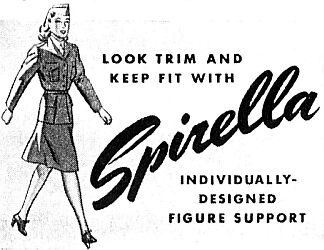
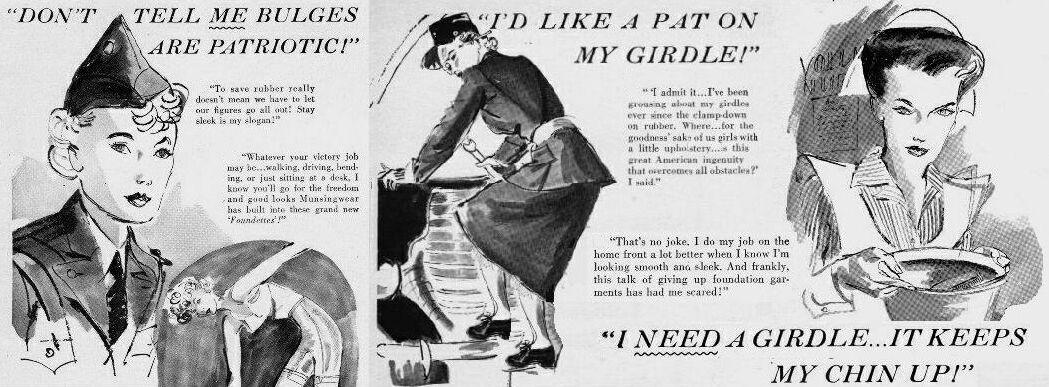
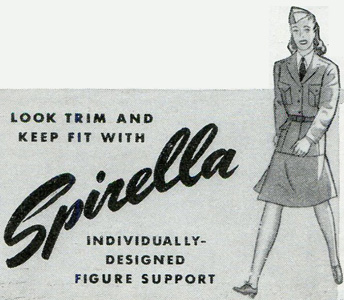
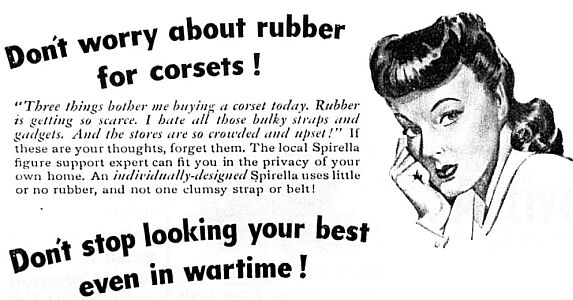
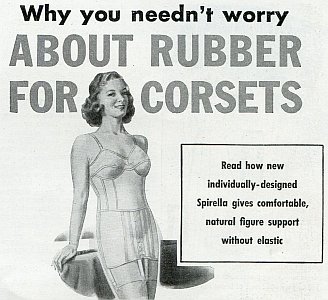
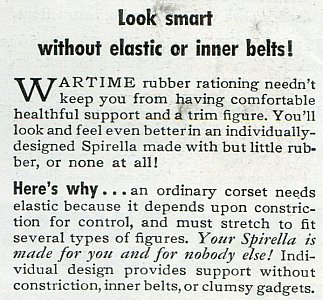
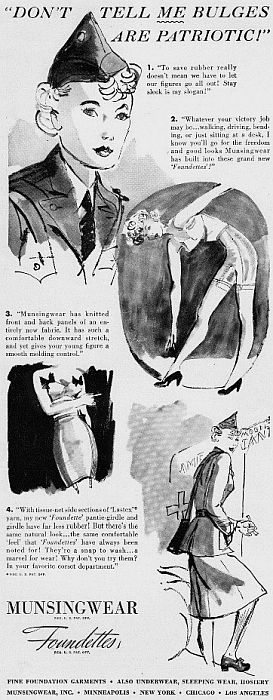
In America and Britain, reference to the War effort was a good selling point, and Spirella subtly accused the poorly corsetted woman of being a virtual traitor. Like Spencer, the lack of proper corsetry was associated with slovenliness and goodness knows what else. If that didn't work, then the necessity of the corset to support the potential customer during her heavy war-time duties would. Don't think that a world shortage of rubber was a problem either; the corsetry business was established long before rubber became freely available and they had any number of alternatives, however, that didn't stop the advertisers drumming home the point. Munsingwear (USA - below) in particular pushed their new spun elastics. It seems that in 1944, Munsingwear had a powerful contract with the military.
|
|
|
|
|
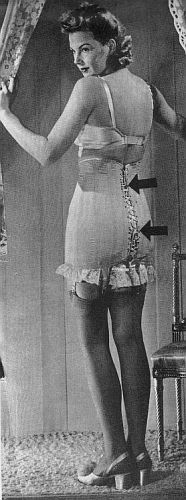
If you wander around many towns in Britain, you will notice where old iron railings have been cut out and never replaced. This was a consequence of the huge drive for iron and steel to make battleships and munitions. Less well known was that ladies pulled the metal stays out off their corsets as their own contribution to the war effort. This need for materials is the USA is illustrated in the LIFE magazine of 1938, several years before the USA came into the war incidentally:- "Women have been wearing corsets for about 4,000 year but it's less than 30 years since they have had the painless variety. To most women in recent times, wearing a corset meant nothing more than wiggling into a firm but not hard "girdle" which expanded and contracted with body movements. Such comfort will soon be only a memory. The WPB (War Production Board) has stepped into the boudoir and 1) decreed the number of square inches of elastic which may be used and 2) banned all zippers (that in those days were metal). Arrows on the pictures indicate legal elastic inserts and hook-and-eye closure. The result is that the new corsets, instead of "stretching to fit," will have to be designed and laced to fit. Lacings, according to Miss Frances Heller, corsetière at New York's Bonwit Teller, are a fine thing. They enable a woman to bind herself firmly where bulges are biggest, and shape remains as laced." The article goes on to explain how one deals with the arcane art of adjusting front- back- and side-lacing corsets. That the article occurs in the MODERN LIVING section of Life seems vaguely amusing these days, but steel for weapons was a deadly serious matter. |
|
In the 1940's Spirella concentrated on how the un-corsetted woman might not only lose her husband's affection, but possibly the entire War as well.
|
1942 I caught my husband talking to a strange woman ! I sent Bob off to the party alone … Is this what it’s like to lose your husband’s love So I sat and took it from the ‘sitter’ To think I was Dreading his Furlough (leave - Ivy) ! 1943 I’ve got the biggest, loudest welcome mat in town - quoted the town's Spirella corsetiere. You can look attractive and feel fit in Wartime Don’t worry about rubber for corsets ! What British Women discovered about Active War Work ! There was a slight division of interests here, where Spirella wanted all women to look their best, yet rubber was being diverted for the war effort and corset steels (literally) were being turned into tanks and planes. |
|
Whist still on the theme of war, we all remember the slogans (particularly if, like my husband, you enjoy the British comedy series from the 1970's, "Dad's Army") "Your country needs you" and "Loose talk costs lives". I doubt, however, if any advertisement before or since has encouraged one to "join the services and get a girdle".
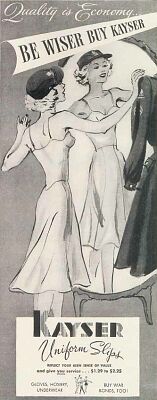

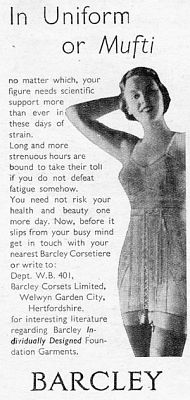
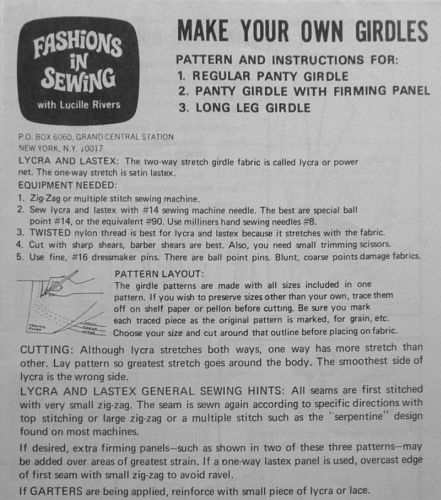
Kayser (above) went to considerable lengths to reassure women that their slips would not take material from the war effort. After the war, Spirella used an excess of parachute silk to make a series of ladies pyjamas! The army even made films about 'personal well-being' and the like and the theme of the age was that if you felt you needed a foundation garment, then please ensure that it fits properly.
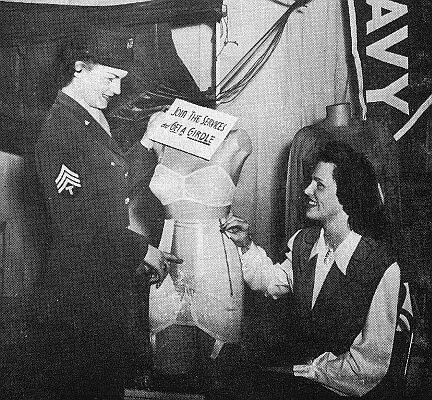

Join the services and get a girdle!
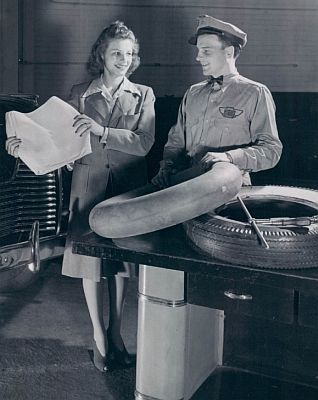
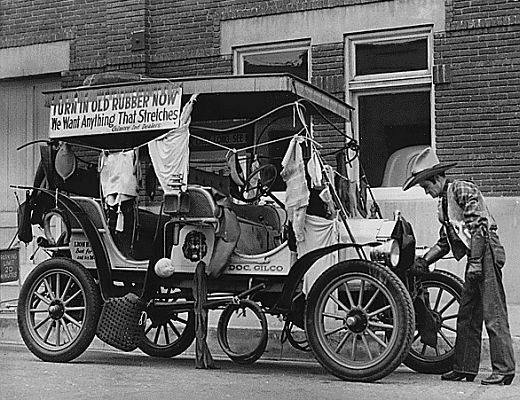
Mind you, the strenuous work ethic of the period probably demanded a good support. The picture on the right deserves some explanation. It has a companion picture of the girdle wrapped around the inflated inner tube. I believe that this was an advertisement designed to persuade women that the war-time elastics were quite equal to the flexibility of the rubber or rubber-elastic girdles that they were used to wearing. Women could still achieve support whilst not detracting from the matériel required for the war effort. Oops! How wrong can you be. After publishing the previous assumption, I was informed that the 'girdle' was in fact some sort of elastic tyre repair kit. Hmmm! I'm not totally convinced, even if Firestone did have a hand in girdle manufacture!
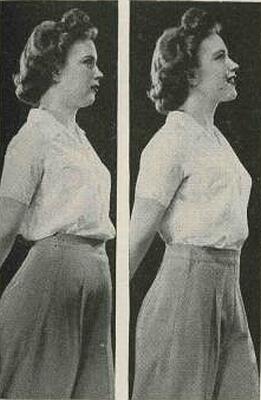
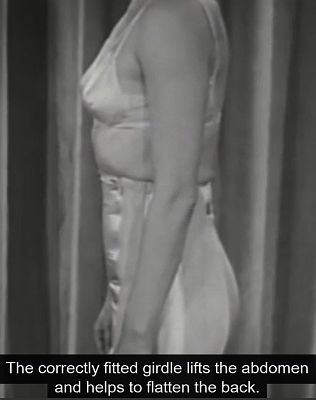
The importance of posture and correct underwear was illustrated in a government film (1943). They compared the corset of WWI to the girdle of WWII. "If you wear a girdle, make sure that it fits and supports the abdomen."
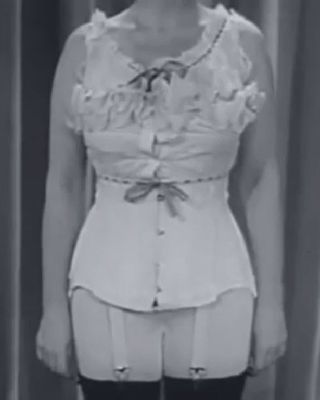
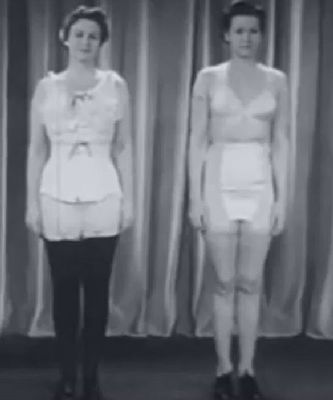
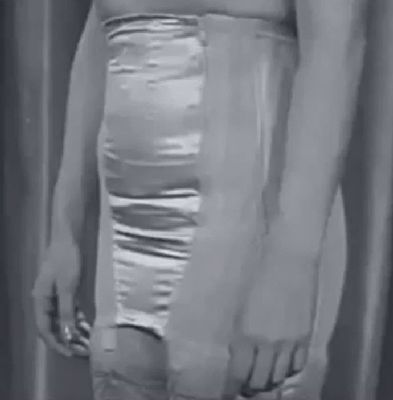
The film declares that the constriction of the corset in WWI had been replaced by the altogether more suitable girdle (how else would you keep your stockings up?) I have, however, talked to several ladies who served in the WRNS who declared that a good corset was the only way that they could successfully complete their chores.
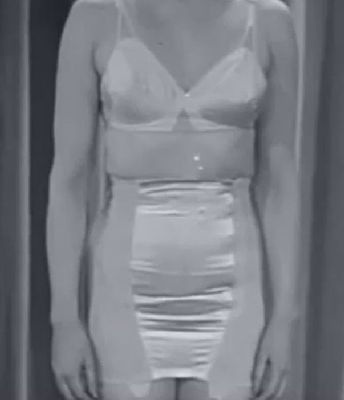

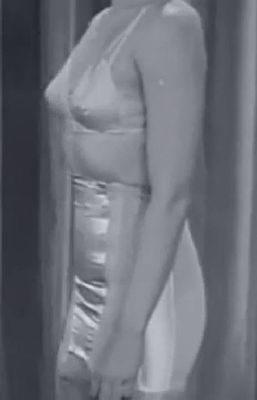
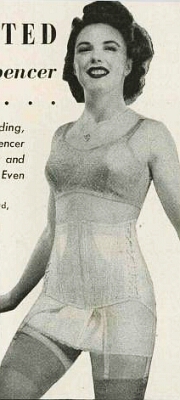
That brassiere looks a little flimsy to me. If any woman with a cup size bigger than B has to march, then a far more supporting garment will be required.
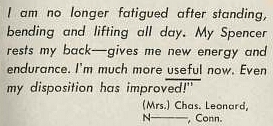
| Even Spencer used the war to jog
women's' consciences by insisting that only proper corsetry (in this case
during pregnancy) would allow a woman to continue her duties (in this case
the word useful is underlined). In the male chauvinistic world
of the 1940's, a women's duties were to her husband, home and country and
often corsets were the only barrier between a happy life and moral (not to
mention abdominal) collapse!
Both Spirella and Spencer put much emphasis on moral strength and attention to duty and chores. Frankly, in this day and age, I admire the sentiments. |
|
Just to complete the association of corsetry and the war, Spirella, using their superb construction principles, made parachutes during the war, and G-suits for pilots after the war. The excess of parachute silk after the war was used for a limited range of ladies' nighties and pyjamas, and one of the MD's of Spirella after the war was none other than Oliver Philpott, the famous escapee of Stalag Luft III who was the third, and last, man through the 'Wooden Horse' tunnel.