Alison's Story
- Her times as a
Spencer Corsetière
-Alison's views on rubber corsets
My
Early Days
A
number of people have asked me about my very early days as a Spencer corsetière
and whether my decision to become a corsetière was influenced by my family
upbringing.
I came
from a strict family and grew up in the 30’s and 40’s. I wore girdles from
an early age and was fascinated by my and my mother’s visits to the
corsetières. When I was growing up, I was like most other girls and started with
a garter belt and stockings and a bra. Later, as I became a little older, I
progressed to a girdle and stockings and a bra.
My
mother was a most fashionable lady of the day.
She always had a personal corsetière who visited and made her corsetry.
Fortunately for me, her corsetière retired about the same time as I started with
Spencer, so my mother became one of my first customers.
My
visits to her were pre-arranged for the whole day every other month, and even
more often before Christmas and Easter when a lot of entertaining was done. The
day before, she always prepared for me, and got out her dresses, suits and gowns
which she wanted to wear with her foundations. She was very fastidious about this.
It’s
hard to remember these days, but a foundation garment is meant to shape the
figure, and the clothes then fit that shape. Well-fitting clothes accentuate a well groomed
figure; they should not be loose and baggy to hide a bad figure. Ivy
My
mother was always very happy, very pleased, to be trying on her new foundations;
she loved them. After fitting her,
I would sit back on my stool while she looked at herself in the mirror, and she
would ask me if I thought she looked good. She did look wonderful and
absolutely beautiful in those white satin and brocade foundations. She always
asked for ribbons adorning the suspenders and fine lace over the front panels
and cups of the long-line bras she favoured so much.
These
were very firm and very well boned garments; the bra cups were full coverage,
the corselets were long over the thigh, and the bras were quite high backed. But
they had a lovely sheen to them, and had the lace and ribbon adornments that
made them so feminine; and of course, they produced such a lovely silhouette.
I was
always expected to be beautifully turned out, and we would sometimes go out for
lunch as a break during the course of our day, or after a morning of product
reviews and preliminary measurements. I
don’t think this intimacy, yet privacy, normally exists in the family today. I
enjoyed these afternoons (but I didn't let on), and she knew it.
My father was very proud of his wife's appearance, and his business
colleagues always complimented him on how stunning she was.
He loved that, so he never complained about the Spencer bills.
Occasionally
her lady friends were invited for coffee at 11:30 and I would fit them too.
After their first fittings, the new designs and fabrics were discussed in
great detail. These were also social occasions, so whilst corsetry was discussed
in great detail, decisions would also be made for which foundations would be the
most suitable for a forthcoming event, where a particular suit or gown would be
worn.
As you
know only too well, ladies openly discussed foundations in those days. The
personal matters and private aspects or complications of a particular fitting
were, though, absolutely confidential, and a special trust existed between me and
my mother and her friends.
The
candid intimacy between women is a surprise to those who were not present during
this period. Look at the Spirella
corsetières quite openly modeling their wares in front of their friends. (I
have to admit that at least one lady looks rather less than confident). Ivy
My
Spencer Training
When
I saw an ad to be a Spencer Corsetière, I applied. When I joined Spencer in 1953
I had to attend a training class given by our local manager. In this class we
learned about the product line, how to analyze figure problems, and of course
how to fit the girdles using the “Spencer method” and the measuring girdle.
Ultimately
I became a "Spencer Consultant" and had a territory, and I visited
ladies in their homes and fitted them with custom-made girdles and bras. I liked
the job very much and I think my customers did too. All the measuring and
fittings were done in someone’s home, and it was a lot more relaxing than
going to a store. But let's return to the beginning.
The main thing I remember about the training was that it was rather
intimidating. It took a week and was held at one of Spencer’s factories. I was
in my early 20’s at the time, and I know there was some discussion that I was
too young. But they felt they needed some younger corsetières to attract the
younger customers, so I was hired anyway.
But right away I got started on the wrong foot. It was summer, and it was
very hot. On the first day of training I came dressed in a summer dress under
which all I was wearing was a cotton bra and a light girdle. For the life of me
I still don’t know why I dressed like that. I had much firmer foundations in
my wardrobe, but here I was coming to Spencer with absolute minimum
undergarments. I guess I knew I had a good figure and was proud of it, so,
perhaps subconsciously, I was trying to show the other women I did not really
need many foundation garments. But I knew I was in trouble when I met the rest
of the class. There were about 12 ladies, the youngest of whom was at least 10
years my senior and all very conservatively dressed, with very matronly looking
figures showing they were wearing good foundations. I stuck out like a sore
thumb.
Our instructor was very nice and made the introductions. We were told that
the mornings would be for general instruction and the afternoons would be for
fittings. We were given the first of our instruction manuals, which, as I
remember, dealt primarily with elementary anatomy and different body types and
shapes.
After a short lunch break came the first fitting instructions. Our
instructor told us that the first thing a good corsetière must do is feel
completely comfortable seeing other women in their foundation garments and we
must be comfortable being seen in our own. So to start us she wanted each of us
to disrobe and describe the foundations she was wearing and why she chose them.
The rest of the class would then make comments.
I was horrified, especially when the first few women disrobed to show firm,
custom-fitted corsetry (much of it made by Spencer) and they described their
figure flaws and how they had been fitted with the various garments. When I came
to my turn I removed my dress to show only my light bra and girdle. I stood
there not knowing what to say while all eyes watched me in silence. I was
finally rescued by our instructor who made some comment how “Alison was
obviously waiting to be correctly fitted so had purposely left her regular
foundations at home.” After the rest of the class disrobed she did too,
showing the most beautiful and exquisitely fitted satin girdle and long-line
bra.
She then introduced us to the adjustable measuring corsets, and guess who
was the first model?
All Spencer girdles were fitted using the “Spencer method.” It consisted
of specially made girdles, corselets, bras and long-lines with a series of
straps that made them completely adjustable. They came in a number of basic
sizes. I was to be the model for the first fitting, so the instructor called me
to the front of the class. I unhooked my stockings and removed my girdle
(another rather embarrassing thing to do in front of a roomful of relative
strangers). She put the measuring girdle round me and zipped it up at the back.
She then pulled on the various adjustable straps and showed the class how she
could pull in my waist, hips, upper thighs, etc., and as she did she gave advice
on what would be best for my figure type.
She made the straps tighter and looser and asked me how it felt and the
class how they thought it looked. She had me sit down, then stand, then sit
again as she made adjustments to the length of the skirt, then bend while
standing and sitting while she got the height and the waist set. Eventually she
got the correct adjustment and wrote down the settings of all the straps and
adjustments on a special form, along with notes about the fabric and boning, as
well as comments about the style, panel design, lacings, hooks, zips, etc.
Explaining the fitting process took all afternoon, during which time I had
to sit or stand in front of the class dressed in the measuring girdle. The
measurements, she explained, would then be sent to the design department. They
would produce paper patterns, which would then be cut and sewn together. This
process normally took a few days, but in the case of our class we would be
monitoring the process, and so my girdle would be ready the next day.
As the class ended I apologized to the instructor about my foundations, but
she said not to worry, as by the end of the next day I would have my first
Spencer girdle.

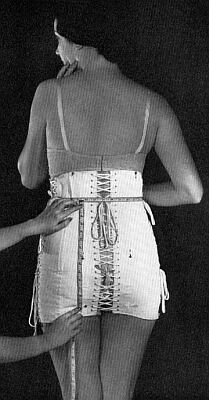
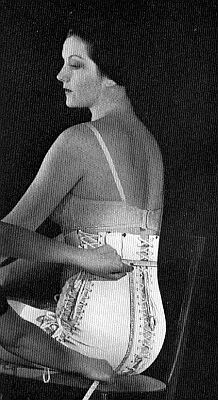
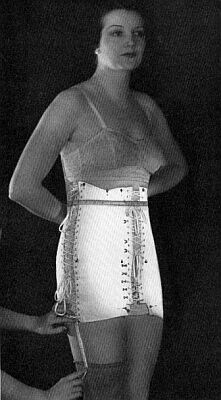
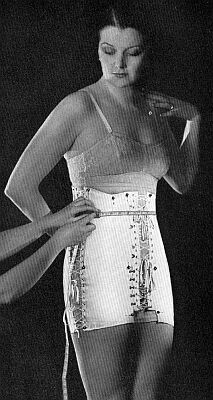
The
corsetière measures the client in a variety of specialised measuring garments
(1947)
As I remember, the next morning’s classes were on the history of fashion
and on the different types of fabrics and elastics and fasteners. In the
afternoon we went down to the design department to see my girdle, which had now
been designed and cut and was then sent to the fabrication department, where it
would be put together. We then went back to the classroom, where we split into
pairs to practice fitting each other. The instructor (whom I really liked) made
me her partner while the other women muttered that I was fast becoming the
“teachers pet.”
This time the instructor removed her girdle and I used the measuring girdle
on her. It was more difficult to use than I expected, as it was hard to get all
the different straps adjusted without getting the girdle completely out of
shape, and I remember we were all engrossed in the fittings when a seamstress
arrived with my finished girdle.
I remember my first impression was that it was like no girdle I had had
before. For a start, it was of shiny black satin like our instructor’s (a
fabric and a color that was considered rather risqué in the 50’s), and it
looked much longer and heavier than I was used to. It was a side-hooked girdle
(which was the most common style in the 50’s), with the hooks covered with a
zip. The class paused and the ladies took their seats while the instructor
demonstrated how to fit it. When it was on me and completely done up with my
stockings attached (to six garters instead of the four I was used to— an extra
set at the back), she had me try walking around. Not only did it look different
from girdles I normally wore, it felt different. It was heavier and stiffer and
had a longer skirt than I was used to. This longer skirt made walking a little
more restricted, and she had also made the garters shorter so they pulled hard
on my stockings at every step. The girdle also pulled my stomach in and its
higher waist made me stand and sit up straighter. The class was very impressed
with the way the girdle fitted. “It almost makes Alison look like a lady,” I
heard a lady murmur.
I
had worn heavily boned girdles before, but I must admit not very often, and most
of the girdles in my wardrobe at the time were relatively light control. So when
I was hooked up into my first Spencer it felt quite different. My initial
feeling was definitely one of pleasure and well-being at being so tightly
caressed, and when I looked in the mirror it certainly made me look very good.
This pleasure lasted for some hours, but I seem to remember that by the time I
started to walk back to the hotel along the hot street I began to have second
thoughts.
As
I mentioned, the girdle had quite a long skirt that held my thighs and limited
the length of stride I could take, and the stronger elastic Spencer used in the
garters caused a pull on my stockings at every step, and that was also something
new to me. I also began to find the overall tightness and control rather
uncomfortable as the evening wore on. It was something I couldn’t escape from;
it was with me constantly whether I was standing up or sitting down.
I
worked for Spencer for many years, and I have to admit I never really got
completely comfortable with being so tightly girdled and controlled. The
foundations I wore were just too restrictive to let me forget about them. I
think this strict corseting was pretty obvious to my friends. If we ever went
somewhere where we had to get changed I would get a lot of sympathy, but also
some envy. I think the whole reason they corseted me so strictly was to show
other customers what a correctly corseted figure looked like.
The
next day we started our training on fitting bras. The Spencer system for
measuring for bras was quite complicated, and some people (especially young
girls) found it quite intimidating. The next afternoon our instructor showed us
the two systems, one for regular bras and one for long-lines. We were told we
should normally use the long-line measurer, as these measurements could be used
for both types, and it often persuaded customers to buy a long-line (which was
more expensive).
I
was again selected as the model. I had to disrobe again, but this time I was
proudly wearing my new shiny black Spencer girdle. Unfortunately, the instructor
pointed out that I did not have it adjusted properly, so I had to unfasten it
and hook it back up correctly. Then I had to remove my bra, and she put the
measuring system on me. The body of it was made of rather firm material with
many adjustable measuring straps, but the cups were made of extremely light,
flexible, stretch fabric. It had shoulder straps, and hooked up at the back just
like a long-line, only with a long row of about 12 hooks. It felt very strange
when it was on, as it was very stiff and heavy, yet it gave no breast support,
so my breasts felt as if they were just pushed through two holes in the rigid
material and left to hang there.
The
instructor then adjusted the measuring straps and, as she did so, she pointed
out that my breasts were being pushed further out into the soft cups. This was
the way it was designed, she explained. Adjusting the body of the bra invariably
pushed the breasts further out and, as the cup material offered no resistance,
they could expand to their correct size. I was not sure I remember liking the
idea. When she was done with the measuring straps she used a tape measure to get
my breast size (remember Spencer did not use ABC cup sizes). Once the measuring
was complete I should have been released from this heavy and uncomfortable
contraption, but she then went on for about another hour explaining all about
breast sizes and shapes while I was standing there in front of the class with
this heavy device strapped to me, feeling more and more uncomfortable and
embarrassed.
Eventually
she finished and released me and sent the measurements out for my bra to be
made. Then we were split into pairs again and for the rest of the afternoon we
got to practice. The measuring system was quite difficult to master, and even
after the training was complete I had to fit quite a few customers before I
became very efficient.
On the final day of the training we again had lessons in the morning, and in the afternoon our instructor had my first Spencer bra ready for me, fresh from the factory. Once again I was called to the front of the class and asked to disrobe to demonstrate the fitting. I undressed down to my girdle (which the instructor inspected and congratulated me—I had it on correctly this time).
She
then unwrapped my bra. I saw, to my disappointment, that it was a long-line and
appeared to be as heavily boned as the girdle. It was, I had to admit, very
pretty and was made of shiny black satin to match the girdle. I put my arms out
and the instructor slid it onto my shoulders and pulled it round me. She had me
lean forward and position my breasts into the firm cups. It was fastened by a
row of side hooks covered with a zip. It overlapped my girdle by about and inch,
and had short straps on the bottom, which fastened to the girdle. She spent a
few minutes adjusting everything and stood back to show the class the effect. I
think it must have looked good, as there was a soft applause from the other
ladies, and again the whispered comment “now Alison really does look like a
lady.” But I did not notice. I was too concerned by the completely new and
alien feeling of being encased from shoulders to thighs in unyielding black
satin. At the time I had never worn a long-line bra and my main complaint was
being tightly controlled around my rib cage. Unlike the long-line bras of today,
there was almost no elastic in the section around my chest and there was no
adjustment, as it had been made exactly to my measurements. The only stretch was
in the fabric itself. Not very good for deep breathing! It was a sensation I had
not experienced before, but one I would come to know only too well during my
employment with Spencer.
The
rest of the class went in a whirl, and at the end of the day we were presented
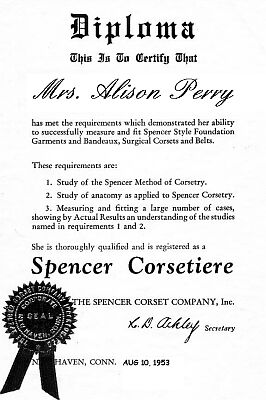
with our certificates and were now fully fledged Spencer corsetières. I traveled
home, and the next day I had my first meeting with my manager, who was, over the
next few years, going to have a powerful influence over my life.
On the Job, the Manager and the Spen-All
I came to the manager's
house proudly wearing my new professionally fitted Spencers. Right from the
start, however, I sensed she did not like me. I think she felt I was much too
young to be a corsetière. At this first meeting she flatly stated that my new
girdle and long-line, despite being fitted at the factory, were not
satisfactory. She required all her corsetières to wear corselets, or
“all-in-ones” as they are often called now. She thought they gave a much
smoother figure (which I must admit they did) and, as they were the firmest type
of garments Spencer made, they gave a good example to our customers. After all,
she explained, if we didn’t wear one how could we recommend they wear one? I
still remember that corselet; it was called the Spen-All.
I
am not sure I remember it so fondly. Spencer’s rules said their corsetières
could wear only Spencer foundations, and these could be ordered only by the
mangers, so I had no choice but to wear my Spen-All and similar ones all the
time. The Spen-All was rather like a combined girdle and long-line bra connected
at the waist. It was made of a shiny flower-patterned material called brocade.
It had an inner supporting section or under belt that had to be hooked up first,
a side zip and laces down the front of the girdle part to give a really flat
stomach. Although girdles at the time almost always came in white or pink, we
corsetières were only allowed to wear black. I found the Spen-All very
restrictive, especially when I had to bend down to measure a customer or adjust
her stockings or garters, but in time I got used to it.
Even
after all these years, I am still a little upset that right from the very start
my manager made me wear one of Spencer's firmest and most restrictive corselets.
In my opinion this type of corselet gave far too much control for a girl in her
early 20's, especially as I had to bend and move about to do my job. The
underbelt on it made it especially tight and uncomfortable, and I did not need
it, as I already had a good figure.
The
Spen-all is a lasting memory for Alison since she partially repeats the episode.
Note how the Spencer corsetières were only allowed to wear black. In the Spirella
corsetière pages, many of the publicity photographs and displays show
women wearing black, which was by no means the most popular colour. The reason,
I suspect, is that many of the foundations looked and photographed better in
black. Also the old-fashioned image of a “corset” could to some degree be
dispelled by the ‘racier’ nature of the colour. –Ivy
A remarkable parallel to Alison's account is drawn from the recollections of Isobel, a British lady who served in draper's shops, as they were quaintly called. --Ivy
Initially
I hated the Spen-All corselets, as not only were they very restrictive garments
with a lot of coverage, but also my manger had fitted them very tightly. Unlike
modern girdles and corselets, which are very elastic and mold themselves to the
wearer, the firm-control Spencer foundations molded the figure to conform with
the foundation. I remember almost crying when I had been wearing one of my
Spen-Alls for hours, knowing I had to keep wearing it until late evening when I
was safe and my manager would not come around.
Then,
strangely enough, after a few months, I began to need it. In fact I felt lost
without it. I am not saying I particularly liked it, but after the first few
months I started to look forward to the feel of its firm support, and I put it
on as soon as I got up in the morning.
Spencer’s
requirement of six garters on a corselet was also a problem. These six garters,
combined with the firmness of the corselet, caused constant tension on my
stockings and greatly enhanced the whole effect of being tightly controlled. I
don’t know whether any of you women who read these postings have ever had the
feeling of being so completely covered and controlled by your foundations that
your dress just slides on top without really touching you. That’s how I felt.
Another
interesting observation here. That the dress should fit the foundation garment
and not the person has already been mentioned; however, to avoid folds and
creases, the dress should indeed slide over the under-garment. To this end,
underwear was made of, or had panels of, satin, to facilitate the sliding. This
is also why the petticoat is called a 'slip' in Britain. (Not to be confused
with a slip, which in Europe means a panty-girdle). –Ivy
Many people have asked me what my Spen-All corselet was like. Well now you
can see. A friend drew my attention to this
Spencer advertisement. According to our brochure, which I still have, “The
lovely Spen-All
banishes bulges, and
gives a healthful lift to mind and body. When you wear it you will see the slim
young lines of healthful posture and you will sparkle with new health and
energy”.
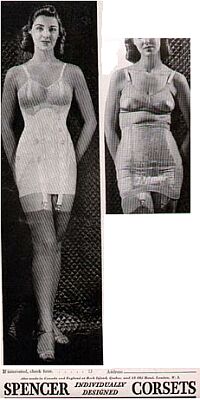
This is a typical
Spencer before and after advertisement from the 1940's. One tends to be a little
cynical about some of Spencer's advertising since it seems that the very act of wearing their
foundations not only
improved the figure but also the hairstyle and teeth. Some of these
advertisements were more blatantly modified than others. Spirella made similar
advertisements which were closer to the truth.
Although
the ad is dated 1941, it is almost identical to advertisements Spencer was using
when I worked for them as a corsetière in the early 50’s. It shows a customer
in her regular girdle and bra with all her figure problems, then there is
another picture of her wearing her custom-made Spencer garments.
Comparing
the two pictures gives you some idea of the rigid control a Spencer corselet
gave. It certainly brings back memories of the years when I had to wear this
corselet 16 hours a day, 7 days a week. Not only did I have to wear it, I had to
work in it all day, bending and stretching while I fitted my customers.
I've often been asked, Why did I have to wear the Spen-All? For two reasons;
firstly, Spencer company policy said their corsetières must wear only Spencer
foundation garments or face instant dismissal; and secondly, only their managers
could measure and order foundation garments for the corsetières.
You have to remember what it was like in the early 50’s. Women workers had
almost no rights and were often expected to dress a certain way, so I was really
trapped. The problem was that only my manager could measure me and order my
girdles, so she had absolute control of what I wore. We were required to wear
only Spencer foundation garments, and my manager’s trained eye could recognize
instantly whether I was wearing my Spen-All. She caught me once without it on
and I was given a warning that next time would be instant dismissal, so after
that I could not take a chance, as I needed and enjoyed the job.
When I ordered a girdle for a customer, I did the measuring, then sent the
measurements to the Spencer factory. They made the girdles, then shipped them to
my manager, who checked them, then brought them to my house. I never knew for
sure when she would be coming; it could be virtually any time in the day or
evening.
She felt all her corsetières should set an example with a perfect figure, so
my Spen-All was always about as tight as it could be. Worse than that, as it was
custom-made there was no adjustment. If I was having a bad day I couldn’t
loosen it in any way. I couldn’t even put on a lighter girdle; I had to wear
my Spen-All all the time.
Another thing I didn’t like was that all my Spen-Alls were black, which
limited the dresses I could wear without it showing through. (I was told this
was to make sure we always looked “professional”.) This was not bad in the
winter, but in the summer I could not wear lightweight or light-colored dresses.
The
Spen-Alls I wore during my career fitted like a glove. This perfect fit was a
combination of being fitted by an expert corsetière (my manager), plus the fact
that she had many chances to enhance and perfect the fit as she made me new
ones. The control was very even all over. There were no portions of it that dug
in or rubbed; it was just form-fitting. I am not sure whether this was because
the fit was so good or that my body gradually adjusted to the contours of the
rigid design.
I
have to admit it was like no other foundation I have worn before or since. From
the wide shoulder straps, through the perfectly contoured bra cups, through the
nipped in waist and the laced front panel, all the way to the skirt of the
corselet and the six garters, it fitted me like a glove and was the perfect
example of a Spencer fitting at its best. One advantage of wearing it constantly
was that it made buying clothes rather easy. My figure always remained exactly
the same inside the rigid confines of the corselet.
Alison's
relationship with her Spen-All continues. She mentions again, as the underlying
reason for wearing foundations, that the clothes are to fit the foundation and
not the woman. If the foundations are firm, then the clothes will fit perfectly
all the time.
The
corselet could be rather uncomfortable at times, however, especially during my
period, when I often felt rather bloated, which made me a little irritable.
Remember this was long before PMS was “officially” recognized as a fact of
life for women. My manager, however, had my periods carefully “charted” and
would avoid assigning me to important customers at the wrong time of the month.
I think she knew my cycles better than I did and mandated the use of the
Spencer-supplied sanitary wear, to protect my corsetry. Just writing about this
makes me think how things have changed (for the better?). Just imagine the
outcry there would be nowadays if women employees were “charted” by their
managers, and their work schedules adjusted appropriately.
As
with all full-length foundations, a lot of the control came from the fact that
they gave vertical control in addition to the normal horizontal control of a
girdle. For this reason my Spen-All had wide shoulder straps as well as wide
garters.
It
is amazing how this increased the overall control of the foundation. When
fitting a customer, I could utilize this effect in a number of ways. For
instance, a regular long-line bra and girdle gave good control. However, if I
attached hooks to the bottom-front of the bra so it could be attached to the
girdle, it increased the control dramatically. Hooks could also be attached to
the back of the bra to give complete control. These worked well, but were both
inconvenient and unpopular.
The
standard Spen-All came with a “floating front,” in which the front of the
bra portion was allowed to “float” over the girdle portion. This greatly
increased comfort when bending and moving. However, we corsetières had to have
hooks under the front, which in essence fixed the two parts and completed the
rigid control. After all, my manager explained, she wanted her corsetières to
set an example, and looks were a lot more important than comfort.
Alison's
continued reference to this garment has prompted us to insert another page. The Spen-All
- Ivy
Marriage
Getting married is always huge event in anyone's life and brings about a lot of changes but I was always amazed in the 50s how it also signalled a major change in a women's corsetry too. I had a number of loyal customers who I fitted from the time they first put on a Spencer through into later life and I always found it interesting how the styles of corsetry changed as the women went from single to married.
One obvious change was the colour of their corsetry that changed from white, which was the most popular pick for my younger customers, to the more mature looking dusty rose pink. The style of their bras also changed once a girl was married. Spencer offered a wide range of bras of course, and it was my job to make sure their bra fitted perfectly and was comfortable at all times, but also suited their new married status.
For example, when I fitted younger, unmarried customers my first choice would always be a relatively light weight bandeau bra whereas i would tend to fit married customers in something longer, more reinforced and heavier to reflect their more conservative status.
For an unmarried girl with an average bust I would order a short bra made of stretch elastic net and broadcloth to hold the bust in a natural position. For an unmarried girl who needed a bit more support I would fit a short bra made of non stretch broadcloth with a little padding to keep her natural rounded lines.
But once a girl married, even if she had a well defined average figure, I would have her graduate to one of Spencer’s long-line bras. As most women know, wearing a long-line bra with you girdle or corset brings a whole different feeling of control as your complete torso is covered, and your chest, although not really restricted, has to cope with the caress of the elastic or fabric of the long-line bra hooked tightly round you.
Spencer's lightest style of long-line bra was made mostly of rayon with net elastic and no stays and would give good uplift with control. They closed with a single set of hooks at the back.
For women who needed more control, the next step up would be a long-line bra giving more control of her diaphragm and would be made from broadcloth and lace, and closed with a double row of hooks at the back. The looser set of hooks would be for casual daytime wear and the tighter hooks for evening wear. This bra came with relatively light stays and hooks at the front to attach the long-line bra to the girdle or corset.
For even more control; Spencer had another line of long-line bras made of heavier, non stretch cotton broadcloth, complete with corset stays and with a longer midriff line to flatten as well as firmly control the diaphragm. This style of bra came with side hooks. These side hooks did not give such a smooth line as the back hooks, but were necessary as this style of bra was too tight and stiff for a woman to reach around and hook at the back. I did sometimes get requests from customers to have back hooks on a bra like this, but i had to warn her that she would probably need to be hooked up by her husband and would be trapped in her bra for the rest of the day.
Maternity
and New Ideas from Spencer
I
always thought I should have called my daughter Spencer. She was born in the
early 50’s while I was a corsetière working for Spencer Corsets. She was
conceived while I was wearing my Spencer corselet, I carried her wearing a
Spencer maternity corselet, and after she was born she was breast-fed while I
was wearing a Spencer nursing bra.
Let
me start at the beginning. I think my husband was just like many of the men who
write to this forum, and was always fascinated by my black Spen-All corselet,
which I had to wear all the time I was working for Spencer. In fact he was so
fascinated that I hardly remember having relations with him except when I was
wearing it. I remember thinking it rather strange, as he always had to battle
with the skirt of the corselet. The skirt, as you may remember, was quite long,
and when he made me keep my stockings on as well he also had the tension of the
garters to contend with. Still he seemed to enjoy it immensely and I must admit
that I found sex while I was so tightly corseted quite exhilarating.
I
had just found out I was pregnant when a message was sent round that Spencer was
developing a new range of maternity wear and they were asking for corsetières
who were pregnant to volunteer to try the new designs. I was immediately
volunteered by my manager and was sent to the regional office where they were
designing them. My interview consisted mainly of an examination by their
consulting obstetrician and an inspection of my current corsetry by the Spencer
design team. Both the doctor and the Spencer staff were impressed that someone
as young as me was used to the strict control of a Spen-All, and I was selected
to try not a maternity girdle, but a new maternity corselet that they were
designing. I was totally unenthusiastic about the idea, as I was assuming my
pregnancy would free me from the restrictive corselet and let me wear something
less controlling. But, alas, it was not to be.
The
designers measured me very carefully, and a few days later I was summoned to my
manager’s house for the first fitting. The first thing I remember about the
maternity corselet was that the “all black” rule for Spencer corsetières was
not going to be relaxed (at least not for me). I still remember thinking how
black it looked and how large the bust was (I found out why when I had it on).
After my manager hooked the straps over my shoulders, I immediately noticed how
heavy and stiff it was.
The maternity corselet was a very interesting and, for its time, a very
advanced design. It had a flexible underbelt, which went under and supported my
belly without compressing it. This hooked up at the side with many rows of
adjustable hooks to allow for expansion. The most innovative part of the design
was the front, which consisted of a floating panel that was attached to the two
sides of the corselet with six adjustable straps. These straps could be loosened
as my belly grew to give firm support to the growing baby without putting undue
pressure on it.
The bust was also very innovative, and probably the most unusual part of the
foundation. The cups were made of stiff material and were sized for what the
Spencer designers estimated would be my final bust size. The inside of these
rigid cups was lined with very soft padding. The idea was that as my breasts
grew they would compress the lining, so they would always be fully supported,
but from the outside my bust would remain the same size. Spencer thought this
feature would be very popular, as it would save women getting different size
dress tops. I am not sure I liked it much, as I remember finding it very
inconvenient going instantly from a B cup to a D, and I also found the thick
soft padding made my breasts very hot. My husband, however, was very impressed
and thought my expanded bust-line very attractive.
Although the front of the corselet was flexible, the sides and back were
definitely not. Spencer was aware that good back support was needed during
pregnancy, and the designers had used their years of experience in corset design
to make it optimum. The corselet incorporated heavy, closely spaced boning in
both the back and sides. My manager also pointed out that there were also two
long sleeves stitched into the back of the corselet on either side of my spine.
These were designed so that two full-length steel stays could be slid into them
to provide complete back support. I winced when I saw them, hoping I could avoid
adding them as long as possible.
After getting it on me, my manager then fussed about and pulled the front
straps tight and adjusted the corselet until I looked perfectly trim and my
pregnancy did not show at all. Finally she produced a pair of stockings, which
Spencer had sent as part of the outfit. I was a little dismayed when I saw these
were also black, as in the 50’s everyone wore beige stockings and black were
rather unusual. I was even more dismayed when she rolled them onto my legs and I
felt they were elastic support stockings. They were, and still are, recommended
by many doctors during pregnancy, but I was at a very early stage and did not
relish wearing them for months to come. But, as usual, my protests were ignored
and my manager soon had them pulled up and attached to the wide garters.
I
wore my new maternity corselet for about a week before I returned to the Spencer
office. Here I met about ten other ladies who were also taking part in the
study. We were taken to one of Spencer’s large changing rooms where we all
disrobed, and I was able to see that we were all wearing different designs of
maternity foundations. It became rather like a pregnant women’s social group
as we all went round comparing the designs of our foundations and discussing
different aspect of child-bearing. I could not help noticing, however, that
despite my manager’s assurance that the all-black regulations were still in
effect, most of the other women’s foundations were pink or white, not black
like mine. I also saw most were wearing maternity girdles with separate bras,
which looked a lot more comfortable, while only two of us were wearing
corselets.
The
other woman wearing the corselet was quite heavy, with the kind of figure you
might expect to be wearing a very supporting foundation. I was more than a
little disappointed to see that the women with my slimmer kind of build were all
wearing relatively light girdles with minimum support. I resolved that I would
have a serious talk with my manager, not that I thought it would have much
effect.
We
were told that all the foundations were different designs that Spencer was
evaluating. For the next few hours we were measured, examined and questioned
about different aspects of our foundations: how comfortable they were, how
convenient, and what kind of support they were giving. All through these
interviews I was dressed only in my corselet and support stockings. Even though
I was used to being seen in my corsetry, there were so many Spencer personnel
coming and going that I began to feel more than a little embarrassed. This was
especially true when I caught sight of myself in a mirror and saw how much the
pink of my arms and thighs contrasted against the black of my corselet and
stockings. But eventually the examinations were over and we all got dressed and
I could return home.
These
visits to Spencer were repeated every two weeks, and at each visit the
consultant obstetrician and the Spencer design team examined and interviewed me.
The doctor was very pleased with the fit of the corselet and the support it
gave, but the designers kept tinkering with the design. They always seemed to be
adding some type of new adjustment such as an extra row of hooks or a different
set of lacings to give just the amount of support they thought was necessary. As
they made these changes and modifications, new corselets were sent to my manager
for her to fit.
As
my pregnancy progressed, my belly expanded, but my manager insisted on keeping
the corselet laced and adjusted very tightly. I remember it did an extremely
good job of supporting me, and I eventually became quite grateful for the
stiffly boned back. However, I remember I was never too enthusiastic about the
design of the bust. Even though the padding inside the stiff cups was very soft,
as my breasts became larger it started to squeeze them slightly and, as other
women who read this posting can attest, that can become very uncomfortable.
My
pregnancy proceeded very smoothly and, despite the best efforts of my manager,
who kept the corselet as tight as possible, I eventually began to show quite
noticeably. The visits to Spencer continued, but the design of the corselet
remained more or less the same, as the design team became satisfied. They felt
the design was one of their best, and I was often asked to show it off to
various visiting managers or top sales people. This was all very well for them,
but I remember starting to feel like some kind of show, constantly being moved
from room to room to meet different people while being only scantily dressed in
my corsetry.
Because
I was so well supported by the corselet, my manager insisted that I kept working
as long as possible, but it soon became apparent that I could not really do all
the bending the job required. Finally, on one of the visits I complained I was
feeling back pain. I thought it was caused by the way the corselet was laced,
but the designers were convinced I needed more back support and decided it was
time to insert the final stays in the corselet. As I described earlier, they had
sewn in two long sleeves at the back of the corselet, either side of my spine.
Two full-length steel stays had been specially made and had been shaped to my
back at the beginning of my pregnancy. These were now produced, my corselet was
removed, and they were slid into place. The corselet was then put back on and
tightened and adjusted. The effect was immediate, and I can still remember today
the feeling of my back being held completely rigid. I could not move my back or
bend at all.
Looking
back, however, I must admit that despite the firm control the maternity garment
gave, it was reasonably comfortable and I was used to wearing corselets anyway.
The elastic support stockings were a different story. I know they were good for
preventing varicose veins, but I found them unacceptably tight and
uncomfortable. They were not like modern-day support stockings. They were made
of strong elastic that only stretched around my legs; there was almost no
up-and-down stretch at all. When they were attached to the wide garters and the
garters pulled tight, it stretched the corselet taut right through to my
shoulder straps. I remember it gave me the feeling of being rigidly encased from
my shoulders all the way down to my toes. I protested to both my manager and my
husband, but they insisted it was part of the package, and insisted on my
wearing them for the remainder of my pregnancy. After all, they told me, it was
my figure they were protecting, and I would be grateful later. I was not so
sure.
I
earlier described the softly padded bra cups for growing mothers-to-be.
This Spencer variable-fill padded cup was designed so that the nipple
could protrude correctly. As I mentioned, I thought these cups were very hot and overly
constraining at the end of my pregnancy. Spencer’s
doctor, who was involved in assessing my development, made sure that the tips of
these cups were empty enough of padding, to prevent compression or flattening of
my nipples by the stiff, contour-holding material of the outer shell.
An
alternative was for a well-constructed firm bra with a good wide supporting
under band, wide non-stretch straps and deep cone shaped cups.
These were to be worn from the twelfth week, and for increasing periods
daily until term. Monthly observations were recommended for the doctor to assess
the woman’s progress for successful breast-feeding.
In all cases doctors were very concerned that the mother-to-be had a bra
that gave very firm support but did not compress the nipples during the last 24
weeks of pregnancy.
Spencer
advertised quite heavily in maternity journals and produced brochures showing
their medically endorsed maternity foundations and related obstetric supports. I
remember the brochures displayed young models who were beautifully fitted with
these foundation garments. They were all most attractive 'smiling and blooming'
pregnant young women, yet they were wearing long-line, heavily boned
posture-supporting designs. Cotton
taffeta and white-flowered broche and satin lace were featured in these garments,
so these young ladies looked very attractive in their foundations.
When
I was wearing my maternity corselet, the manager at Spencer’s head office
arranged a number of photo sessions for brochure illustrations, with me wearing
in the company's most expensive and controlling corselets.
I was supposed to convey the life-form and life-style for these
brochures, which were aimed at sales to elegant mothers-to-be and their
husbands. In some cases Spencer was
trying to sell two expensive foundations, the first one having been endorsed by
the husband for his wife, and the other being chosen by wife for herself.
I don’t think any of my photos were ever used.
At
this time, obstetric figure-care was also very much in vogue.
Doctors were recommending the wearing of a really firm and well-boned
deep girdle after the birth, in order to bring the hips bones (pelvic girdle)
back to original size, the hips having expanded in later pregnancy in order to
provide a widening of the birth canal.
Fitting Clients
Looking
back, I find the social aspects of my fitting sessions were rather interesting.
As I mentioned in some of my previous postings, girdle- or corset-fitting
sessions at Spencer were often almost a social event, with family members and
friends present.
Nowadays,
I think the idea of disrobing in front of friends and family would be very
disconcerting to most people, especially as it was my job to point out the
customer’s figure flaws. Perhaps it was because, once she was correctly
corseted, all her flaws disappeared and many women ended up with a virtually
perfect figure. (Even though they were now very firmly controlled by their
foundations.)
Thinking
back, I remember more than one person attended many of my fitting sessions.
Perhaps solo sessions with only you and your corsetière were just too
intimidating and women enjoyed the moral support of a friend or family member.
I, as a trained corsetière, always had an idea as to what I wanted a woman’s
figure to be like, and, with the degree of control a Spencer could give, I could
mostly attain it. The customer however had to decide whether the discomfort she
experienced would be worth it, and she would often discuss this with other people
present. For instance if I pulled in her waist very tightly with the adjustable
measuring corset, she might ask her partner how it looked versus how it looked
when it was less constrictive and more comfortable. My customer always knew
that, as her corsetière, I would push for the firmest control, so perhaps it was
good to have someone else on her side.
There
was also the flip side to this, as sometimes the other ladies present encouraged
more control. This was sometimes the case with mothers and daughters, although
very often teenage girls were highly motivated to get their first real girdle.
They had, perhaps, seen their older sister or mother in their foundations and
they had certainly compared notes with their friends at school. Many of these
teenagers picked quite heavy girdles from my catalog and insisted on firm
control. These girls often became my best customers and, while still in their
teens, would have quite an extensive wardrobe of different girdles and
corselets.
Customers either came to my house, or I went to theirs. I always tried to
make the fitting a relaxing and pleasurable experience. If they came to my
house, we would first have some tea or coffee and I would chat to make them feel
comfortable. All the time I would be watching them for posture, how they sat,
etc.
I would then ask them to remove their clothes down to their underwear. I
would carefully study their figures and critique them. I had been trained to
point to problem areas. A bit of a tummy bulge here, poor posture there,
shoulders slumping, bust too small (or too large). After this I would tell them
how a Spencer foundation would take care of all their figure problems. How could
they refuse? If they still hesitated I would remove my dress and show them my
Spen-All, which, despite being uncomfortable, was perfectly fitted and looked
really good.
We would then look at the catalog and I would make some suggestions.
Remember I got paid a percentage of the sale. Of the foundations we sold, bras
were the cheapest, longline bras next, light-control girdles next, then
firm-control girdles, corselets, and finally the most expensive items, gorgeous
satin strapless corselets for special occasions. I was always supposed to guide
the customer to the most expensive item. The last thing I wanted a customer to
buy was a regular bra and light-control girdle.
After we had decided on the style, say for a girdle, I would use the
'Spencer method' for measuring. This was a special measuring girdle that the
customer put on. It was a basic size non-stretch girdle that had all sorts of
pulls and buckles that I could tighten. As I pulled them tight I got rid of all
the slumps and bulges and got her figure exactly how I wanted it. She could then
look in the mirror and get a preview of what she would look like in her Spencer.
All the straps had markings on them, and when the customer's figure was exactly
right I would write down the numbers that would give me the size for her girdle.
I would then help the customer dress and make an appointment for the next
fitting.

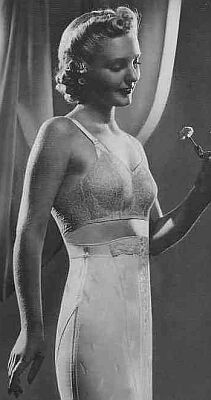
A corsetière in the late 1940's gets her client fully adjusted and measured. A Spencerette for the younger figure.
I then used the measurements to fill out the order form. At this stage there
were all sorts of options I could add to customize the basic design of the
foundation. For instance, I could make the skirt of the girdle longer or shorter
or tighter. I could make the waist higher or lower or tighter. I could add zips
or lacings. I could add boning or an under-belt. On the bra section, I could
select different types of cups and add padding. I could increase the coverage by
lengthening the waist or use a built-up back to bring the bra up towards the
shoulder blades at the back. I could decrease the size of the cups for cleavage
or could increase coverage so the breasts were held immovably.
After the measurement session I described last time, I would normally wait
about a day before I sent the order in. This was because I often received a call
from someone who had had second thoughts on the style of the garment. It is
interesting that she almost always called to order a firmer girdle than the one
she had originally chosen. I think she tended to forget exactly what she looked
like and perhaps thought more control would be better. The other people who
called were mothers who had had their daughters measured. In these cases they
had known from the start they wanted their daughter in a firmer girdle, or in a
corselet instead of a girdle, but didn’t want to argue at the session.
Sometimes they would even call me in advance to tell me that although they had
told their daughter she was being fitted for a girdle they were actually going
to order a corselet or a girdle/long-line bra combination.
The girdle would then be made at the Spencer factory and a few days later my
manager would deliver the girdle to me. It would be time for the fitting. Again,
this could be done at my house or the customer's. Although I tried to make the
fitting session a relaxing experience, the customer always seemed tenser. If it
was a new customer she was worried what her first Spencer would look and feel
like. If it was an old customer she always seemed a little worried about the
fit.
After some small talk came the moment when I would remove the corset from
its covering and the customers got their first look at it. It was interesting to
see the different expressions on their faces. These went all the way from
pleasure and a smile, to a giggle, to consternation or even shock. This was
especially true if a girl was expecting a girdle, and a corselet confronted her.
Or if she had been expecting a light-control girdle and instead saw a rigid
control girdle. With some teenagers I had to leave the room and let their
mothers sort things out.
Most would settle down relatively quickly and I could move on to the next
stage, where I would carefully and slowly show them all the features of the
garment, the various hooks, zippers and laces and show them how they fastened.
Then I would hand it to them and let them examine it, to get them used to the
look and feel of the garment.
Then came the actual fitting. If it was in their home I first had to
double-check that there were no prying eyes or 'little boys' around. Then I
asked them to remove their clothes down to their panties or bloomers. While they
were removing their clothes, I would often remove my dress to point out some of
the features of my corselet and let them see how firmly I was corseted. I liked
to do the actual fitting dressed only in my corselet and stockings. This had a
great calming effect and I think they often became more relaxed with their
garment when they saw the extent of my corsetry, and there was a sort of “we
are all girls together” camaraderie.
I can still remember exactly how I fitted the girdle, as I did it so many
times. First I would sit or kneel down, place the girdle round her and do up the
top hook to hold the girdle in position. Next I would turn her round so her back
was towards me and straighten the girdle, centering it on her body. I would
fasten the back suspenders to anchor the girdle in the correct position, then
turn her sideways so the fastenings were facing me. I would then draw her
towards me, and, keeping my legs together, I would pull her against my knees to
steady her while I did up the hooks from the bottom up, pulling the girdle
closed as I went.
After I had a few of the hooks done up, I would stand up and survey the
girdle and say a few reassuring words. Normally the girdle had to fit about two
inches below the fold where the buttocks met the thighs at the back and had to
be straight on her figure. (Sometimes mothers would want the skirt of the girdle
to extend further down their daughters’ thighs, but I will tell you about that
later.) I would then adjust it by giving a steady downward pull (not a sharp
jerk or she might fall over and we would all end up in a heap of girdles and
stockings), which would settle the girdle well down over her seat and thighs.
Once I was satisfied it was sitting properly on her body I would continue the
fastening. While sitting, I would undo the top hook and finish fastening the
hooks from the bottom up. I could then pull up the zipper to cover them. I would
then turn her towards me and adjust the front if necessary. Last of all I would
fasten the front garters to her stockings.
I was asked if men were ever present at their wive’s girdle fittings. Most
fittings were done during the day, so husbands got involved in the fittings only
if they happened to be at home when I was there. When they were there I liked
it, because it always seemed that I sold the more expensive (firmer control or
with more coverage) when men helped decide on the styles.
We had one style that the women almost never chose, but
was popular with their husbands. This was a corselet that fastened with a
full-length back zipper that ended between the shoulder blades. It was supposed
to be designed so the wearer could unzip it herself, but when the corselet was
tightly fitted, as most were, she was basically trapped until someone decided to
unzip her.
It was a really beautiful corselet made of white or
pink satin, and because it was fastened at the back it had a very smooth line at
the front with bones running full length. It had to be custom-made and fitted
(as all Spencer’s were), because it was of rigid construction with virtually
no elastic. It looked really nice in our catalog, but after it was delivered and
I did the final fitting, many of my customers complained it was difficult to
wear, as it was too constrictive. This was especially annoying if their husband
zipped them up in the morning and didn’t return till late, and the garters
were pulled tight to the stockings. I don’t believe anyone would wear that
type of foundation today.
When
it came to bras (whether it was a regular bra, a long-line or a corselet), the
most popular style from Spencer that I fitted in the early 50’s had rigid,
heavily padded cups. This style was not often featured in our brochures, but was
what women (or their husbands) actually wanted.
When
I fitted a woman or even a teenager, I was trained to ignore the size and shape
of her actual breasts, and instead to design the foundation for the best
possible silhouette. For instant, suppose I measured a young woman as an A cup,
but decided she would look better with a B cup or even a C cup, I would simply
specify that on the order form and the factory would add the appropriate padding.
Sometimes
the customer would tell me how much padding she wanted, but normally it was my
job as a corsetière to give my customer the idealized silhouette she saw in the
magazines. (Note that we didn’t actually use the ABC cup sizes at Spencer in
the 50’s, but you get the idea.)
This
style of bra had a lot more coverage than today’s styles. It showed no
cleavage and held the breasts completely rigidly. The bra covered the breasts so
completely that it was impossible to tell what their real size was. Although
these heavily padded cups did wonders for a woman’s figure, they also caused
some problems. I remember one girl telling me how she had been at a dance when
someone accidentally bumped her breast with his elbow. It made a big concave
dent in her bra and it wouldn’t pop back out. She had a very embarrassing few
minutes before she made a dash for the ladies room and could get her fingers
inside to push it back out!
The
corselet I described in my last note was normally considered too restrictive for
younger girls, even in the 50’s when girdling was common. The only exception I
remember was one of my better customers, who complained her teenage daughter
kept removing her girdle whenever she got the chance. She looked through my
catalog and decided the back zippered corselet would be the answer.
To
my experienced eye her daughter had a good figure, certainly not the type that
needed firm control, but as I was paid a percentage of the sale, and the
corselet was one of our more expensive items, I did not argue. The measuring
session went quite smoothly and I delivered the finished corselet.
I
remember the fitting session quite vividly as the girl later became one of my
best customers and we often joked about her first real girdle (or corselet). I
arrived a few minutes before her, as she had to be excused from school. Knowing
she was late the girl came rushing in skirts flying. She was dressed in her
school uniform, a gray pleated skirt and white blouse. I remember noticing she
was wearing bobby socks, Mary Jane shoes and no stockings. Her mother had her
undress and she was wearing a lightweight roll-on girdle and bra. She removed
these; I unzipped the corselet and held it out so the daughter could put her
arms through the straps. She took one look and burst into tears. Her mother and
I had to persist and persuade until we got it onto her shoulders and smoothed
out in the front. I then zipped up the back. At this stage we managed to get her
calmed down. Her mother produced a pair of dark beige stockings, she put them on
and we attached them to the garters. I remember the stockings were too short and
we had to pull them up as high as they would go. She then put her uniform back
on and we tried her sitting down. She had to practice sitting down very
carefully and to smooth her skirt down, otherwise the tops of her stockings
showed.
She
was sent straight back to school. But this time she moved a lot slower and more
carefully. I guess you could say, more ladylike.
A
number of people have asked me whether my customers were all older ladies. The
answer is yes and no. Although my customers were predominantly older, on
occasions they would bring their daughters to be fitted also.
Now
most people thought that fitting young ladies was a waste. For a start
Spencers’ were more expensive than regular girdles. Secondly, a Spencer was
carefully custom made to the customer’s exact measurements, and was more
rigid. Thus it did not allow room for growth, and young ladies were obviously
still growing and would soon outgrow their girdle.
Nevertheless,
some of my better (and probably more wealthy customers) seemed to think it was
worthwhile. I also got some referrals from other corsetières, as, at the time, I
was the youngest corsetière in my district.
Spencer
did have some designs that were targeted towards younger ladies, such as their
Spencerette. But even this was a lot firmer, and gave a lot more coverage, than
a girl expected. Unfortunately, I have to admit I took on these fittings, as at
Spencer we were paid on a commission basis and at the time I needed all the
income I could generate.
What
was the biggest complaint I got from these young ladies, you may ask. Well the
biggest by far was the length and the tightness of the skirt of a Spencer. They
complained that it made sitting too uncomfortable. I was always very careful
during a fitting to check the Spencer when the customer was sitting down. This
often meant adjusting and shortening the front boning of the girdle to make sure
it did not dig in. So it was not the boning that caused the problem. I suppose
it was just the overall control of such a rigid girdle.
The
other complaint was about the back garters. Although I could order a Spencer
with only four garters, my draconian manager (whom I told you about previously)
always checked my orders. She insisted that all Spencer girdles and corsets be
fitted with the proper and traditional six garters. No exceptions!
It
is true that the back garters were difficult to attach, reaching behind, then
fiddling to get them fastened. But I think the main reason that younger wearers
disliked them was that when the suspenders were done up the pull on the girdle
was really noticeable.
The
time you really felt the tension of the back garters was when you sat down. With
four garters your girdle would release a little as you sat, but when the back
garters were tightly fastened to your stockings that was not possible. Remember
also that in the 50’s stockings did not contain any Lycra and did not stretch
the way they do now. Leaving the back garters unfastened was not too good
either, as they could be very painful if you sat on them awkwardly!
The
biggest complainers were the girls who were still in high school and had to
spend most of their day sitting at a desk on a hard chair. This tended to
emphasize both the tension on the garters, and also the lack of seat room in the
tight skirt of their Spencer girdle.
Talking more about garters: With a regular girdle or corselet the garters were, of course, attached to the bottom of the garment. If the foundation had an underbelt, however, the garters were attached to a loop between the underbelt and the skirt of the girdle. I always found this to be a far more satisfactory technique. This was because the underbelt was much more firmly attached than the outer shell of the girdle, and gave much better anchorage for the garter.
Fitting College Aged Girls
One of the things we had to do as a Spencer
corsetière was always to be on the lookout for new business. To help us,
Spencer had cards printed for us, a bit bigger than modern business cards, more
like an index card with a picture of one of Spencer's nicest corsets together
with my name and phone number and the words "Alison Perry professional
corsetière" across the bottom. These cards were meant to be pinned up on notice
boards. This form of advertising was popular in the 50's. You could pay a small
fee and have them displayed in local shops.
I was hungry for business so I distributed these cards wherever I could. One of
my most successful postings was in the female dorms of our local College. Female
dorms in the 50's were nothing like those of today's universities. They were
definitely totally female domains. No males were ever allowed past the entry
foyer. If a boy came to pick up his girlfriend he had to wait in the foyer
while she was called and under no circumstances was he allowed inside.
Anyway, to get back to my recollections. I asked to have one of my cards posted
on the notice board and I was a little surprised when I got a call the very
next day from a student who said she was interested in a Spencer fitting. Now
you would think that the last thing a liberated girl who has just gone to
university would be interested in would be wearing a Spencer. After all, these
girls had probably just escaped from their mothers' domination and for the first
time in their lives they were away from home and able to make their own
decisions. Surely one of these decisions would be to dress as they liked in
whatever skirt or dress they chose and more especially what kind of underwear.
But remember these were the 50's when fashions were a lot more formal and the
more exclusive colleges had expected dress codes for both men and women to
attend classes. For females this included stockings which inevitably meant a
girdle or suspender belt.
When I met with the girl, it turned out she was not so interested in a corset or
even a custom girdle but it was a custom bra she wanted. She said she was too
flat-chested and her clothes did not fit properly When I asked her to take her
blouse off I could see why. It was not that she was particularly flat-chested,
she was simply wearing a terrible bra. I had to giggle to myself as she almost
looked like the model in one of the awful Spencer ads. Her bra was so saggy and
worn out it was giving her no support at all. I immediately switched to my
professional mode and told I could really help. I told her I would fit her for a
regular bra and also for a long-line bra. I explained that part of her problem
was with her posture. She was slumping her shoulders and a Spencer long-line
would straighten her posture and pull her shoulders back, push her breasts out
proudly and give her confidence in her figure. Then with some professionally
placed padding in the cups she would have a pert firm bust-line that would be
the envy of her friends. I was in actual fact following almost exactly what my
manager had trained me to say.
When I came back the next month with her new Spencer bras and did the fitting,
the transformation was just amazing. Gone was the flat-chested girl with slumped
shoulders and in her place was a woman with the classic Spencer figure with her
breasts pushed up and out and with the stiff padded cups I had ordered. A
perfect transformation.
In
this female dormitory, I had found a lucrative source of customers for my
fledgling career as a corsetière. A group of four ladies all living in such
close proximity to each other and all trying to impress their friends by looking
their best. When I had delivered the bras I suggested that I should measure her
and fit her with a girdle as well. She hesitated telling me she didn't want to
be corseted like her mother so I left it. But sure enough I received a call a
few days later asking for a fitting. When I arrived she told me the reason was
that she loved her new Spencer long-line bra but it was uncomfortable when worn
with her girdle. When she disrobed I could immediately see the problem. Her
girdle was too short and she was having the excruciating problem of
flesh being caught
between the two garments. My new customer was quite tall and was a
perfect candidate for a high-waisted custom made Spencer as it was unlikely she
would find an off-the-shelf-girdle of the required length. I considered her
figure carefully then pulled out one of my favourite samples, a beautifully made
Spencerette. It was an exquisite corset from Spencer's range of corsets
designed for younger customers. Much lighter than a traditional corset and
designed to control and support a younger figure who's body was supple and easy
to shape. I thought it was a beautiful garment with it's satin and lace
embellishments and available in white or dusty rose but not in black as black
would definitely not be allowed for a virgin female. Even if I had put an order
in for a black Spencerette either my manager or the factory would have checked
it against the particulars of the customer and would have rejected the order.
Even worse I would have been disciplined or my commissions frozen as punishment.
If I may digress for a moment, I should mention that Spencer corsetières were
closely supervised. In the 1950's opportunities for women were limited. A girl
could aspire to be a nurse, a teacher or a secretary but not much else. Being an
independent corsetière was considered a privilege and we were closely managed to
make sure we didn't get too many independent ideas. My commissions were managed
for me and money put into a savings account so I couldn't be a silly female and
spend it all. If I misbehaved I could be fined and money taken from my
account. As I mentioned earlier, this discipline extended to a strict dress
code. My Spen-all had to be correctly and tightly laced and perfectly fitted
at all times and anchored securely to my stockings with all six garters. The
slightest movement or wobble of my breasts or behind would result in a new
corset fitting by my manager to give my figure even firmer control. A Spencer
corsetière was supposed to wear severe straight fitted dress, but being younger
than most of my peers I was allowed a little leeway and could sometimes wear a
more fashionable fuller skirt, especially when I was filling younger customers.
Well fitted gloves were also expected, smart slim fitting leather gloves if I
was outside making calls and cotton or satin gloves, dyed to match my outfit, if
I was inside ready for a fitting. I remember becoming quite adept at working in
gloves and it perhaps gave my customers more confidence if I was touching them
with satin gloves rather than bare hands. Jewellery was to be kept to a
minimum. A pearl necklace was acceptable especially when tastefully matched with
a black dress. No bracelets or bangles which might interfere with lacings or
tight hooks. Spencer required an overall professional look.
(It was recommended practice for fitters to
show off their own foundations if required to secure a sale, hence Spencer's
insistence on properly fitted garments - Ivy.)
Getting back to my customer, as she was a student and would be doing a
lot of sitting in class, I measured the Spencerette a bit shorter than normal so
make sitting more comfortable. I also ordered only four garters. I knew this
might get me in trouble with my manager who said all Spencer's should have six
garters, but I knew how uncomfortable the back garters could be when sitting on
a hard chair and how hard they pulled on a girls stockings when seated. I then
discussed the different priced fabrics that Spencer offered. I was very pleased
when the girl told me she would order the most expensive option. It turned out
that her mother had visited and the girl had shown off her new Spencer long-line
bra. Her mother was so pleased and impressed with her daughters 'proper
corsetry' that she had offered to pay the entire cost of any other Spencers her
daughter wanted.
Girdles and Swimsuits
One of the questions from the 1950's is “Did women wear girdles under their
swimsuits?” The answer for many women was yes, and perhaps I can tell you
about my own experience Those of you who remember the fashions of those days
will recollect that the average woman's swimsuits were much fuller coverage and
of thicker material than today's. The material of the swimsuit was not so
stretchy as it is today but they had some rubberized elastic built in to give
them shape. Before I went to work for Spencer I could comfortably wear just such
a swimsuit, but once my body had got used to the ultra firm support of a Spen-all
it didn't react that well to suddenly being unsupported. I thus joined the
legions of women who needed a girdle under their swimsuits.
For once Spencer did not have a specific dress code for swimsuits. Perhaps they
felt their corsetieres would be too busy to participate is such leisure
activities as swimming, or perhaps the average corsetiere was too old, but
either way I was free to chose my own foundation. I remember the fist time I
went swimming after joining Spencer I happily removed my constrictive Spen-all
with all its hooks and laces and put on my swimsuit. I felt great for about an
hour, but then I began to feel this dull ache from my stomach and back and that
strange ‘falling out’ sensation with which corset wearers are familiar. I knew I
was going to need to wear a girdle under my swimsuit.
At this stage I knew there was no time for me to get a Spencer girdle made so I
decided to get one off the shelf from a department store. I had seen adverts
about the new molded rubber that seemed very popular (Spencer never produced a
molded rubber girdle but for a short while they did supply rubber girdles made
from stitched sheet rubber that I described previously). They had displays of
these strange girdles on the counter and you could just pick one out without
being measured by the corsetiere. This was a new concept for me I thought. I
finally picked out what would nowadays be called a rubber panty girdle. A single
piece molded rubber garment with no apparent seams complete with a rubber crotch
which was perforated with a number of holes. I was a little surprised when the
girdle came complete with a small pack of scented talcum powder. The shop
assistant told me in a conspiratorial whisper that this was to help the girdle
slide on easier and also to disguise the rubbery smell.
I took my purchase home. It seemed like the perfect girdle to wear under my
swimsuit; light and very form fitting with no seams to show through. I unpacked
the girdle and was impressed by its cool rubbery feel but was a bit concerned by
the pungent smell. I shook some of the talc into the girdle and rubbed some onto
my thighs then I pulled on the girdle. It was rather tight but as my body was
dry it slid on surprisingly easily. I pulled it up, and the initial feeling was
quite nice; a pleasant feeling of firm control without any of the restrictions
of stays or laces. I had selected the panty style without garters of course, and
it was nice to walk around for a few minutes without stockings or the inevitable
garters flapping against my thighs. I then pulled on my swimsuit and looked at
myself in the mirror. I was impressed. The girdle firmed me up and there
appeared to be
no
sign of it under my swimsuit.
This was wrong as it turned out!
(In those days, swimsuits were often constructed like corselettes, and with their figure forming power too. Spirella’s swimsuits had back zips and even boning. Remember that women were very used to wearing some support in the 1950’s and 60’s – Ivy)
I
thought the rubber girdle would be perfect under my swimsuit. I decided to go to
the public pool and I put on a dress over the swimsuit rather than try and
change at the pool. I was so used to being tightly corseted in my Spen-all that
it felt strange to be out wearing only a girdle and swimsuit under my clothes
and even stranger not to be wearing stockings. It was so unusual not to feel
the familiar pull of my Spencer supplied stockings on my garters and onto the
bottom of my corset as I walked. It was not the front garters that pulled so
much as those annoying back garters with their wide strong elastic. The back
garters were awkward to clip to my stockings and annoying to walk in, in fact I
sometimes think they were designed by the male designers at Spencer to further
subjugate women.
I arrived at the pool and, as it was hot, immediately got ready for a swim. It
took a little while to get my hair clipped and corralled under the mandatory
white rubber swim cap. In the 50's all women were required to wear swim caps in
our public pools as it was claimed our long hair was unhygienic in the pool
water and would clog up the filters. I am not sure that was true but it also
kept the chlorine out of my hair. I noticed as I pulled down my rubber swim cap
and fastened the chin strap that it had the added bonus of masking the rubber
smell of my girdle.
I remember having fun swimming but it was when I got out of the pool my problems
began. For a start water had got inside my rubber girdle and when I stood at the
edge of the pool, the water drained out of the perforations of the crotch of
girdle and through my swimsuit. I was acutely embarrassed as it looked exactly
as if I had an accident. I quickly sat down to sunbathe but as my swimsuit
dried in the sun it changed colour slightly as material did in those days. And
to my embarrassment the suit dried unevenly as part had the rubber of my girdle
under it and part did not, and it was soon clear for all to see that I was
wearing a girdle and exactly where my girdle ended.
A few days later I happened to mention my problems to my manager. She was rather
upset with me and insisted I bought one of Spencer's custom made swimsuits with
built in corsetry from our catalogue. I had been avoiding this as they were
rather expensive even with my employee discount, and gave a lot of control, but
she took the money from my commission anyway so I had no choice. My manager
already had all my measurements and ordered one with extra control features
probably as punishment for my foolishness.
Spencer Under-belts
Spencer offered quite a number of girdles and corselets that came only with underbelts,
and, as all our corsetry was custom made, I could specify that an underbelt be added
to almost any of our styles. Having said this, I must say that an underbelt was
not an option that many women relished. The wearer herself almost never
requested it. Mostly it was a feature added either at my insistence, or at the
insistence of a mother, a husband, or some other person who was accompanying and
advising the customer.
The reason for this was simply that an underbelted girdle or corselet was a
very difficult and controlling garment to wear. In the case of a Spencer, the
underbelt was heavily boned at the back as well as the front. It could range
from about 6 to 10 inches deep and was fixed permanently to the girdle so the
wearer could not remove it. Spencer underbelts were also laced closed under the
girdle to give the maximum control.
Speaking from personal experience I might also comment that it made getting
dressed in the morning a grueling process. When I wore my Spen-All, first I had
to loosen the laces of the underbelt. I then had to place the corselet over my
shoulders and get it into position. Then I had to hook the underbelt up, adjust
its position, then pull the laces until they were completely closed. The
corselet itself was so tight that I could only do it up if the underbelt was
completely closed.
Most
Spencer underbelts were front or side-laced and fitted very snugly around the
customer’s waist, so there was no chance of them moving. Speaking from
experience, I felt it made the garters and stocking more comfortable to wear, as
it minimized the pull on the girdle.
This
method of attachment was, however, predicated on the girdle or corselet having
an underbelt. Although I was required to wear one while working for Spencer, not
many people my age or younger would put up with the extra control the underbelt
imparted to the foundation. So it was mainly my older customers who experienced
the underbelt’s advantages.
Spencer’s
underbelts were stitched securely onto the girdle or corselet. I could order
them stitched to the back, in which case they were like an inner girdle going
completely round the body, or stitched to the sides so they were like a “half
girdle,” to give more control at the front to smooth the tummy. Either way
they were shorter, but more strictly boned, than the outer shell of the
foundation.
As these foundations
were custom made and fitted, there was no need for any adjustment, and if a
customer wanted a less controlling foundation without an underbelt, I would do
my best to sell a second foundation.
It is certainly
possible that some of the senior girls at school in those days were wearing
underbelted foundations. As I mentioned, they were not popular among younger
women, but I did occasionally fit them to girls, normally at the request of
their mothers. I am not sure whether they were always needed for figure control,
but perhaps despairing mothers were hoping they would make their daughters more
refined and ladylike.
Bridal Corselets
Spencer
bridal corselets were our most exciting (as well as our most expensive) items.
They were beautiful corselets made of shimmering white satin and were mostly
strapless. When fitted properly, they could make the bride look absolutely
stunning. They were also among my favorite corsets to fit, and I soon gained a
reputation of being an expert at making brides look their best, so I had many
referrals.
From
the outside, these bridal corselets looked light and lacy, but the looks were
deceiving, and to the bride wearing them they were very heavy and restrictive
and gave the ultimate in firm control. You only had to hug the bride to find how
firmly she was corseted and, when I was present at the wedding, I often watched
some of the male guests holding the bride a little too long while running their
hands up and down her back and round her waist feeling the extent of her
corselet.
These
corselets were cleverly constructed of two parts, an outer decorative portion
sewn to an inner control portion. The outer portion was made of sheer, shiny,
full-length satin panels, normally with no elastic inserts. They were decorated
with frills and lace and gave a perfectly smooth effect.
The
real control of the corselet, however, came from the inner portion, which
consisted of a full-length under-belt constructed of rigid brocade. This
under-belt covered her from her hips up to just under her breasts. It had very
heavy boning and laced up at the back just like an old fashioned corset. The
idea was that all the lacing was on the inner portion so it did not spoil the
effect. The bra portion consisted of strapless cups, which were heavily padded.
I was considered an expert at maximizing a bride’s cleavage to the extent
that, on occasion, I was worried she would 'bare all' during the ceremony.
When
the bride got dressed, the corselet was laid round her body and an assistant
held it up while the inner belt was laced as tight as possible. The laces were
then tied off into a neat knot. The rest of the corselet was then carefully
positioned, her breasts were anchored in the padded cups, and the full-length
back zip was closed. The bride was then effectively trapped in her corselet
until it was unzipped and unlaced. Spencers advertising stated, “With a bridal
Spencer, your bridesmaid zips you in and your husband zips you out” (I always
thought this was rather risqué for the 50’s). White stockings were then
attached and the six garters were pulled taut.
One
refinement I always made (which was not part of the standard Spencer design) was
to add a U-shaped insert to the front of the skirt of the corselet that could be
unhooked and removed on their wedding night. I thought the use of this was
obvious, but some of the girls,
especially those from wealthy and sheltered families, seemed to have no idea
what it was for. When I explained its use to one young bride, she was absolutely
devastated and reduced to tears. In hindsight I think this removable panel made
it too convenient for their new husbands. Wives would sometimes tell me stories
of how their husband loved their bridal corselets so much that they were trapped
in them for days before they would finally release them.
The
bridal corselets were definitely more difficult to put on than regular ones
because of the back lacing and zip. I don’t believe it would have been
possible for the bride to put it on by herself (or remove it either). It was
assumed the bride would have help, either from the bridesmaids or her mother.
In
the 50’s being fitted for bridal corsetry was often quite a social occasion,
and I would often fit the mother of the bride and the bridesmaids all in the
same session. Then, when it was the bride’s turn, there was always a lot of
encouragement from mothers and the bridesmaids to out-do them.
The
bridal corselets looked so pretty in the catalogs that it was easy for the bride
to underestimate the degree of control they gave. I think many of the brides had
no experience with an under-belted corselet. They did not understand how
restrictive an underbelt made the foundation or how tightly it could be laced
until the garment arrived, and then it was too late.
The
painful memories of long hours tightly laced and firmly molded to Spencer’s
ideal shape did appear to linger for a while, but sooner or later many of the
women were tempted to wear them again and they were frequently brought back for
alteration at a later date, by which time I assume their husbands would have
mastered the art of fastening them up.
I
often thought that Spencer made them with back lacing and a back zip to stop the
bride from attempting to loosen the corselet once it was on.
The End of an Era
This
time I thought I would recall some aspects from life in the late 50's towards
the end of my career at Spencer.
As
you know, women continued to wear stockings as normal everyday wear long after I
left Spencer. Many women did not
like pantyhose when they came in during the late sixties, and the long-leg
pantie girdle had come into fashion, which made stockings a little more
tolerable. But then, particularly
in the fifties and early sixties, pants were not worn by many women, except for
when doing practical, domestic or cleaning jobs, and even then, stockings and a
high-waist short girdle were usually worn underneath.
Many
of my customers complained that ready-made corsetry in the 50’s did not fit
properly, was plain, was generally too bulky about the waist, and was
uncomfortable. They wanted Spencer’s tailor-made foundations, which were
beautifully made of satin with lace, and looked so feminine.
Another
big complaint was that bras in the shops were always too big in the width of the
back for a full bust and would ride up all the time, and to get them to fit you
had to buy a size too small, and then they pinched the sides
of the breast.
Fashion
has changed so much over the years; then, as you will remember, the most
desirable look was to achieve ultimate separation of the bust cups, so that the
whole of each breast was fully contained and properly positioned within each
cup, and then lifted so as to totally eliminate any pendulous appearance in the
lower part of the breast.
Spencer’s
cup design maintained a fullness and youthful appearance of the breast in the
top half of the cup. I still remember my customers saying “I want to go in the
right places, and I want to go out in all the right places.”
Corsetry
was rapidly changing by the early 60’s, and Spencer was finding it difficult
to keep up. Only full-figured women
over 25 now wore the corselet, and whilst paneled, they were generally made of
the new flexible spandex. I did continue to fit some women who wore classic
foundations, but they tended to be in their forties.
Another
big change was that the zip almost completely took over from lacing and
hooks-n-eyes. This was a massive change-over in the ten years since I started.
In the 50’s I fitted lace-up foundations and well-boned high-waist
girdles to be worn as normal everyday wear. By the late 50’s pantie girdles
and pantie corselets were becoming popular.
These had a forward-facing hook-and-eye crotch, or were open, or with the
short leg cut for the upper thigh.
It
seemed that some mothers still wished their daughters to grow up quickly,
particularly if they did a lot of entertaining, dinner parties and more formal
events. They wanted their daughters
to wear formal dresses and evening wear when entertaining, so they adopted the
tradition of having their daughter fitted with their first foundations as soon
as they developed their figures, and they would purchase a quality semi-padded
bra and open girdle.
A
good bust was very important, and often a young lady who had not developed by 14
tended to be fitted with a very well-padded bra. Mothers seemed most concerned that their daughters should
have 'a nice full bust', and I often fitted a well-padded long-line bra for a
daughter who was a little small. The bra needed to be a long-line, as the cups
were so well padded that they would not stay in place without a generous
under-band to keep them in place. But this was, by now, the era of the spandex
long-line bra, with front and side boning. The new fabric allowed much more
movement in the upper back and shoulders, and they were popular and reasonably
comfortable, particularly when worn with a cuff-waisted girdle.
This
reminds me of an incident from my times at Spencer. I was the equivalent of a
natural B cup, and when I started with Spencer my first corselets came with
natural cups, and I bought my entire wardrobe to fit appropriately. Every few
months our corsetry was replaced by Spencer to keep up with the latest styles.
Unfortunately, on one occasion while my manager was measuring me, we had one of
our many arguments. When I received my new corselets, not only did they have a
tighter waist, I found she had padded out the bra portion from a B to C plus
cups.
The ideal
image of the day was the shapely woman and both Spirella and Spencer’s
publicity photographs show their
corsetières as being ‘well endowed’. It
would never do for a client to think that Spencer garments diminished the
bust-line!
As
you can imagine, all of a sudden none of my dresses or blouses fitted properly.
All of my clothes were pulled taut across my bust and I had difficulty in doing
the buttons or zippers up. It was an extremely embarrassing situation for the
next few days, until I could finally get them altered.
At
the end Alison echoes the sentiments of so many of us:-
Those
are some of my fondest memories of those days of corsetry, sadly now gone; these
memories bring tears to my eyes.
Questions
Corsetry in bed? A man wrote to me and recalled the stories of young
women wearing their older foundations under their nightgown in bed. Obsessively
(he said), they claimed that it was cold and removing their underwear was a bit
cold just before bedtime. When he
pursued this once as a tease, he got the answer, "you shouldn't ask a lady
so many questions” and "anyway we want to preserve our figures."
It
turned out they were wearing the pink bust-reducing or pink waist- and
buttock-reducing foundations that could be worn as a set to “solve all problem
areas at once.” These were
available in the late fifties and were also often worn as nightwear or at home
as late evening wear under a nightgown or taffeta housecoat. They were marketed
on the basis that "they worked for you whilst you were resting." They
promised to tone the flesh, and the natural rubber lining could be removed from
either cup in the case of uneven breast size, or worn for longer periods at home
in place of the usual bra, if a woman wanted to reduce a heavy bust.
Rubber
“reducing corsetry” has an amazing history right from the invention of latex
until the present day. Currently, the latest generation to sweat through a muggy
day or night in its rubber underwear is the Latin Americans. Our mothers started
it in the late 1920’s. There is another question on this subject later. –Ivy
Long-line bras: A caller described a brassiere as follows “It is
beige and has 7 hook-and-eyes in the back. There is no elastic on this at all,
but looks to be made of cotton. The cups are lacy and have darts in them. The
straps are satin with metal slides. There is a piece of elastic hanging on the
front that has a hook on the end; did it hook to the girdle?”
Although
this one was made in the 40’s, I fitted similar ones when I worked for Spencer
in the 50’s. The seller seems puzzled by the fact that this long-line bra had
no elastic in it whatsoever. I must admit it was not the most comfortable style
we made, and a woman was constantly aware she was wearing it every time she
breathed, but it did give excellent figure control and had hooks to attach it
firmly to her girdle.
Girdles
of the past: Girdles today are a
lot different from those of the 50’s, when I was fitting them. I think it
would be difficult to reproduce the corsetry of the 50’s, mainly because the
type of material is no longer available. Spencers’ were made of non-stretch
material with only the minimum elastic inserts, and were designed so the
women’s body had to conform to the garment rather than the other way round.
That
is what made Spencers so different from today’s foundations. When the
underbelt of the Spen-All corselet I used to wear was laced tight, there was
almost no give in it and my stomach was held as flat as a board. The rigidity of
the upper part of the corselet made me breathe with the upper part of my chest,
and because the cups of the corselet were also very firm, it caused my breasts
to be pushed up with every breath. This “heaving of the breasts” was
considered very seductive and desirable in the 50’s, and the effect was much
sought-after by Spencer corsetières. I don’t think many women today would put
up with this degree of control, except perhaps for special occasions.
The mysterious corset:
A reader describes a corset she found. “I'm
wondering if Alison has any memories of anything similar to a Spencer corset
(way more than a girdle, methinks) like this one which I have in my collection.
The tag reads "Individually Designed" and the Spencer Logo is between
the words. There are only two small stretch panels located at the top front. The
rest of the foundation is of non-stretch materials. Most of the material has a
beautiful stitched leaf and flower pattern. It cannot be opened, that is, it has
no busk. It is laced in the front. To put it on, these front laces must be
loosened enough to struggle into it. The back has two sets of double ½ inch
wide by 22 inch long steel "S" shaped stays, one set on each side of
the spine. They reach from below the buttocks to between the shoulder blades.
Also on the back, toward each side is a set of side by side 1/4 inch wide by 21
inches long stays and each side is another similar set of 1/4 inch wide by 13
inch long stays. The stays go to the top of the corset and the fabric extends
below the stays 1 ½ inches at the center and 3 ½ inches at the side That's a
total of 12 steel stays on the back. The top back tapers to the side to go under
the arms. Approximately centered with reference to the back is a
"flap" 9 inches high at the side and 11 inches high at the front.
There are two more sets of the 1/4 inch stays on each side before a final single
5/8 wide by 10 inch long stay next to the set of 13 eyelets through which the
front laces are strung. That is a total of 22 steel stays. The eyelets don't go
quite to the bottom of this front flap, as there is a buckled cinching strap at
the very bottom. There are two non-removable garters in the rear and two more
just below the eyelets and cinching strap.
In
addition, each side has another "outer flap" that starts from the side
of the rear section and is 11 inches tall from the bottom. It tapers to 7 inches
in height and has seven hooks at the edge. The two side garters are attached to
this "flap."
My
process for putting this on is to first get into the main body, position it
properly, and attach the front and rear garters. This is necessary as, once
laced, I cannot twist enough to work the rear garters. I then pull the laces
closed and pull the cinch closed. There is a loop in which to tuck the excess
cinch strap.
This
next part took me forever to figure out and I suspect that there may be some
parts missing. I use the hooks on the outer flap as if they were eyelets, and
crisscross lace the front as tight as I think the hooks will stand. This turns
out to leave about a 2-inch gap in the front. This flap covers the bottom
portion of the main laces and the cinching strap. With difficulty, I fasten the
side garters.
We
are not through yet! There are straps that attach to the top of main rear stays.
There are several ways they can be positioned. They can be crossed in the rear,
brought over the shoulder, under the armpit, though a vertical loop in the
center of the back, around the waist though two more loops in the front where
they are hooked together and tightened. This can cause a very severe pulling
back of the shoulders. They may also be brought straight over the shoulders,
crossed in front, through the rear and front loops, hooked and pulled tight.
Even with practice it takes me about a half an hour to get it all put on.
So
you ask, what does it feel like? The amazing thing is that it fits me! However,
it certainly is the most restrictive thing I have ever worn. There is very
little twisting of the body possible. The outer "flap" is low enough
that it restricts my stride considerably. It is awkward and difficult to climb
stairs. Sitting is absolutely impossible. Transition from a standing to a
horizontal position is very difficult and returning to a standing position is
next to impossible. So far the longest I have had the opportunity to wear it, is
about an hour.
I
really can't imagine the original purpose or the fitting process. Do you have
any ideas?
After
this remarkably detailed description, Alison replies and I have included my own
thoughts after hers.
The
corset you describe is definitely a Spencer. Although I cannot visualize exactly
what it looks like I remember we had some very rigid models for people with real
(or imagined) back problems.
I
did fit some women in these types of back support corsets with no openings where
they had to squeeze it on. I also used steel stays in the garments, but I never
remember using 22 in a single corset!
I have
seen a few pictures of what I believe the questioner describes. Have a look at
the picture below (with the slightly unfeeling comment added, of course, by my
husband) and regard the lady. She must be wearing something rather similar to
the description. –Ivy
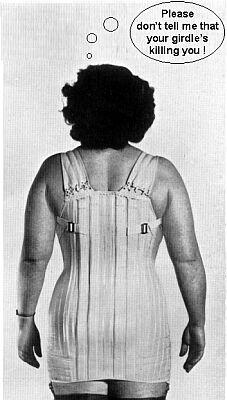
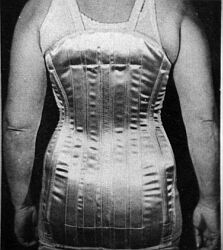
The photograph on the right might have been the same lady as on the left, but she isn't. The lady on the left is a Spencer client in the 1940's and the right hand lady is Norwegian from the 1960's. A recurring theme of the corsetry of this period is that there is no need for a functional garment to be plain. Satin looks pretty, is hard wearing and allows clothes to slide over the garment unimpeded.
Roger
K's Questions
Yes.
I know of a number of instances where youngsters were caught either
eavesdropping or peeping into a fitting session. The reaction of the women
present ranged from anger to amused tolerance. I have been asked whether the
“little boys” were punished by being fitted with corsets, however, I know of
no such case.
2.
Did little girls (under 14) ever attend a session, and what were their
reactions?
In
the 1960’s it was common for daughters to watch their Mothers being fitted.
This would be in preparation for their own fittings to come within a couple of
years. It’s much the same as a Father letting his son drive the family car in
the driveway of the house before being allowed on the road.
3.
When teens were fitted, if it
was their first girdle, did they experience “rite of passage” (“now I’m
a woman”) emotions?
Very
much so. For many girls, stockings, adult underwear (meaning a girdle and
brassiere) and make-up were the defining moments of womanhood. Sadly many young
women learnt far too late that Motherhood is the real defining moment.
4.
Were there any husbands who objected to their wives’ purchases on the
grounds that they thought girdles and corselets were unnecessary items?
Rarely
in the 1960’s and 1970’s. These days, many men object to their wives even
wearing pantie-girdles. Fortunately my husband is not one of these men.
5.
Did the males (some? all?) at headquarters routinely observe models
and/or visiting corsetières in their underwear, as happened when you were modeling your maternity corselet? How
blasé were they about it? (E.g.,
how quickly did visiting corsetières at Spirellas who might never have
“modeled” before adapt to The Male Gaze?
Were there written or customary guidelines for them to observe, such as
Don’t Stare (not to mention Don’t Wink!)?
How blasé were the models and other undressed women there about being
observed by males or being walked around the plant to be checked out—or was
the latter something that rarely happened?
I
never met anybody who wasn’t embarrassed the first time they appeared in
public in their underwear or watched somebody else parade around undressed. Some
of the photographs on my web pages show the various degrees of confidence of the
amateur models. Professional models are, of course, unflappable, but even they
had their ‘first time’.
6.
Were (to your knowledge) many male employees embarrassed about where they
worked? Did other males kid them
about it? Many male employees were
quite coy about their jobs.
Even
when girdles and corsets were widely worn by women, there was always a smutty
undertone to the expression ‘ladies underwear’ which featured strongly in
many of the “Carry On” films for example.
7.
Is there some way to contact former managers at your company and collect
anecdotes from them? They must have
a few dozen interesting tales.
I
have been trying to do this for some years with limited success. So many of the
Spirella employees saw nothing unusual or remotely amusing in their work. I do
have a couple of interesting stories about ******** ******** and *******
*********’s daughter who were regular Spirella wearers, but such confidences
cannot be aired on the Internet.
8.
Did Spirella sell Merry Widows? To
whom, and how satisfied were they with them?
The
nearest item to a Merry Widow that Spirella sold was their Spirelette basque. It
was bought by brides but was such a low volume seller that it was discontinued
in the 1970’s.
9.
How well did “cold calls” go—i.e., calls where you introduced
yourself by saying a mutual acquaintance had given you her name?
Did you get any remarkable reactions from women who refused?
What happened if only a man or child was at home?
Cold
calling was never as successful as a positive recommendation, or better still,
an introduction. If the lady of the house was not at home, the corsetière would
simply leave her card.
10.
How many customers failed to reorder, and why?
Failure
to re-order, which was thankfully not common, was due mainly to the expense of
the garments. Today, a Spencer corset costs about GBP 160. For a widow, that is
two weeks of state pension.
11.
What happened if the fit was badly off, e.g., because a novice corsetière
made a mistake. Were returns allowed?
Returns
were allowed and not infrequent. Sometimes the fitter would be at fault, but
often the client’s whims, or even body size, would change during the weeks it
took to construct the garment.
12.
Was there a repair service? What
were the most common repairs needed? Were
there ever amusing reasons why repairs were needed?
Repairs
were carried out at the factory provided that the garment was returned in a
clean and laundered condition. The most common failure was when the ends of the
bones broke out of their casings. Splits in the material from wearing the corset
far too tight did occur. In the 1980’s there was a disastrous batch of black
orchid material which was not to specification. I tore two (very expensive)
corsets of this material by the simple act of sitting down. Torn seams are very
hard to repair and I only ever got one corset repaired, at my own expense I
might add. Spirella discontinued all black material a few months later. It was a
regrettable trend in the general decline in the choice and quality of materials.
13.
How long did an average garment last?
Did they outlast store-bought garments?
(I read recently that European bras outlast American by 2 to 1, for some
reason.) What failed first?
An
average garment can last from six months to several years. The variables are
regularity of wear, duration of wear, is the garment worn next to the skin, how
acidic is one’s perspiration and frequency of laundering the garment.
Spirella’s girdles definitely outlasted store purchased items particularly
when you consider the repair service. Elastic gets worn but can be replaced.
14.
What was the dropout rate for new corsetières?
Did new (or experienced) corsetières make any embarrassing or amusing
blunders?
The
dropout rate was remarkably low. Many corsetières needed the money and many saw
their services as a social need. Those that did drop out found the rewards poor
(by today’s standards a corsetière earns something less than a chemist’s
assistant).
15.
How long did it take for first-time customers to get used to the
“control” of the rigid Spencer’s? Did
you have to reassure them that the garment and themselves would both get broken
in over time?
The
women that wore the rigid Spencers usually had been wearing all their adult
lives, and so were used to the control. Certainly, a new corset will be like a
new pair of shoes and it does take about a week for corset and wearer to adopt a
comfortable compromise.
16.
Did you need to keep back-up measuring garments, etc. in the trunk of
your car (e.g., in case the customer was very fat)?
A
good corsetière would always try to gauge the size of the customer over the
phone. Even on cold calls, a future appointment would normally be arranged. The
measuring garments were actually very versatile and could accommodate most
frames. Only once did a corsetière of my acquaintance have to improvise with two
measuring garments to circumnavigate a huge client.
17.
Did you ever get a sense of the attitude of sloppy dressers of the time
(e.g., like the wife in “Anatomy of a Murder”) to well-girdled women?
The
attitude was one of jealousy, much in the same way that a plain woman will
criticise a pretty woman for wearing too much make-up.
18.
Did you ever get a sense of what the attitude of your customers was
towards sloppy dressers? Did they
envy them their lack of need for figure control, or look down on them as
slackers, or regard them with indifference?
Indifference,
unless it was a family member when pressure to ‘smarten up’ would be
applied.
19.
Did you ever get a sense of the attitude of your customers toward other
well-groomed women? Did you sense a feeling of camaraderie? (I’m developing a theory that women wanted to look
shipshape, in part, to one-up the male sex and raise women’s status
collectively.) Did you ever sense a
“team spirit” and an unspoken sense of feminine superiority to males in the
realm of clothing, body presentation, and demeanor?
That’s
a complex question that neither I, nor my husband can answer offhand. I’m not
sure that I feel superior when I try to look my best, I simply feel good.
“Roger
K”
“Ivy
Leaf”
Rubber Corsetry: Some of the questions asked to Alison have prompted so many recollections and ideas, that I've moved the topic to a separate page with the idea of developing the entire theme.