Pre-War Spencers

|
Pre-War Spencers
|
|
| The Spencer corset company was formed
in the USA at about the same time as Spirella; we have no exact
date.
In Britain, however, the Spencer company was formed, as an offshoot of the American company, by the exotic, yet latterly reclusive, Dorothea Allen and her husband. They became fabulously wealthy from the proceeds of the corset business. On Dorothea's death, so reclusive had she become, that her estate lay unclaimed for years. She never wore a Spencer corset! |
|
Spencer's Beginnings in Britain (Our thanks to Paul Jones and Alf Woodward (author of Banbury Spencer and the Dorothea Allen mystery) who contacted the Berger family of New Haven, Connecticut.)
On Thursday, January 27, 1927, the
Banbury Guardian included a significant item of news within its pages. “We
are pleased to announce that during the last few days Lucas's Factory (in
Britannia Road) has been sold through the joint agency of Messrs Douglas Young
and Co of London and Mr F.J. Wise of Banbury to the Spencer Corset Company of
America and Manchester”.
The key figure in the preparations for the operation of this factory was Darwin
Spencer Berger who arrived in Banbury from America in February, 1927. He and his
brother George Wendell Berger represented the Berger Corporation and became
joint directors of Spencer Banbury Ltd alongside Robert and Dorothea Allen, who
had previously run the Gaylord corset factory in Manchester.
Within a month of his appearance in the town, Darwin Spencer Berger was making
confident predictions about the future of the company.”We are starting in a
small way and we have every confidence that the future will witness a big growth
here”.
This was what people locally wanted to hear, especially in the light of the
unemployment situation. Significantly from early on there were only two members
of the company's American staff, Frank Howlett and Philip Grillow. The intention
was to train English people to hold responsible positions within the firm.
|
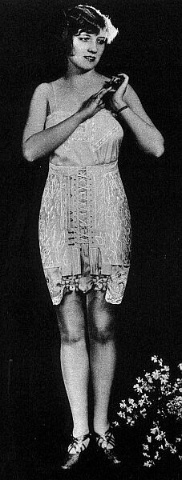
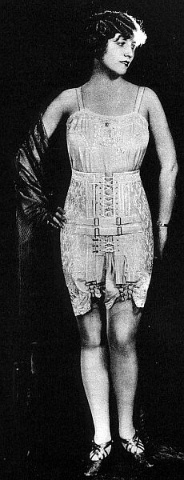
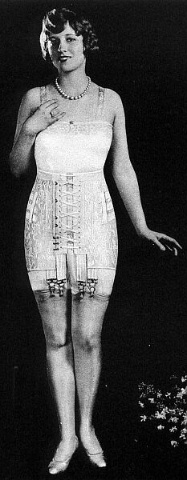
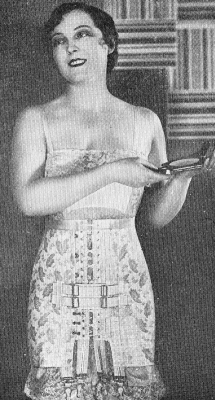
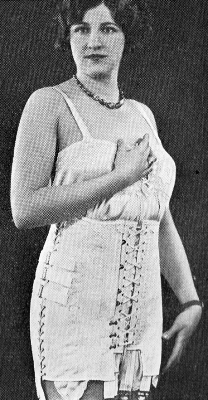
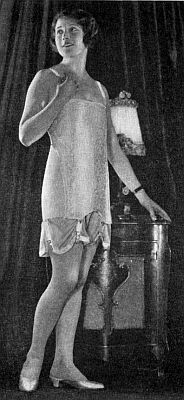
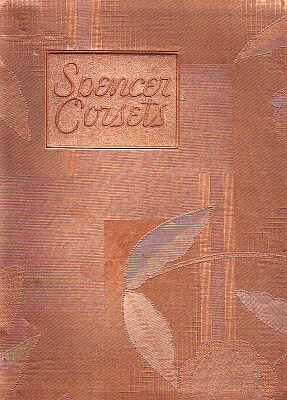
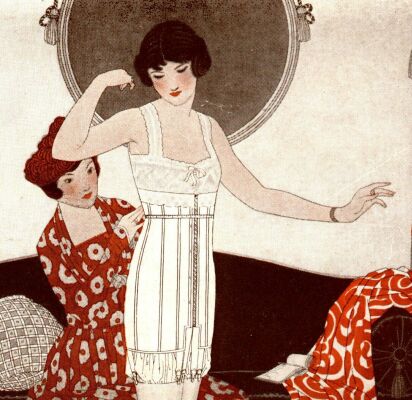
Spencer in the 1920's The photographs here are so tastefully composed, and this was a hall-mark of Spencer for several of the earlier decades. Even the corset catalogues are beautifully bound with coloured prints on the front cover. A guide to dress-making of this era quotes that a corset is designed for three purposes:- 1) to support the figure; 2) to generate an outline on which the dress may be hung; and 3) to hold up the stockings. The last point should not be forgotten and explains the design of the corset and girdle for years before tights became fashionable in the 1960's and the consequent advent of the pantie-girdle. By today's standards, the stockings are very short coming about halfway up the thighs. I have often been asked why the two front sets of suspenders are mounted so close to each other. There may be a number of reasons. Stockings were thicker then and two suspenders offered a back-up should one fail to grasp the stocking. Women with 'tired legs', the euphemism for varicose veins, often wore two sets of stockings, and the parallel suspenders were a convenient solution.
Even as early as the 1920's the Spenall makes its appearance. Note how the bosom has not yet been invented! (Right) Above right are shown three almost identical front-lacing corsets from the Spencer catalogue of 1927, the differences being the under-belt on the right corset secured by three buckled straps on each side. The corsets in the centre and bottom left have the lumbo-sacral exterior strapping. The lady in the middle below sports a maternity corset. In addition to the other trials of pregnancy, Spencer added four sets of lacing, six buckles and the mandatory six suspenders (at least). We may mock from the perspective of 2009, but 80 years ago, women had far harder lifestyles, and the support of such a complicated device was very welcome.
|
|
Spencer in the 1930's
|
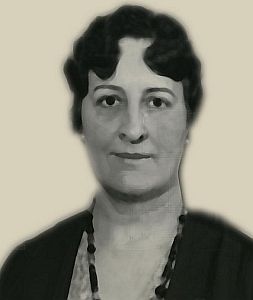
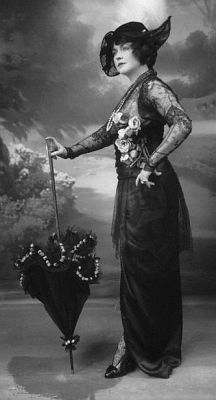
In the late 1920's and 1930's, the social reaction to the carnage of World War I, bought emancipation and a number of women rose to positions of power in the commercial world. Dorothea Allen in England was one and Blanche R. Green (above) was president of Spencer US in 1931. |
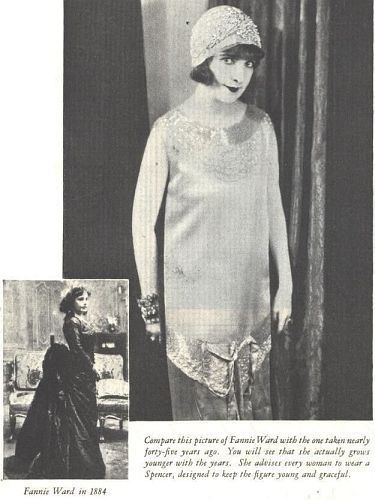
It is often, and incorrectly assumed that this emancipation and the tube-like dress styles of this era meant that women were liberated from the stiff unyielding stays of their mothers. The actress Fanny Ward (right) was born in 1872 at, as a girl in 1884 was obviously wearing severe Victorian corsets as, indeed, her peers would do. In 1929, she wears the cloche hat and tubular drape that had become popular, but despite the unfeminine shape, women still wore foundation garments. In the film 'Thoroughly Modern Millie' (1967), the heroine visits a corset shop to have her bosom (that would be as assets in the 1950's and 60's flattened into the required style. There was serious figure control here, but the emphasis was not on an enhanced waist, but a reduced bust. Spencer uses Fanny as an example of how wearing Spencer keeps you youthful.
|
|
Fanny Ward, somewhere between the periods depicted on the left would have been wearing an Edwardian style corset. |
In the 1930's, foundation garments were as important as at any other period, however, technological advances were making the garments more flexible.
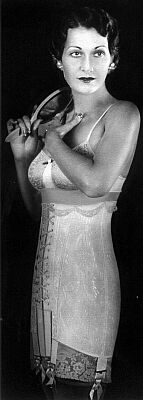
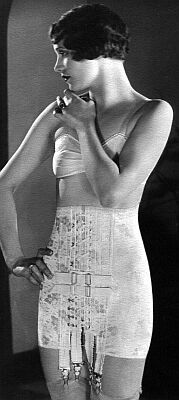
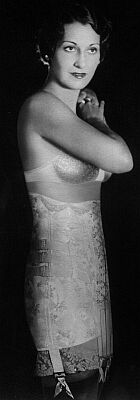
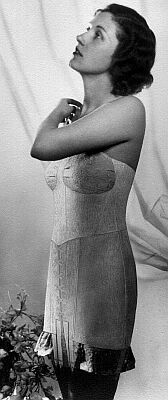

|
The gorgeous cover of the American Spencer catalogue of 1934 |
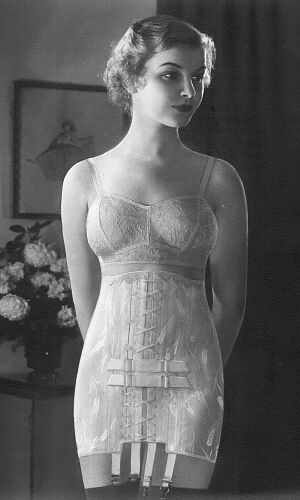
In 1932 (above), the same styles are echoed as in the 1920's. The differences are in hairstyle and the important fact that the brassiere has come of age. Little did the corsetieres of those days realise that the brassiere would become in the 1990's the only foundation that 99 percent of women would wear. Despite the up-market move by Barcley (a breakway from Spencer), these girdles from 1932, with the famous Spen-all (right of centre) are beautifully finished, and although Spencer hasn't gone to the expense of an antique chair, they have retained the bunch of flowers. In 1934, the models and poses are still quite beautifully photographed and posed, however, there is an oddity here. The 'vamps' below could have come straight out of Herman Wouk's 'Marjorie Morningstar' in which "Those divorcees in their tight corsets" look to snare another husband. The innocent flower on the right, however, wears a sacro-illiac corset that suggests that pregnancy is not unfamiliar to her!
|
|
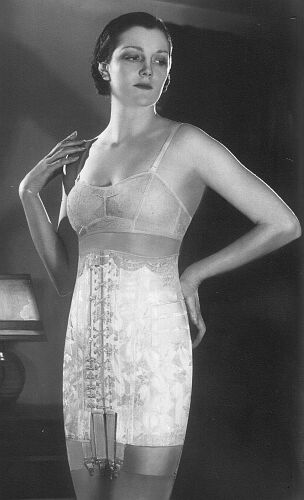
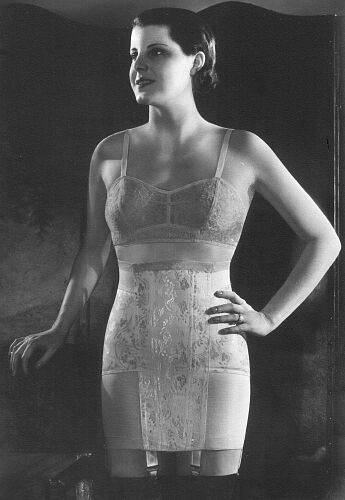
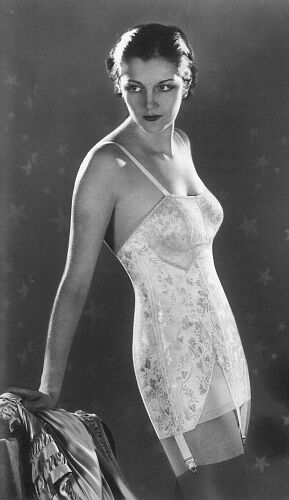
The Style Corset, the Spencerette and the Spen-all are still there in 1934.
Spencer in the 1940's
In the 1940's catalogues, a pink tint is added to the other wise black & white photographs. This lends an air of class and comfort to these products. The brassiere has developed further, although is not strongly advertised. The flowers remain part of the picture, as does the strange Spencer option of four front suspenders. Perhaps it represents a subliminal reminder to both corsetieres and clients that there was no limit to the extent of available options (and of course, the corsetiere's commission).
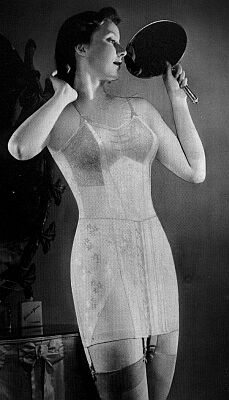
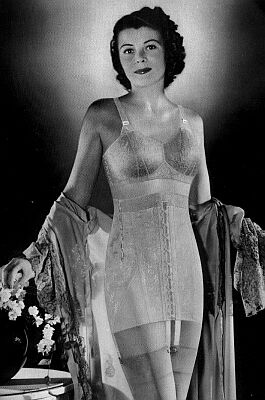
The Spen-all from 1941 and a well-disguised maternity corset. Notice the subtle half length side-lacers. Not only could these be adjusted, but they were made of elastic.
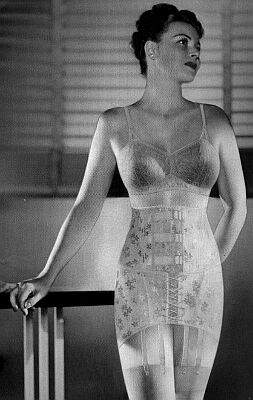
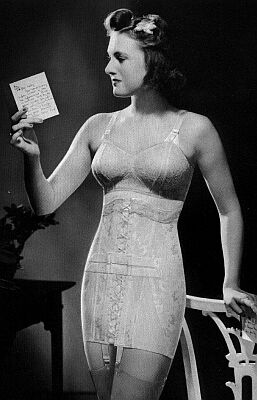
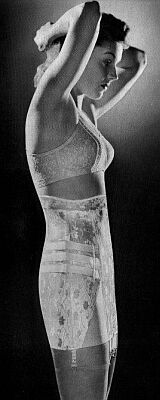
We've seen these corsets for the last three decades now, and the two on the right will be around for another amazing five decades, although by then selling only a minute fraction of their number in 1941.
These advertising pictures were quite expensive to make and some were used for several decades, particularly those portraying the less fashionable 'support' garments, whose wearers would be of an age where their own styles of hair would also come from a previous decade.
In reality, neither the models nor the garments were quite as alluring (although they could be). Below is a series of pictures of a mid-1940's Spencer corset. It is a type that has been worn by thousands of women. The material is relatively plain, the busk front fastening and large hooks date it pre-1950, as do the elaborate suspender clasps. Busk fastenings on conventional corsets lasted until the 1970's, however, the large hooks are largely pre-war or early post-war.
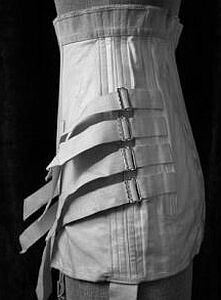
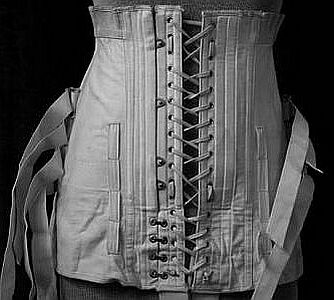
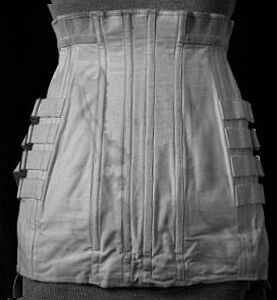
This corset has a number of interesting features. Busk front and large bottom hooks as mentioned previously. The underbelt is secured by four straps on each side; however, the photographer has not placed the belt under the front lacing. All too often the belt is imagined today as some sort of back support. The creases in the lower part of the garment indicate that it has been used as do the bending of the bones at the top of the back. These bones were normally bent before use by the corsetiere. In another photograph, the suspenders clasps are unevenly adjusted, again suggesting use. Oddly, the laces have no spare length for tying. Either the photographer re-arranged them to make the garment appear neater, or the original wearer had lost weight and found that the garment could be opened and closed with the busk alone, obviating the need for daily re-tightening of the garment..
This page has moved to Barcley.