|
The
History of Jenyns
|
The Jenyns corset was developed by Mrs. Sarah Ann Jenyns. A nurse, particularly interested in female welfare, she designed one of
the world's first side-lacing corsets. From Queensland in Australia, she had to
take a ship to Britain to register the patent on her invention! Such
determination, tenacity and business sense saw the foundation of one of
Australia's best-known corsetry firms, that remained for decades, a family run
business. Even during the World War II, corsets were made from army material,
and her son, Herbert,. was canny enough to buy up all the available needles on the outbreak of
war!
The company flourished for six
decades, however, at the end of the 1960's, when corsetry throughout the world
suddenly felt the chill wind of change, the German firm
Triumph acquired Jenyns as it
saw the huge potential of the Australian and Far Eastern markets. Triumph's
advertising in the early 1970's, whilst proclaiming its success, spells clearly
the beginning of the end:- "now the largest producer of bras in the
Australian market." As in Europe, the shelves of the foundation garment
shops would cease to groan under the weight of girdles and corset, and
ultimately be replaced by an anodyne sea of brassieres.
|

|
We recently came across another account of the history of Jenyns which covers
more detail.
JENYNS, EBENEZER RANDOLPHUS (1865-1958) and SARAH ANN
(1865-1952), surgical instrument makers and corset manufacturers, were husband
and wife. Ebenezer was born on 27 July 1865 at Fortitude Valley, Brisbane,
fourth son of English-born parents Joshua Jenyns, grocer, and his wife Betsy,
née Willis. As a young man he was employed by Guyatt & Co., surgical instrument
makers, Sydney. Sarah was born on 1 March 1865 at Largs, New South Wales, fifth
child of Charles Thompson, a builder from Scotland, and his native-born wife
Mary, née Bluford. Ebenezer and Sarah were married with Baptist forms on 5
October 1887 at the Burton Street Tabernacle, Woolloomooloo; they moved to
Brisbane about 1896 and were to have eight children.
|
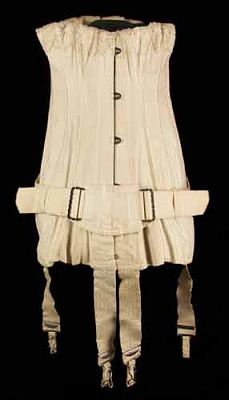 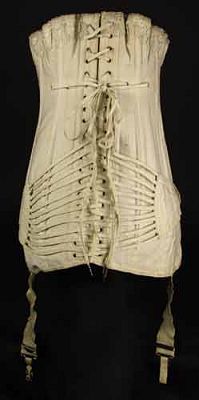
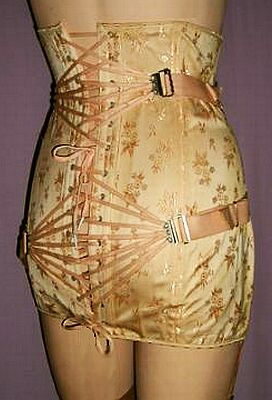
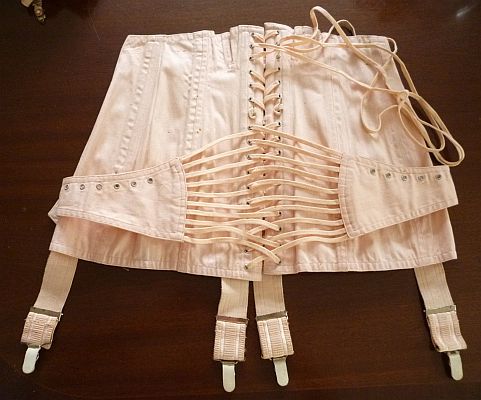
The classic Jenyns fan-lacing corset that appeared within a few years of the
Camp surgical corset |
The family was
poor, at the start. In 1905 Jenyns worked as a cutler, but by 1907 was also
calling himself a surgical instrument maker. With his wife assisting, the
business prospered, operating in 1909 from two addresses in Brisbane, one at
321 George Street. Yet the marriage and business partnership was shaky. From
1911 Sarah independently conducted her own business in George Street, making
surgical instruments, corsets and belts. In 1910-12 she patented a series of
corsets and 'improved' abdominal belts, and travelled abroad to expand her
business. In England she contracted to have her corsets manufactured under
licence by Symington & Co. of Market Harborough, Leicestershire.
She also went to
Canada, the United States of America and Germany, seeking to sell her
products under licence. By 1915, although still running separate businesses,
Sarah and Ebenezer formed the Jenyns Patent Corset Pty Co. to market her
reducing, surgical and fashion corsets, accredited by the London Institute
of Hygiene. In 1922 the firm (also called The House of Jenyns) was
registered as a limited company.
Family relations
became extremely acrimonious in the 1920s and remained so. Ebenezer
continued to direct his own business, extended his field to include surgical
corsets and lodged a patent for 'A Combination Surgical Substitute Corset'
on 24 April 1923. That year his son John acquired Ebenezer's business: he
traded as Jenyns Truss & Patent Pty Co. at 355 George Street, still using
the trade mark of E. R. Jenyns. The split heralded long-term divisions in
the family and its businesses.
Ebenezer
reactivated his manufacturing in 1925 as the Improved Patent Corset
Syndicate. He continued to advertise as a supplier of surgical goods and as
a corset-maker in the 1930s and 1940s, though he was not a success in
business. An active worker for the Young Women's Christian Association and
widely known as an open-air preacher, he was a veritable 'bookworm' and a
formidable debater. He eventually retired to Kuraby. |
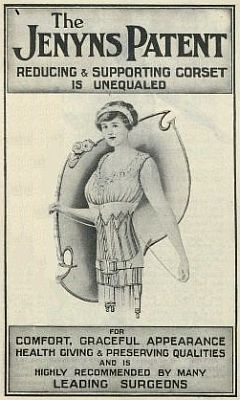
. |
In 1916, having
recovered from a stroke, Sarah had built three-storey premises at 327 George
Street which remained the core of her business. Her son HERBERT, who trained as
a surgical instrument maker under Ebenezer during World War I, joined her about
1920. The business was sound and employed fifteen women. She took control of the Jenyns Patent Corset Co. Pty Ltd and in 1925 bought into another building,
probably at 309-315 George Street.
Sarah continued to
patent improvements to her surgical corsets. In 1928 Herbert, by then the
manager, branched into the manufacture of foundation garments and underclothing.
The firm continued to grow, despite competition in the 1920s from
Berlei Ltd (their main rivals), the
Gossard Co. and Symington.
Jenyns prospered as a
protected industry in World War II, receiving large contracts to supply garments
to the army and navy. In 1946 Herbert became managing director of a new Jenyns
company. Sarah lapsed into senility and was placed under a protection order in
1948. Three years later, in the Supreme Court, it was alleged that Herbert had
unduly influenced his mother to transfer 13,655 shares in the company to him.
She died on 29 February 1952 at Huntingtower, her home at Annerley, and was
buried with Presbyterian forms in South Brisbane cemetery. Her estate was sworn
for probate at £51,001. Survived by five of his six sons and by one of his two
daughters, Ebenezer died on 13 July 1958 at Rocklea and was buried in Toowong
cemetery with the forms of the Churches of Christ. Herbert continued to manage
the company which expanded extensively in the 1960s; he became a millionaire and
a noted yachtsman.
A rather special
tribute to Sarah Ann Jenyns comes from the Queensland Times of 18th July 2104:
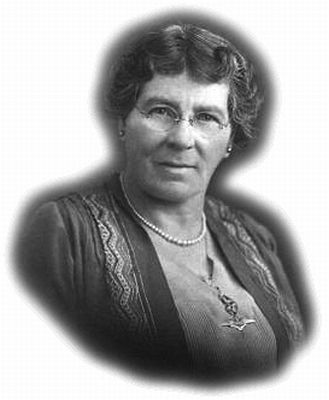 |
Revolutionary, Sarah Jenyns,
had seven children to feed and her husband's
preaching was not
paying the bills. After feeling the sharp pain in her side while lifting
a heavy pail she made it her mission to design a corset that would
support
women’s spines and ease
their back pain.
Using knowledge from her
time as a nurse and her husband's role as a surgical instrument maker,
Mrs. Jenyns pioneered a pain-free surgical corset. From a humble
workshop in Brisbane in 1909, orthopaedic surgeons abroad praised it as
"the best corset the world has seen" three years later.
She had 15 sewing machinists
in 1916 but the House of Jenyns had expanded to 1100 machinists and
seven factories by 1964. Mrs. Jenyns had trouble securing suitable staff
in Brisbane but Ipswich was a fertile place to recruit qualified
workers.
By 1970 all the factories
had consolidated at Ipswich and were creating 45,000 garments a day.
The Ipswich factory shut in
the early 1990s when the once exceptionally popular corsets became
obsolete. Former workers had a reunion at the Ipswich RSL Services Club
on 28th June 2010, two days shy of the 20th
anniversary of the closure of the factory - now being used as a
motorbike showroom.
Sarah Jenyns' underwear
empire was a Queensland fashion success story that lasted close to a
century despite monumental changes to women's fashion.
|
On 17th July 2014,
Mrs. Jenyns’ entrepreneurship was celebrated when she was inducted into the
2014 Queensland Business Leaders Hall of Fame.
Ron Jenyns said that his
grandmother's designs were a major breakthrough in corsets that resulted in
her travelling the world. He said traditionally, corsets were based on
shaped waists and a laced back that meant women needed help to get them on.
"My grandmother developed a new
style of lacing which meant the person could put on the corsets themselves.
They could hook and eye down one side of the garment and take hold of the
belts that would pull the laces tight.”
Mr. Jenyns, who would take the
company to even greater heights after Sarah died in 1952, said he believed
his grandmother’s success stemmed from recognizing that women had so many
different shapes. She created a product that had 12 different figure types.
Whether women were short, tall or had a big abdomen, she had a corset design
for your figure. Before then there was one shape. She eventually patented
these designs and the lacing principle took them out to the world.
Mr. Jenyns said his grandmother
came through tremendous hardships in her early days to lead the family to
business to success. "She had quite a unique personality.
She would have been one of the
first women who really stood up in business and said she could do it. The
struggle of feeding your family when your husband just wants to get out on a
street corner to preach; I think it was that desperate need that drove her.
She was the beginning of three generations of business."
Mrs. Jenyns lived in an era
where there were few women who owned large successful businesses and where
women were expected to rear the children and look after the home. Whilst
achieving the latter, she was an astute businesswoman who had a vision
together with a very strong will and determination. She overcame several
obstacles - including a male-dominated business environment - to reach
success. Her tenacity and determination to help people saw her build a
Queensland fashion empire with an enduring legacy. |
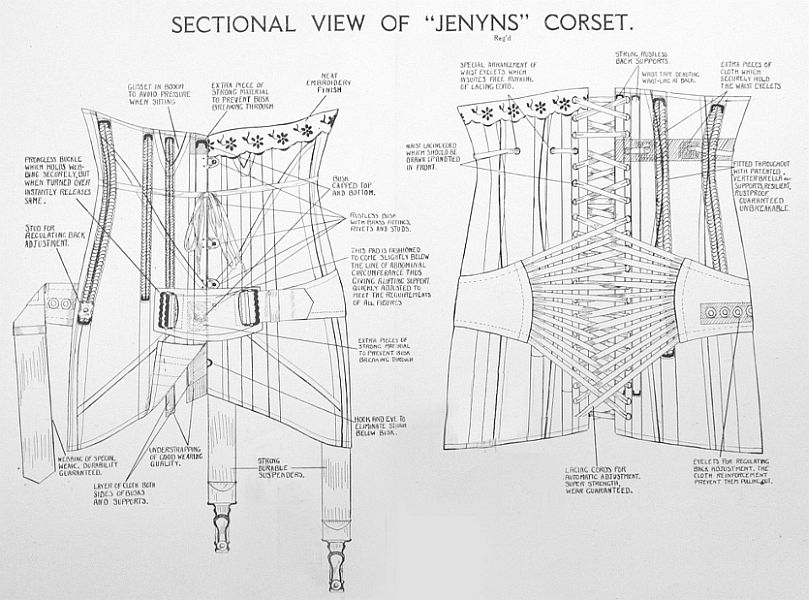 |
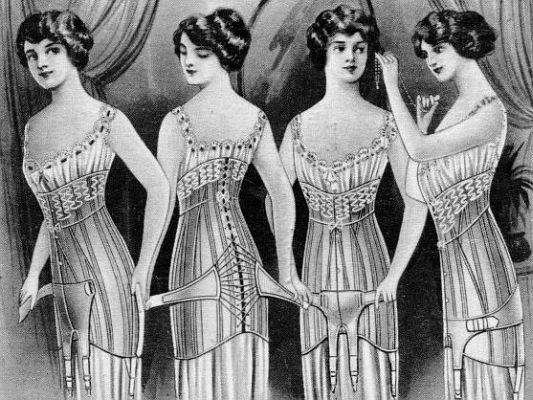
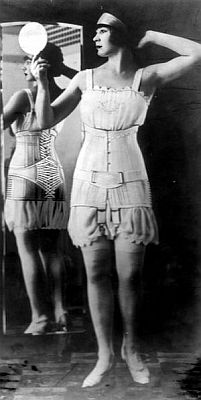
The following articles were kindly sent to us by Pat Jenyns, grand-daughter of
the founder.
|
THE HOUSE OF JENYNS 11-2-1964
Back in 1898 tight lacing was the height of
fashion. Corsets were designed to produce hour glass figures – and women
did not know that in doing so they ignored anatomy, displaced delicate
internal organs and caused considerable ill health.
But there was in Brisbane one woman who did
care. An expert in the making of surgical belts to relieve the conditions
the corsets of the time so often caused. Madam Sarah Jenyns decided that
foundation garments could be designed to relieve backache, improve posture
and alleviate that dragged-down feeling – while at the same time smoothing
the figure into fashionable contours.
Working scientifically from medical
principles, she succeeded in designing a corset that gently reproportioned
the figure into slimmer, more healthful lines – yet had all the supporting
virtues of a surgical belt.
These new supporting and reducing corsets
were endorsed by the London Institue of Hygiene and during the 63 years of
continuing research carried out by the Jenyns company they have become
universally accepted.
Jenyns took pride in the materials they used
and the workmanship that went into their garments. They made other
important advances in corsetry too that the world was soon to copy such as
the method of standardising figure types for the corset trade which is now
used the world over.
The Jenyns organisation have occupied
premises at 321 George Streeet, 327 George Street and 309-315 George
Street. In June 1960 they transferred their production to 194-208 Melbourne
Street, South Brisbane., with an area of 50,000 square feet. .
After negotiations with ‘Leading Lady’ of
U.S.A. and ‘Goddess Co.’ of New York, licences were established for the
manufacture in Australia of a full range of maternity wear and high fashion
foundations. These new lines, with the existing Jenyns surgical and fashion
production, enabled tremendous growth and increased production area was
necessary to meet this rapid expansion, so a new wing comprising another
20,000 square feet was added to the production area.
In 1964 the Jenyns organisation has over 500
employees and is planning further extensive expansion to cope with the
production and marketing of the world’s largest corsetry manufacturers
‘Triumph International’. This includes swimwear, underwear and leisure
wear.
This Queensland owned and controlled company
with sales over $1,000,000 per annum, has demonstrated that Queensland can
market successfully Queensland made products throughout the whole
commonwealth of Australia and New Zealand.
The Board members of 1964 are:
Mr H C Jenyns
Mr R G Jenyns
Mr K H Jenyns
Mr K J Bain
Mr G M E Offner
|
THE CHRONOLOGICAL HISTORY OF THE
JENYNS PATENT CORSET COMPANY
HOUSE OF JENYNS
|
1898
The Jenyns company was founded by Madam Jenyns in Brisbane, Queensland,
Australia
1908 Patented first
improvements in corsets
1910 Added more patents
in supporting corsets
1912 sold patent rights to
manufacture Jenyns Corsetry in England, Canada, France, Belgium, Germany, U.S.A
and New Zealand
The English manufacturer
was granted rights to sell in South America and Africa
1914/18 These were
difficult years because of lost shipments of goods
1916 Moved to new larger
building – 327 George Street. Increased production
1920 A very good year.
Increased staff and production
1924 A difficult year
because of the ‘No bra or corset’ fashion.
1925 A very good year with
bras and corsets in great demand
1926 Jenyns Corsetry was
being sold in every medium and large size retail draper and salon in Australia
1928 The company appointed
Madam Jenyns’ son, Herbert Jenyns, as Manager of the company
1933 The company moved to a
larger building – 309-315 George Street, Brisbane. This move enabled increased
staff and production and sales
1939/44 The company was
declared a protected undertaking, manufacturing 40% corsetry and 60% clothing
for the Air Force, Navy and Army
1945 A very good year of
corsetry production and sales
1946 Madam Jenyns formed
her business into a private limited company. Increased staff, production and
sales followed
1948 Sales were expanded
to New Zealand, South Africa and Pacific Islands
1951 Mr G M E Offner, B.Com.,
F.C.A., who had extensive business association with the company became a member
of the Board of Directors
|
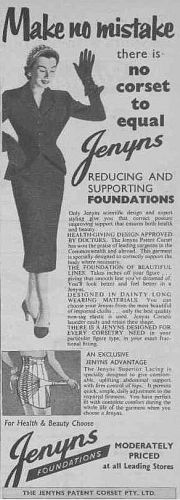
The text is reproduced on the right |
AN EXCLUSIVE
JENYNS ADVANTAGE
The Jenyns
Superior Lacing is designed to give comfortable, uplifting abdominal support
with firm control of hips. It permits quick, simple, daily adjustment to the
required firmness. You have the perfect fit with complete comfort during the
whole life of the garment when you chose a Jenyns. |
|
1952 Madam Jenyns
died.
Mr K J Bain, F.C.I.S.,
A.A.S.A., Company Secretary who joined in 1948 was appointed to the Board of
Directors
1957 Mr Ron Jenyns,
grandson of the Founder, appointed to the Board of Directors
1958 A licence
agreement with Leading Lady Brassiere Co. of U.S.A. enabled our company to
launch Materna Lady foundations on to the Australian market
1960 The company moved
to much larger premises at 194-208 Melbourne Street, South Brisbane. 50,000
sq.ft. capacity
A Licence Agreement
with Goddess of New York enabled the company to introduce to Australia
Goddess high fashion bras and girdles, with great success
1961 Mr KEN Jenyns,
grandson of the Founder was appointed to the Board of Directors
1963/64 Enlarged the
building by adding two new floors – an extra 20,000 sq.ft. of production
area
1964 Signed licence
agreement with Triumph International Overseas Ltd of Munich, West Germany
Leased Plant 2 and
commenced production 1-6-64 8,900 sq.ft. area leased for 5 years with
options
Leased Stoddarts
Building, Sydney and established a large wholesale sales distribution –
14-10-64
1965 Purchased 36
perches in Edmonstone Street, South Brisbane for employees car park –
31-5-65
Leased Plant 3 and
commenced production 1-11-65 7000 sq.ft. area leased for 5 years with
options
Leased Plant 4 and
commenced production – 22-11-65 6000 sq.ft. area leased for 5 years with
options
1967 May 1967
purchased 35.5 perches adjoining Plant 1 – used as car park.
17.7.67 Leased Plant 5
and commenced production. 6000 sq.ft. area leased for 3 years with options
1968 Leased Plant 6 and
commenced production 13-5-68 7100 sq.ft. area leased for 5 years with options
Leased Plant 8 and
established new warehouse 7-10-68 19000 sq.ft. area leased 5 years with options
1969 Leased Plant 7 and
commenced production 11-8-69. 26,300 sq ft area built to our design leased for 5
years with options
November 1969 – company
purchased by Triumph International Overseas Ltd. of Munich, West Germany
1970 Leased Plant 9
Ipswich and commenced production 1-9-70. 40,000 sq.ft. area leased from the
Jenyns family for 5 years with options
|
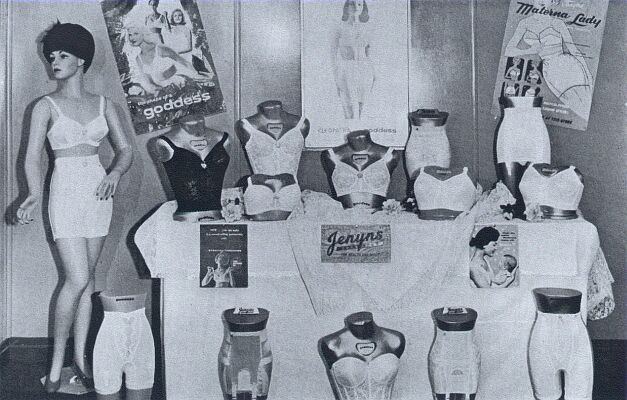
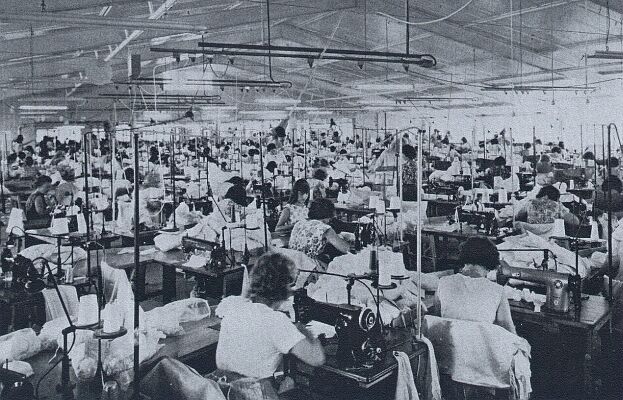
Jenyns' Hey-Day |
From the early 1970's.

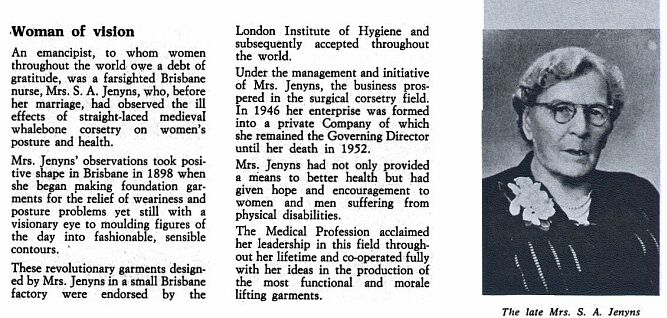
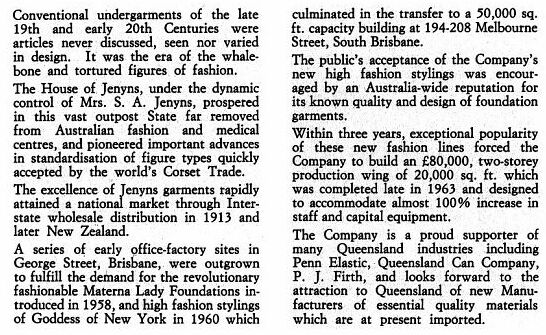
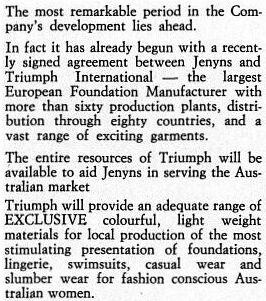
The upbeat message would not last for much longer...
Jenyns Corsets
Let us look closely at two examples of these powerful and functional
garments that were recent acquisitions from an Australian lady. She purchased
them at the closing down sale of a corset shop in 1993.
|
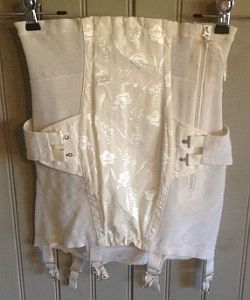
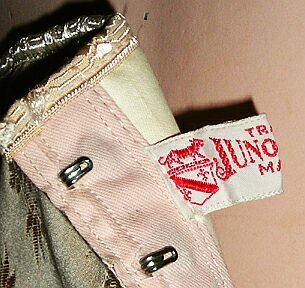
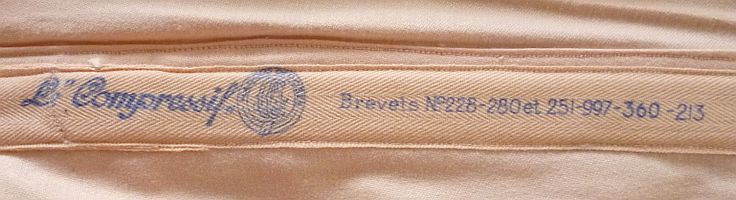
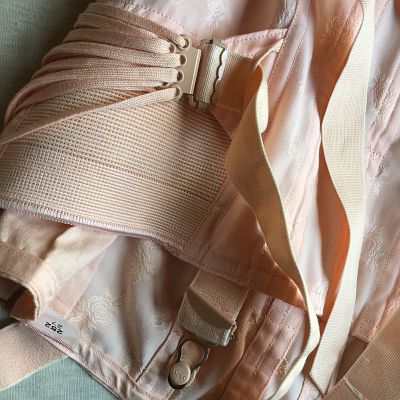
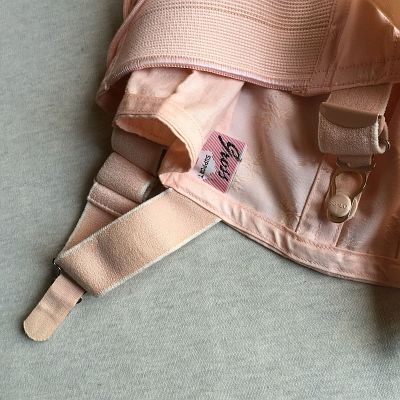
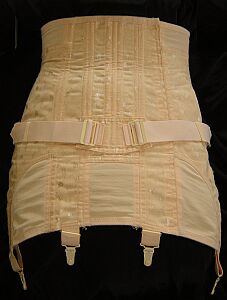
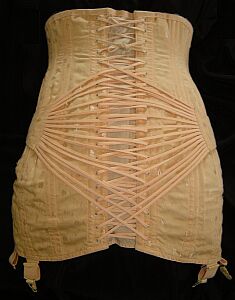
The Jenyns Standard Corset (interestingly, the word
Bryant is hand-written on the label)
Big hip, long meant that the front of the garment
measured 15", the sides, 19" and the back, where the fan-lacing
was placed, 18".
Finished in a pretty brocade, there is no doubt about the
serious intention of this corset. It is the antipodean equivalent of the
'standard' 141 series Camp corset.
 |
|
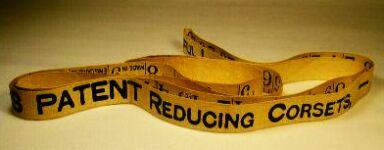
Tape
measure (oddly enough manufactured in London). Jenyns loved the word
'reducing' and used it until their demise.
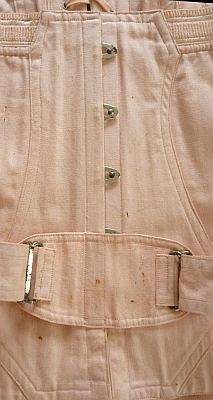
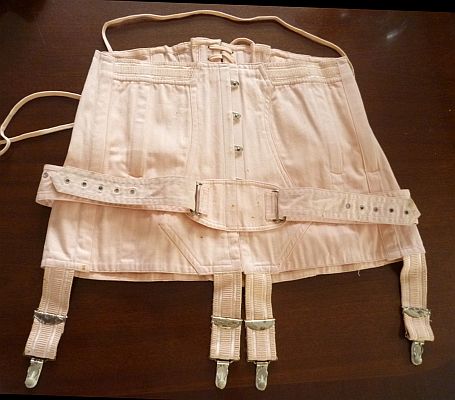
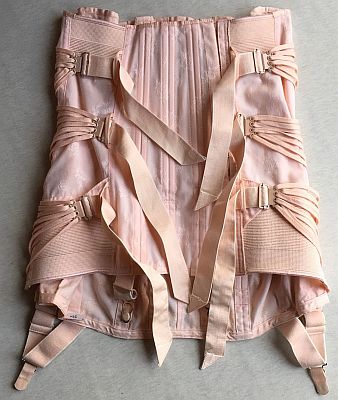
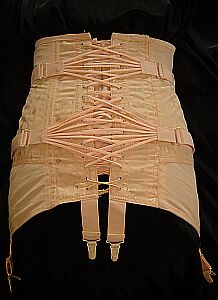
| Jenyns Dorsal Lumbar Support
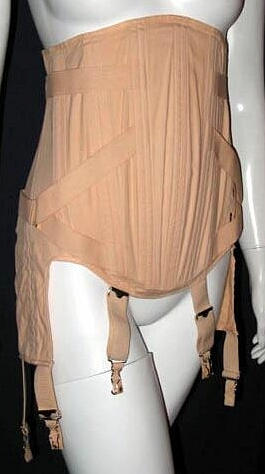
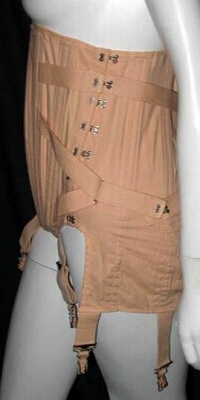
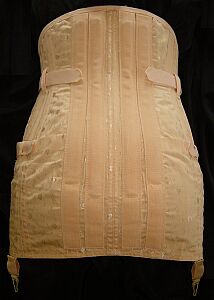
Until I saw this corset, I would never have believed that fan-lacing
ever passed across the stomach, but it does here. The reason is to pull
the four (!) rigid spinal steels encased in their heavy fabric pockets
against the wearer's spine. I tried the corset, which, in all fairness to
Jenyns, was not designed for me. However, as somebody who has suffered periodically from a poorly back,
I felt qualified to give the corset a 'road test' (as my husband quaintly
put it).
This corset is very, very supportive, although it failed to flatten my
abdomen quite as effectively as the standard version. |
|
|
|
|
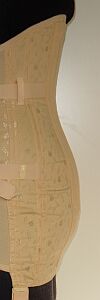
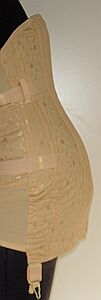
I found that that it felt natural to lean
back ever so slightly into the steels, however, the very long, rigid back,
20", and the relatively short front of 13", revealed something that
has always concerned me about these corsets. If one should one dare to bend forward,
even to the extent of getting into a car, for example, the top of the corset
comes off the spine and is visible to the onlooker as a distinct ridge. Like
many women, I need my underwear, however, I do not want its presence advertised
either visibly or audibly. Again, I must add that had the corset been designed
for me, I would have had the front cut longer above the waist so that the
bending manoeuvre would not be as easy.
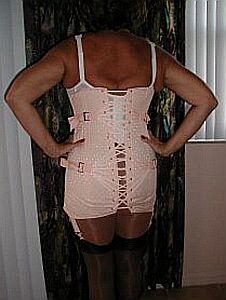
Oh dear. One's corsets should never draw attention to
themselves in this fashion (left).
|
|
|
|
|
It's a shame since Jenyns have gone to considerable
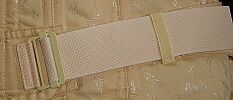
trouble to disguise the straps and webbing that are always a problem
with the fan-lacers. The buckles, and neat little loops ensure that
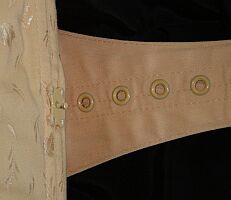
the webbing lies close to the corset. Jenyns' unique way of securing
the straps by fitting a lace-hole over a small spigot sewn to the
side of the corset was innovative and it works.
|
|
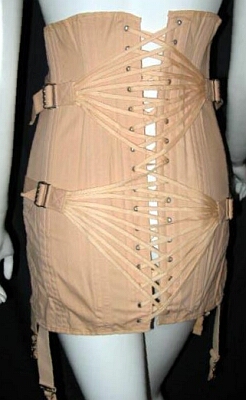
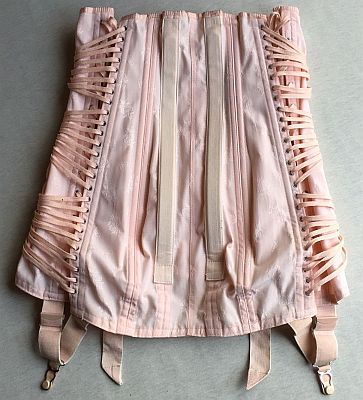
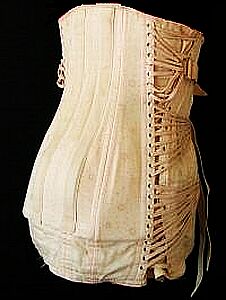
Jenyns Side-Lacing Corset This is an incredibly
powerful garment. The front length is sufficient to avoid the perils
mentioned above. Note the inordinate number of lace holes running the
length of the garment. Jenyns lacked the mechanical pulley effect of Camp and
compensated by sheer number of laces! No problem with the corset length
here. Short corsets were a problem with the latter-day Camps as
inexperienced fitters grabbed what was left on the shelves as the British
end of the company slowly went broke. Invariably, the remaining corsets
were the left-overs, the odd sizes that had resisted a decade or more of
uncomfortable fitings.
Again, the convergent evolution of disparate corset
companies becomes apparent in these Jenyns Orthopaedic supports
(below). |
|
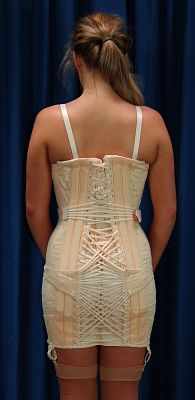 |
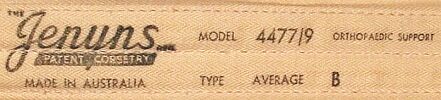
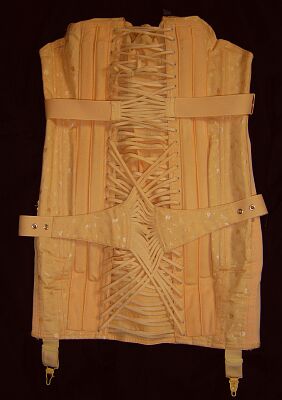
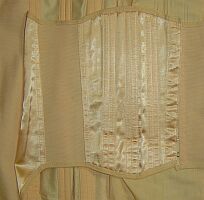
In contrast to Camp's mainstream offerings, Jenyns often
managed to insert just a touch of femininity. The two gratuitous panels of
satin on the 4477 are there, simply to remind the wearer that although she must don the
'contraption' each day (as the old ladies used to call them), at least there
were some pretty female touches. Unlike Camp, Jenyns opts for the front
fan-lacing. Despite their similarities, Camp never used front fan-lacing. I
wonder if there was a Jenyns patent involved?
|
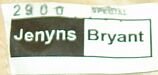
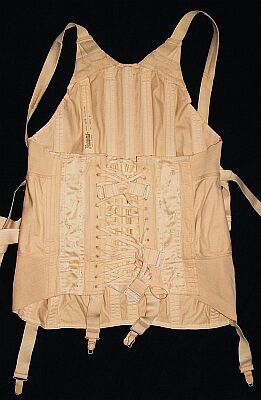
On the outrageous 'special' 2900 (left) that
measures an alarming 23 inches long, the under-belt, once again, is
trimmed in satin. For this immobilising device, Jenyns reverted to
back-lacing.
 |
 |
|
|
The Jenyns Fashion Corset
I'm not sure if this was what the corset was actually called;
the label reads a more prosaic

however, the corset is one of the most beautiful of its sort
that I have ever seen. It showed that Jenyns (and Camp) could produce a serious
garment and yet make it in heavy grade corset satin with exquisite little
touches of lace, and suspender flashes.
|
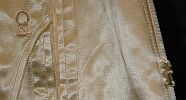
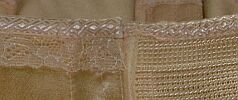
The Jenyns Satin Corset
This surely must be the flagship of the Jenyns corset company. The
corset is made from sumptuous, heavy corset satin of a quality unknown to wearers of modern foundation garments.
Amazingly, Camp (below right) had a similar idea,
but the Jenyns elevates the style to a higher plane with exquisite lace
details, the apron front and the suspender flashes.
These are details that Camp overlooked, although their 'top
range' corset is another stunning example of the corset-maker's craft. The
suspenders on the Jenyns are interesting. The front ones are painted metal
with moulded rubber grommets which come from the 70's or 80's, however,
the rear suspenders, have the traditional metal pin in the centre of the
grommet; a 50's - 60's feature. The garment is completely original and
unmodified. I suspect, that in the 1980's, when Jenyns was sadly in
terminal decline, that the seamstresses used supplies of old stock rather
than order afresh. I believe that the corset dates from the mid-1980's.
This immaculate, unworn example must have been one of the last ever made.
We are very lucky to have such beautiful pieces in the Ivy Leaf
Collection.
|
 
  |
I was corrected
here by none other than Ken Jenyns who visited us in 2010. The elastic on
this garment is from the 1950's having a high latex content. It may be
that the owner replaced the front suspenders for a flusher, newer design.

The Jenyns corset modelled in 2013 by members of the
calendar team. Three Jenyns and one Camp. |
At the Melbourne cup in the
1960's and 1970's, many a flat stomached matron owed her remarkably good figure
to these wonderful corsets. When jet travel to the Antipodes became more common, a number
of these corsets found their way back to the old country as Grandma, returning
to Bexhill with fond memories of her offspring and a token Koala soft toy for
the mantelpiece, would also be carrying a few years' supply of Jenyns,
definitely not for display!
The Demise of Jenyns
|
Jenyns
lasted for over a century, however, as with all the corset houses, the
gradual decline set in toward the end of the 1970's. In 1969 as
mentioned above, Jenyns was bought by Triumph and became The House of Jenyns,
Triumph International. The company appears to have continued the
traditional Jenyns line but with some diversification into medical
products as well. |
 |
|
In 1992, I suspect things were not going well and Triumph decided to sell the
venture. It was split into a medical products company Jenyns Pty Ltd., owned by
Ken, Pat and Julie Jenyns, and a specialised surgical corset business, Jenyns
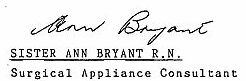
Bryant Surgical Corsetry Pty Ltd. The name Bryant comes from Sister Ann Bryant
who negotiated the release of the surgical corset division. Some corsets from
this period have the label Jenyns with a hand-written Bryant added afterwards!
 |
|
It seems that this move was
simply a delay of the inevitable. I have letterheads dated 1989 displaying the
logo Jenyns CAMP, suggesting that the successful European company that had
managed to struggle on making similar corsets took a part of Jenyns, however,
this is not the case. Jenyns simply sold CAMP corsets. Rather like Spirella and
Spencer in the 1980's; there was simply no room in a diminishing world market
for two firms competing in the same diminishing market. Jenyns' catalogue of
1994 speaks of Jenyns-Camp and features as many pure Camp corsets as Jenyns
corsets.
|
 |
Jenyns and Camp in the late
1980's
|
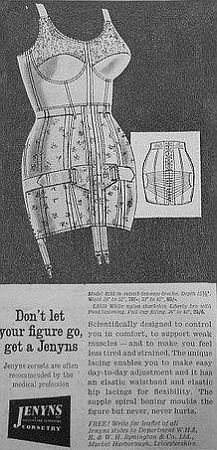
A rare advertisement from
Britain in the 1970's shows that Symingtons of Market Harborough were trying
to sell these corsets. I doubt if they succeeded. Camp had the niche-market
for this unusual garment and I've never seen any sold in Britain. |
|
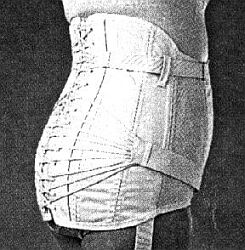

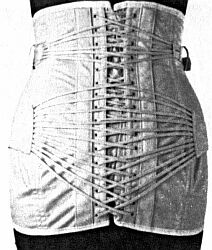
The apparent similarity of Jenyns and Camp
products as seen from their 1994 brochure. The lacing systems are, however,
quite different.
Jenyns brochures were
now poorly photocopied and bound lists. Shops ended up stocking whatever sizes
remained on the shelves, and these are inevitably the less common sizes. Prices
went out of control, and the elderly pensioners could no longer afford their
means of support. Old
women desperate to replace their ageing underwear would grasp at any, even
ill-fitting examples, and a vicious circle of decline was inevitable. The last
Jenyns corsets were sold as the century came to an end. We even have invoices
from 1998, one apologising for supplying the wrong size!
What happened to the life-long wearers of Jenyns' amazing foundations? There was
no alternative the way that bereft Spirella wearers could turn to Spencer in the
late 1980's. Did they sit down and weep for a lost cause? Not all all. Typically
of the 'frontier spirit' and 'can do' mentality of the hardy Antipodean
there remain to this day, a few die-hard
women in Australia, lovingly repairing and caring for their Jenyns corsets in
the hope that they'll both see out their time together.
What an example to us all! |
Letter from a Jenyns Wearer #1
Your site has brought back many
memories from during and after the war years in England. Sad to say, but in
Australia where I now live, those days are long gone, although I do know a
couple of women who still wear Jenyns surgical corsets. They wouldn't do
without them, but on days like today when it is so hot (38 oC Dec
2005) they do suffer. Jenyns have now gone out of business, and at the end
were basically surgical suppliers.
One of the ladies is a Miss H., who is 83 years old. We
had quite a chat recently and she invited me to visit her, as she had some
Jenyns catalogues to pass on. I met up with Miss H. yesterday at her home.
She is a very pleasant lady and made me most welcome. When I arrived the
front door was open, I rang the bell and she called me in. She was sitting
at a large table in the lounge which had on it five or six old Jenyns
corsets and she was re-lacing one of them in the hope that she
would have at least one that she could use. She had been working for hours
on 'the darn thing’ as she put it. She had started wearing corsets just
before the war after a riding accident and had worn them ever since.
For such a lady, who has worn
corsets for over 65 years, it will be impossible to do without. Sadly, the
manufacture of corsets is dying out as the profit margins have long gone.
Maybe with a burgeoning older class of 'baby boomers' this loss of knowledge
may yet turn out to haunt us. - Ivy.
Letter from a Jenyns Wearer #2
As a long time
resident of Brisbane (eighty years and counting!) I was delighted to read your
well informed article on the Jenyns company. My sisters and I bought our corsets
from their Fortitude Valley Outlet for almost half a century until they closed a
few years ago (was it really as long ago as 1993, as your article states?) I
suppose I am one of your few die-hard women in Australia , lovingly repairing
and caring for their Jenyns corsets in the hope that we will see out our time
together!
Contrary to popular
belief, Australia was until relatively recently a very old fashioned and
straight laced place. We were always taught there was absolutely no excuse for a
lady to not to always look her best and firm foundations were accepted as a
natural part of life. Australia liked to think of itself as the best corseted
country in the world and until the 1970s even the slenderest of teenagers wore a
zippered step-in, and their mothers something rather more substantial. Firm
corsets, along with hats, gloves, stockings, full face make-up and a smart set
of dentures were seen as a natural part of an adult woman’s engagement with the
outside world!
I obtained my first
Jenyns shortly after the war when I commenced work at David Jones (a well known
department store in Brisbane ). We wore rather slim fitting black skirts and
blouses in those days, and decent foundations were a must. A great deal of
standing up was required, and a few years later I moved up to the Dorsal Lumbar
Support. You are correct that when leaning forward an unsightly and rather
draughty ridge appears. Rather than be greeted with my friends sing-song “I can
see your corset”, It was soon retired to the back of the drawer!
I have worn the
Jenyns Side-Lacing Corset since the mid sixties, which although heavier, gives a
snugger fit and is generally more comfortable and quite easy to put on.
They often came without suspenders, which you bought from Woolworths and sewed
on yourself
The standing up all
day meant that by my late twenties support stockings had become a fact of life.
Surgical stockings seemed to be fairly common in the decades after the war, and
they were not particularly frowned upon, although at David Jones they did expect
you to put something more fashionable over the top. If this was required, one
needed two sets of suspenders, as the two pairs of stockings were seldom the
same length or weight. You either sewed on extras, or wore a suspender belt or
corselette over your corset
I still own six
wearable Jenyns corsets, plus two
Spirella corsets I bought while on holiday in England in the
early
1990s, none younger than a decade! How nice it is to think that some things are
made to last
In
another letter, she elaborates on her first corset experience.
I remember very well
my first corset. I the week before I left school and started at David Jones, we
rode on the tram from Wooloongabba to Fortitude Valley (both inner city suburbs
of Brisbane ) to the Jenyns outlet. I was fourteen and until then had worn
liberty bodices and knee high socks for both school and home, but it was time to
join the “grown-up word” of corsets and stockings
I distinctly remember
being lead by the hand into the cool, rather dark interior of the shop, and my
mother telling the corsetiere she wanted me measured for “ a standard fan-laced
corset". After the measuring, the trying on, and I remember the hard, grippy hug
of that first corset and the rising thrill as I watched its effect in a
full-length mirror. My torso kinked dramatically into my waistline, my spine
straightened and stretched, I lifted my chin in an automatic counter-reflex. I
metamorphosed from podgy 15-year-old girl to tall, shapely woman. All
the parts of me that I did not really like, suddenly moulded into this lovely
adult, shape.
Regarding who wore
what when, Australian women tended to stick to what they started with, so my
mother, who lived to be 103 and only passed away in 2005, wore her entire life
the “Warner’s Rust Proof” Corset she was first introduced to as a teenager. Her
corsets must have been very old by the end. I similarly have stuck with the
Jenyns side-lacing corsets that I had adopted in the mid fifties
Australian women from
the generation behind me favoured the all-in-one foundation, a combination
of brassiere and elastic corset introduced in the thirties by Warner’s with the
introduction of the two-way stretch material. By the late fifties, many younger
women were wearing girdles that were constructed out of rubber elastic and the
newer stretch net fabrics in rayon or nylon. The different types were:-
Step-ins - zippered or
laced girdles.
Roll-ons - all-elastic
tubular girdles that were rolled on like a stocking.
Pull-ons - tailored
girdles elastic enough to pull up like a pair of briefs.
Wrap-ons - which
opened out fully like corsets and were closed by hooks and eyes.
My husband was British
and I did spend several years in the UK in both the fifties and seventies.
Australia , in those days was several years behind the times in terms of
fashion, and Queensland , which was very conservative and rather puritanical,
was several years behind the rest of Australia ! I think corsets were more
greatly used, and for longer than in England, and for any family that liked to
think of itself as middle class, strict corseting was seen as a sort of status
symbol and mark of respectability. Certainly, I remember once at a genteel
County Woman's' Association tea party, while the Lady Mayoress gave a speech, all
I could hear in the background was the whirl of the fans and gentle creaking of
many corsets!
Because of the
conservative nature of Queensland , mini-skirts and trousers were never thought
appropriate, and subsequently, panty girdles and pantyhose caught on much later
than in England – perhaps not until the mid-seventies, and not at all among
women above middle age. Pantyhose were viewed with suspicion, and the general
belief (not always wrong!) was that they would not stay up on their own – I
remember my husband offering me a pair of his braces if I wanted to try them!
Young women seemed to
have abandoned shapewear altogether after around 1980, although in recent
years, the shops seem to be full of “miracle suits” – very high wasted, long
legged panty girdles, almost like bike pants, and I understand they are very
popular.
In the days before air
conditioning, Brisbane summer heat was oppressive, and (strictly in the
seclusion on ones own house, and seldom in the presence of company) you did your
housework in nothing but your slip/petticoat and your corset. It was not an
uncommon site to see a neighbour pinning out her washing dressed in a bright
salmon “passion killer”, but that was never considered “quite the thing.”
Although there are
many good brands in available in Australia, my sisters and I always bought
Jenyns, as they were a Queensland brand, and Queenslanders patriotically like to
support their own. My daughter, on the other hand, has always worn an
open-bottomed corselette, and I don’t believe my granddaughters wear very much
at all, unless they are dressing up for the races!
As for me, I am sticking to what I know – my
corsets are for people who like to look like people.
|