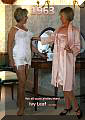
Girdle Memories From Growing Up in the 1960s
Part One - In Public Places and in the Office
Growing up in the Midlands in the 1960s, the world felt very different from today—almost like another country entirely. Social rules were looser in some ways, stricter in others, and the things people discussed openly would raise eyebrows now.
I can still remember bus and train journeys where women would chat freely and loudly about their girdles, as though they were discussing the weather.
“Oh, it was a struggle to get mine on this morning,” one would sigh. “My new one really pinches—I hope I can stand it all day,” another would reply.
Once, an older lady joined in with great authority. She described her girdle as her “armour,” explaining how she had to lie flat on the bed while her husband fastened her into it that morning. She told the younger women they had it easy nowadays. No one lowered their voice. No one seemed concerned that young boys, husbands, or complete strangers were sitting within earshot. It was simply part of everyday life.
The school gate was another location for girdle talk as the mum’s waited for school to end. I heard a few mums say that they enjoyed the sensation of being held in by their girdles and in control and they felt more comfortable wearing them than not when on the school run. Once or twice, I remember one of my teachers joining in the conversation with the mums at the school gate in front of all the children. She was in her 20s and wore multi-coloured Mary Quant mini-dresses and multiple rows of glass bead hippy necklaces. Under all the 1960s hippy chic she announced that she favoured the new style panty girdles as they gave her freedom to bend over in class in her mini skirt. However, sometimes with all the talk of pinching, lacing or breaking in it was sometimes hard to work out if the conversation was about shoes or foundation wear.
One story has always stayed with me since the early 1970s.
My aunt, newly divorced and determined to rebuild her life, returned to work once her children were at school. She became a sales office manager for a wholesaler of electrical equipment—long before the internet, when business depended on daily calls, handwritten orders, and face-to-face visits.
Her sales team consisted of several attractive young women, known rather cheekily as the “dolly birds.” Their skirts were short, their dresses fashionable, and their platform shoes impressively high. Makeup was carefully applied, and perfume generously spritzed. Presentation mattered. Their clients—purchase managers at large firms—were almost always middle-aged men, and appearance was considered part of the sales strategy. Dressing smartly, even provocatively by today’s standards, helped secure appointments and, ultimately, orders. The girls all smoked back then and there was an unwritten rule that if a client offered one of them a cup of tea and a cigarette in a meeting they must accept even if they had just finished one earlier. Smoking was part of the job description!
One weekend, while we were visiting my aunt, she shared a workplace incident with my mother and me. My younger sister was there too, though she was too young to grasp the conversation. I, however, listened carefully.
One of the saleswomen, though young and pretty, had a noticeable tummy that showed beneath the waistband of her skirt. My aunt had called her into the office one lunchtime and asked her directly if she was pregnant. The young woman, somewhat indignantly, replied no—she was “on the pill.”
My aunt told her, quite matter-of-factly, that she needed to wear a firm girdle when visiting clients, to present herself at her best. But the young woman flatly refused. A week later, my aunt called her in again. This time, her tone was firmer. If she chose not to wear a supportive girdle, she would be reassigned to an office-based, non-customer-facing role. It would not be a demotion in title—but it would mean losing her commission from sales visits.
Faced with that reality, the young woman tearfully relented. She agreed to buy and wear a girdle and, somewhat dramatically, announced she would go on a black coffee and cigarette diet. In those days ladies with ambitions in sales had to wear a tight girdle like it or not. There was no emailing HR to complain about body shaming and bullying behaviour back in those days. Ladies had to pull on their big girl girdles and step up to the job.
What strikes me most now is not just the incident itself, but my mother’s reaction. She was not shocked. Not outraged. Instead, she fully supported my aunt.
“She handled that very well,” Mum said approvingly. “That haughty young thing needed taking down a peg or two. She should wear a sensible girdle like the rest of us.”
At the time, no one questioned the fairness of it. It was simply how things were. Appearance mattered. Expectations were different. Standards—particularly for women—were rigid and rarely challenged. Looking back now, it feels almost unimaginable. But in Britain in the early 1970s, this was ordinary life. And that, perhaps, is what makes it so extraordinary today.
Part Two - Standby for Action - Girdles are Go!
After finishing the first part of my story, a few more memories drifted back to me from the 1960s—true stories from a time so different they now feel faintly unreal. They belong to an era of coal fires, milk bottles left on doorsteps, and, most curiously of all, girdles drying in plain sight.
After school, I often went to a friend’s house to watch Thunderbirds or Stingray. The television flickered in the corner while, directly in front of the gas fire, an airer stood open like a small metal tent. Draped across it were formidable items of foundation wear—beige, elastic, industrial-looking garments that seemed designed less for comfort than for containment. They steamed gently in the heat. No one found this odd. It was as ordinary as the smell of toast or furniture polish.
One afternoon, at a neighbour’s house, my friend’s mum came into the lounge while we were absorbed in the latest puppet-based peril. Without ceremony, she positioned the airer squarely in front of the fire and carefully draped a freshly washed girdle across it. She stepped back, assessed her arrangement, and asked politely whether it blocked my view of the television.
I assured her it did not.
“Good,” she said briskly. Then, as casually as if discussing the weather, she added, “Don’t worry if you hear screaming in the morning as you walk past the house. I’ve given it a hot wash, and it may have shrunk. Might be a bit of a struggle to fasten.”
I was about seven years old. I had no idea why I required this information, nor what I was meant to do with it. Perhaps she imagined I would carry the news home as a kind of neighbourhood bulletin. I heard no screaming the next day, but on the walk to school I saw her at the gate, patting her impressively flat stomach with both hands, glowing with quiet triumph. Whatever the struggle had been, she had won.
Another memory concerns a different school friend who lived with his mother and grandmother. My mum and his mum had been school friends, and they would sit with coffee in the front room while we boys played board games on the carpet.
One afternoon, his grandmother began recounting the previous Sunday. It was summer, and she had worn her best girdle to church. The intention she explained was to endure it for a respectable two hours. But after the service, before she could escape home and unhook herself, her daughter, grandson and son-in-law—home on leave from the army—bundled her straight into the car for an impromptu picnic in the woods.
By mid-afternoon, fortified with sausage rolls and warm lemonade, she found herself in difficulty.
“I could barely breathe,” she said gravely. “I had to take it off.”
Fortunately, they were deep in the countryside, with not another soul in sight. The girdle—surely a marvel of 1960s elastic engineering—was wrestled free and discreetly tucked into the folds of the picnic blanket. She told no one. But when they packed up and returned home, it was gone, abandoned in a clearing among ants and pine needles.
She insisted she was not especially distressed at losing it; it had been, in her words, “most unforgiving.” What horrified her was the thought of children discovering it.
“Just imagine,” she said, lowering her voice, “some young boys and girls tying it to a lamp post and dancing round it like a maypole.”
My mother responded with a thin, strained smile. Her lips tightened, her eyes cooled. I knew that look. It signalled disapproval of the highest order. “Just a small slice for me” she replied whilst patting her tummy when offered some cake “my bones are a bit nippy today”. She had made her point to everyone in the room. Ladies who guzzled lemonade and scoffed sausage rolls got what they deserved. Her girdle might have been a bit nippy but it showed she exercised admirable self-control and restraint and that she was justifiably proud of her figure. She didn’t need to elaborate. Her comments had hit home.
Later that day, at home, she delivered her verdict: girdles must be kept on and were not to be removed before bedtime. Women who discarded them the moment they returned home were slovenly and unladylike. She did not approve, and she did not condone it. When purchasing a new one, she would announce — clearly, and for the benefit of anyone within earshot — “The tight fit is the right fit,” ensuring the sales assistant and surrounding customers understood that she intended to be properly, firmly dressed.
At home, most mornings, before the kettle had even boiled for coffee, she would put on her girdle in the bedroom with the minimum of fuss. At breakfast she would draw herself up, somehow taller. “There,” she would say, with quiet pride and satisfaction, patting her flat stomach and putting her hands on her trim nipped in waist “that’s much better now.”
She preferred things secure, accounted for, held in.
However, on a few occasions if her regular weekday girdle was still damp in the airing cupboard and unwearable she would announce that her special occasion girdle would just have to be pressed into action for the day. This girdle was more of a corset with its rows of hooks and fastenings, zips and rigid vertical boning. It looked formidable. I was often asked to check if the side fastenings were properly done up before it was zipped up and closed.
“Are they all done?” my mum would ask?
I would stand on the bed to see properly, my fingers tracing the neat row of hooks.
“That one’s loose,” I’d say.
“Thought so,” she’d reply, reaching back without looking, finding it by instinct.
Once, emboldened, I asked why she didn’t just leave it off for a day?
She paused, considering me in the mirror.
“And feel all over the place?” she said. “I don’t think so.”
She breathed in and gave the zip a final, uncompromising tug to close it up and the bones and elastic panels magically locked into position to give her a sleek silhouette.
“A woman’s got to hold herself together.” She said examining herself in the mirror with a look of accomplishment and pride in a successfully completed task.
If people were going to look, she once added, they might as well see something properly put together.
It was steadiness. A way of presenting a composed front to neighbours, to family, to work colleagues, to the unpredictable weather of the world.
When she stepped out of the house, she seemed braced against disorder. Held in. Composed. Ready.
She greatly admired Scarlett O'Hara, and while watching Gone with the Wind once observed that even if Scarlett failed to win Rhett Butler’s enduring devotion, she could at least take comfort in looking magnificent in her stays. I privately suspected Scarlett had the better bargain in losing him; Rhett struck me as a self-centred cad unlikely to provide long-term happiness.
Before we left the house, my father would always ask, “Have you got your girdle on?” as a joke. He needn’t have bothered. She always had. “It helps keep my stockings up and my tummy flat,” she would reply, with a note of brisk practicality.
Often my younger sister asked to sit on my mum’s lap in the evening to watch TV but was told in response “not tonight because I have my firmest girdle on”. My mum patted her tummy with gusto using both hands to demonstrate its drum-like tautness and said comfortingly, “maybe tomorrow instead”.
For all the complaints I heard over the years—the pinching, the breathlessness, the ritual wrestling—part of me suspects that many women took a great deal of pride in wearing them. They endured the initial discomfort for the smooth line of a dress, for the approving glance, for the quiet satisfaction of hearing, “You’re looking well.” Collecting compliments for many ladies became addictive so the girdles stayed firmly in place.
It was a world of small disciplines and private victories, conducted in living rooms scented with coal fires and laundry starch—where even a shrinking girdle could become a story worth telling.
Part Three - Market Day, A Rite of Passage, Corsets and Soup
In case anyone imagines there were no cultural taboos for women in the 1960s and early 1970s, I can assure you there were — and they were enforced with quiet precision.
Thursday was market day. One week in the early 1970s, a lady in her sixties — a pensioner and a regular on the bus — arrived at the stop wearing the most extraordinary shoes: metallic blue, high-heeled court shoes with platforms. They were bold, fashionable, and entirely out of step with the sturdy footwear usually seen in our queue.
She explained, almost apologetically, that her sensible lace-ups were at the cobbler’s being mended, so she had borrowed a pair of her granddaughter’s shoes for the day.
The reaction was swift, if not openly hostile. There was tutting. Meaningful glances. Raised eyebrows. On the bus, the woman seated behind my mother and me leaned forward and whispered into Mum’s ear, “Mutton dressed as lamb.” I remember being puzzled by the phrase at the time. I thought the shoes looked wonderful — though perhaps better suited to someone a lot younger.
The following Thursday, the dependable black lace-ups were back in service. The metallic platforms were sadly never seen again. They were sensational though. I wished she had introduced me to her granddaughter, but it was not to be. I still think about this even today. I clearly remember wishing I had a girlfriend with shoes like that.
I remember when my cousin turned twelve in 1971, a few months later it was solemnly suggested that she accompany my aunt into town to visit Marks & Spencer because “the time had arrived.” The tone implied something serious, almost ceremonial.
The outing culminated in the foundation garments department, where my cousin was fitted with two pull-on girdles: a medium-control version for everyday wear and a firm-control one for church. She loathed them. She told me once “I am too old for skipping ropes, too young for lipstick but old enough, apparently, for a girdle”. She also said, “I thought my stomach had been packed away, my Sunday one could have held up a bridge. I couldn’t sit properly in it. I could only perch. Like my visiting aunt”. I think she was talking about my mum who was always firmly girdled but never seriously complained.
Considerable persuasion — and sometimes outright coercion — was required to make my cousin put her girdle on, though she secretly enjoyed the compliments she received about her neat figure. Also, she was very susceptible to bribery, and she started being given money to go riding at a nearby pony club shortly after the visit to Marks and Spencer on the condition that she wore her girdle. She said “I have traded my stomach for a pony” but the girdle stayed on. The pony was worth it.
If she protested too much about having to wear her girdle, she would stage a dramatic faint onto the sofa, clutching herself and declaring, “My girdle’s killing me!” My aunt and my mother remained unmoved. It was, they insisted, better to get used to wearing one now than later. On one memorable occasion she was warned that it was better to wear a girdle than be “left on the shelf as a spinster.” Any more complaints were met with my mum and aunt saying “we all wear them and you don’t hear us complaining” which closed the topic of conversation. This was not quite true. I often heard my mum announce that her bones were tight today or a bit “nippy” , usually in the presence of other women. The response would be “but you look amazing and have an hourglass figure, I am so envious of you”. On hearing compliments like these my mum’s face would glow with righteous pride not unlike the stained-glass image of Joan of Arc at church. Strangely I never heard my cousin even once complain about wearing tight jodhpurs and they left little to the imagination.
She endured girdles for several years. But when tight, high-waisted jeans came into fashion around the era of The Nolans, she abandoned her pull-ons and embraced denim instead. The jeans were so unforgiving that, as she once confided to me, she had to use the hook on a coat hanger to pull up the front zipper while she lay flat on the bed.
She did look wonderful, though. Not long afterwards, she became engaged. My own younger sister, being born a few years later than my cousin, missed out on the familial visit to Marks and Spencer as by the late 1970s girdles were no longer considered de rigueur for teenage girls.
Another memory concerns the mother of a work friend of my mum’s. One evening, Mum and her friend went to see Sacha Distel perform in a nearby town — a rare girls’ night out. My
father offered to collect them after the concert, and I went along to keep him company. I couldn’t take my eyes off my mum’s lady friend’s knee high platform boots with at least 6 inch high heels when they came out of the theatre. She walked in them with perfect poise and control like she was walking on air. She towered over my mum who wore sensible court shoes for the evening. I had only ever seen boots like that before on Top of the Pops. I was very impressed. We dropped Mum’s friend off first. She still lived at home with her parents. She rang the doorbell whilst we waited to say goodbye.
The door opened — and there stood her mother.
Not in a dressing gown.
In a corset.
A proper stout pair of stays, laced over a pale nightdress. You could see the rigid boning running vertically through it, holding everything upright and immovable. It looked engineered rather than worn.
She explained, quite calmly, that she had bought a new pair and intended to sleep in them for a few nights to “break them in.”
“They’re as tight as I can possibly stand,” she said, breathlessly with quiet steel through gritted teeth. “But I’m not going to be beaten, I am going to persevere.”
Then she turned to go back inside — and the porch light caught the back of the corset.
The lacing was pulled taut on a neat pattern down the back and neatly tied off in a bow, drawing her into a remarkably defined trim waist with curves in all the right places. It was less underwear and more architecture.
And with that, she disappeared into the house to continue her private contest of endurance.
I found it astonishing that she would answer the door dressed like that. The adults found it entirely normal. My mum was even very approving of this behavior.
That was quite an evening but possibly one of the first occasions that I thought my mum looked a little dated in her tightly fitting clothes with her knee length hemlines, nipped in waist and her pointed court shoes with low heels. Her friend wore a flowing flared skirt half way down to her ankles that swished beguilingly when she walked and truly amazing boots. I definitely approved. I felt like Mowgli being entranced by Kaa the snake in Jungle Book; As Bob Dylan sang “Times they were a changing”.
My closing story concerns a humorous event that happened at my grandma’s house a few years earlier . Anyone with an Aga will understand.
My grandmother lived in the countryside and had a solid-fuel Aga with a wooden rail across the front for drying tea towels. On occasion, girdles joined them.
One afternoon she reached for a tea towel and accidentally hooked one of the girdles, which lifted clean off the rail and dropped straight into a saucepan of soup simmering on the range.
It was retrieved with admirable speed and rewashed.
That evening at dinner my father remarked that the soup tasted different to normal. “Rather spicy” he said and also that “he liked it!”.
My grandmother didn’t say a word and kept looking straight ahead. That was the first and only time I have eaten girdle soup!!
Looking back, what strikes me most is the social norms. A pensioner in blue platform heels disrupted the order of things and was quietly corrected. A twelve-year-old girl was introduced to restrictions as a rite of passage. A mother laced herself into stiff stays in the privacy of her home yet stood calmly in the doorway as if armour were as ordinary as a dressing gown.
Respectability mattered more than comfort, more than self-expression, even more than common sense. You could answer the door in a corset, and talk loudly in public about wearing a girdle; you could not be seen stepping out of line, especially in inappropriate blue metallic platform shoes.
That was Britain in the 1960s and early 1970s — a place where conformity was stitched into everyday life, and where women, more than anyone, were expected to carry its weight.