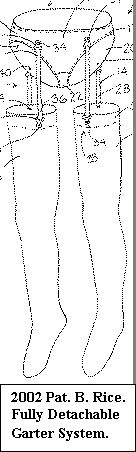
GARTERS
Four
or Six Garters:
Garters
are a characteristic of garments from the "Golden-Age" of girdles that
seems to exert a special fascination. An example of that fascination was
attributed to the young protagonist in Philip Roth's Portnoy's Complaint (1969).
|
|
When
intended for use with stockings, girdles (and corselets) in mainline catalogs
are equipped with 4 or 6 garters. Some specialty or fetish catalogs may
advertise garments with more than 6 garters, and that concept also occurs in
fantasy literature. However, I have never seen a store-type catalog image with
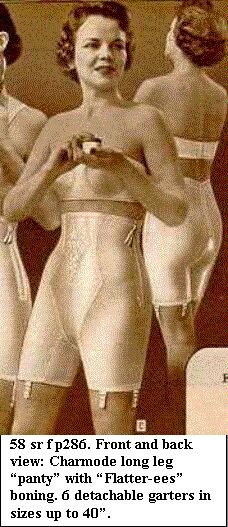
more than 6 garters. Some typical arrangements are illustrated as follows. The
two open bottom girdles from Sears in 1958 are equipped with 6 and 4 garters
respectively. The panty-girdle illustrated on the same page is one of few that
I've seen with 6 garters. Also, note that these garters are exposed and attached
to the bottom of the panty legs. In later years, a more common arrangement with
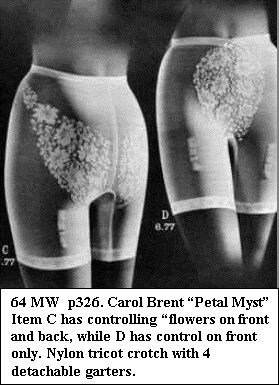
4 hidden garters is illustrated by the image from Montgomery Ward in 1964. |
|
|
|
I've
had various theories to account for differences between garments offered with 4
or 6 garters. Does having 6 garters, rather than 4 imply higher quality?
Perhaps, but then "higher quality" would likely be reflected in price.
I have not been able to discern a distinct relationship between number of
garters and price. In fact, that is why I selected the earlier illustration
(Sears 1958, p286), because it showed two open bottom girdles with 6 and 4
garters, respectively, in the same illustration and at nearly the same price.
From an engineering perspective, six garters would provide a more even
distribution of attachment for stockings (and decreased stress). On page 316,
Montgomery Ward stated in its 1966 fall catalog that its Carol Brent "panty
and girdle" represented "outstanding value" because those
garments used "6 garters to prevent stocking sag." However, more
garters also require additional time and fuss for attachment for the wearer.
Lacking any additional definitive indications, I'm left with the idea that the
number of garters is primarily a matter of user preference! This is certainly a
question that needs further input from corsetiers and women accustomed to
wearing stockings and girdles.
"Trolley"
Garters:
|
Sometimes,
I've encountered the term "trolley garter" in advertising copy from
Sears, Montgomery Ward and JC Penny. When it is used, it appears to refer to a
garter that can slide along a loop of fixed length, where the ends of the loop
are generally attached to the garment at separate locations (or some times the
same location). The image for a double front, side-hook girdle in Sears 1936
identified trolley garters and clearly illustrate this feature. This would allow
for some flexibility while still holding the stocking at about the same height
on the woman's leg. I've only seen trolley garters used with open bottom
girdles, garter girdles, garter belts, and corselets. Interestingly, I've
observed that a garment with garters (that appear to be identical with the ones
labeled as trolley garters on another garment) may be shown on the same page of
a catalog but it is not likewise identified. I
strongly suspect the use of "trolley" garters helped give more
flexibility to stiff girdle-to-stocking attachments. However, it did not allow much adjustment for stockings of
varying length. (Hence, the practice by many women of folding the welt for
overlong stockings.) In 1936, Sears also referred to "loop" garters on
p 125, which seems to be fairly descriptive. New garments with trolley garters
are advertised on the Internet as well as replacement trolley garters for repair
of garments. The
following examples covering a span of several decades were specifically labeled
in the advertising copy as using trolley garters.
|
|
|
|
|
 |
The
ends of the garter loop are clearly separated in the waist whittler (Sears
1958), the waist nipper (Sears 1961), and the 1966 Montgomery Ward
"cross-over" girdle. This arrangement makes it easier to visualize how
the garter clip can slide along different parts of the loop to respond to the
wearer's various body positions.
The
long front garter loops associated with a typical open front corset function as
trolley garters. The two boned, all-in-ones shown in the 1960 National Bellas
Hess catalog probably provided very firm support and the additional flexibility
with the trolley garter-stocking attachment would be a significant benefit. The
high waist girdle (Montgomery Ward 1980's) and firm control corselette show
examples of trolley garters (as identified in the copy) used in the early
1980's.
|


French
Garters:
| I've
seen modern garments advertised with "French garters". However, that
description seems to refer to fancy decorations - like sequins - for show
purposes. Sears lists the "Uplift Charmer" as having French garters in
1936. However, it has the appearance of a trolley garter as shown elsewhere in
the same catalog. This is the only example I've seen of a "French
garter" in a standard catalog.
Garter
- Stocking Flexibility: Ripped
stockings were a concern of inventor Emma Bettinger. In 1920, (Pat. # 1,362,556)
she developed improvements for a garter belt so that garter tension was better
distributed whether the wearer was sitting or standing.
Inventor
Sallyann Zanka (Pat. #3,130,730) developed a system of panels to modify the
standard design for panty girdles in 1964. These panels provided additional
flexibility to and maintain a more uniform tension between stockings and garters
and reduce excess stress at connections. |
|
Movable
Garters:
In
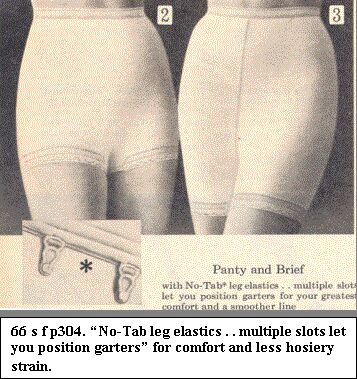
1962, Benjamin Murdock proposed a modification to panty girdle legs to include
multiple slots in a reinforced hem. Then the wearer could move the garter-tabs
almost anywhere on her panty girdle to suit her convenience. Also, she could
select the number of garters she wished to use. Garments incorporating this
invention were sold by Sears in 1966 and described as "No-Tab leg
elastics."

I
infer from Murdock's patent description (following) that he feels that designers
have failed to consider functionality or user needs when designing garter
attachments for girdles and panty girdles.

Garter Placement vs. Stocking Length:
|
The
concept of a girdle, garters and stockings working as a dynamic system will be
discussed in detail in a later section. However, it should be apparent to the
reader that the whole process of selection of the right combination of
foundation and stockings was somewhat haphazard (unless the woman's measurements
were close to the "average" used by manufacturers). I am forced to conclude that each woman worked out what she
could wear on the basis of trial-and-error. Depending
on the length of the girdle and stocking length, adjustable garters had to
accommodate this variation to fit smoothly. Shorter stocking lengths would be
required when garters extended from the bottom of the leg of a panty girdle.
However, the hidden garters used with later panty girdles appeared to be
attached at varying heights along the thigh. Garments provided some allowance
for length adjustment like the panty girdle sold by Sears in 1961. However, the
relocation of the garters was probably to achieve the hidden effect and minimize
"garter bumps" as much as any other reason.
|
 |
"Goodbye
Garters"
| To
me, this ad in the 1971 Sear's catalog is the harbinger of the ending of the
"Golden Age" of girdles. Pantyhose had arrived! While some foundation
garments with garters are still available, those items are definitely on the
fringe of fashion today. The "Be-Slim" briefer in the mid-1990s still
includes four tabs for attaching garters, but the copy doesn't bother to mention
this. (Note that when they were used, the garters would have been located
relatively high. This would have required stockings that were longer than
usual.) |
 |
||
|
|
|