LEG
BAND GIRDLES
Some
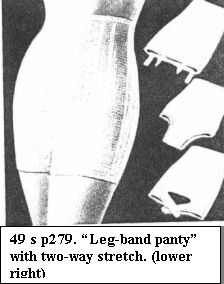
girdles were offered in a "leg-band" style without garters.
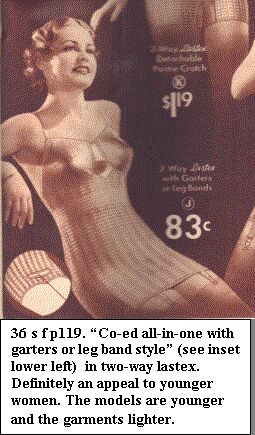
An example of this style is shown with an all-in-one corselet from the
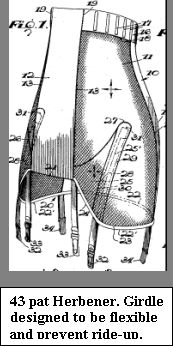
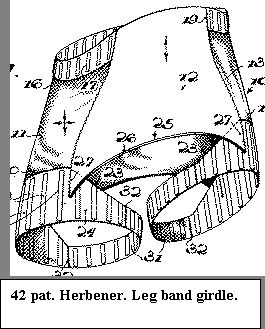
1936 Sears. Henry Herbener applied for a patent in 1939 on this style. There
appear to have been technical details in his patent that differentiated it from
the garment offered by Sears. His patent #2,300,153 was finally granted in 1942.
|
|
|
|
In
1949, Sears advertised this again, as the "pre-war favorite . . . first
time back". One of the intended features was that the leg-bands would act
to anchor the garment and prevent ride-up of the girdle. This may have been
necessitated if the woman intended to wear her girdle with slacks, but didn't
wish to wear stockings.
From
an engineering perspective, a girdle (or garter belt), garters, and stockings
are an interactive system. The girdle acts to hold up the stockings, and
ideally, the stockings are attached at the right length and tension with the
garters to prevent girdle ride-up.
|
|
JC
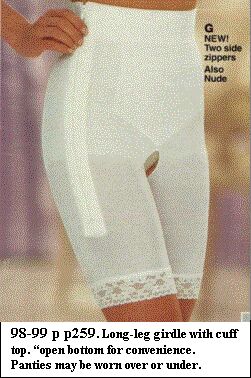
Penny offered a variation of the leg-band style around 1998-99. Essentially it
was a crotch-less long-leg panty girdle. It was shown with the model wearing
panties underneath. However, I think this would defeat any aspect of
"sanitary convenience". I suspect that it was not a popular item for
women (although it may have been very intriguing to their "significant
others"), and it was only offered for about two years.
|
Martin
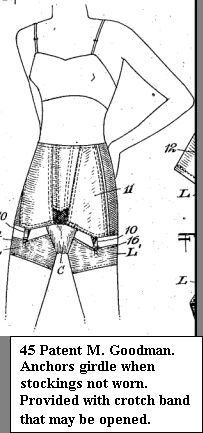
Goodman developed Patent # 2,382,477 in 1945 for a woman who may wear an outfit
where she did not wish to wear stockings. His invention would serve the same
purpose as girdle anchors and additionally, was equipped with a crotch piece
that could open.
|
|
Girdle
Anchors:
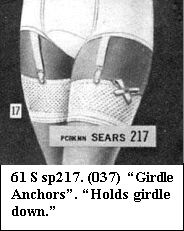
These
examples from the 1958 and 1961 Sears, show another approach to address the
girdle ride-up problem with "girdle anchors". With this accessory, a
woman could wear her regular girdle (with garters) and not have to use
stockings.
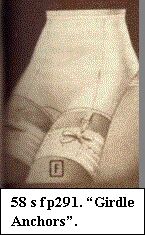
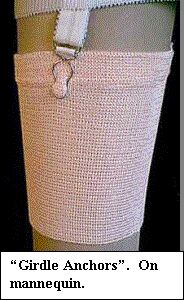
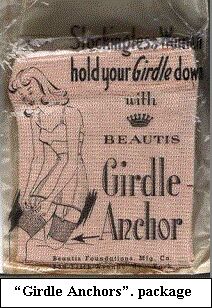
| An
original example of this accessory was offered for sale as a collectable and I
included those images to help clarify how it was used.
|
|
|
Girdle
Hooks:
To
complete the integration of the system of interconnecting support for separate
female undergarments, long-line bras were often equipped with from one to four
"girdle hooks" (also
called corset hooks, girdle tabs, foundation grips, foundation hooks, or corset
attachments) on the bottom.
|
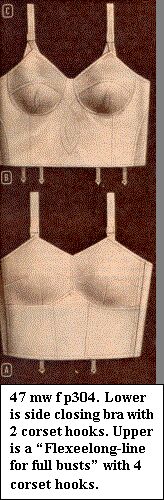
A post-surgical long-line bra in the 1960 Sear's
fall catalog was equipped with 6 girdle hooks. Examples are common in catalogs
from the 1930's through the 60's. One longline bra with girdle hooks was
advertised on the Internet in 2002.
The
1936 Sear's "aircooled reducing brassiere" description makes it sound
like it's being run by a Volkswagen engine!

|
|
|
|
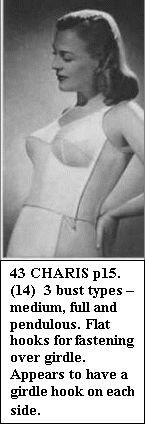
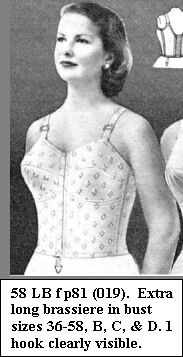
Unfortunately,
I haven't located an ad that shows these hooks being employed with a bra and
girdle where it clearly shows how the hooks attached. The shape of the hook is
most clearly visible for the 1958 Lane Bryant extra long brassiere.
The loop type shape looks like it is intended to slip over a button or
hook on the girdle. However, the images in the 1943 Charis catalog and 1936
Sears don't show any such protuberance.
 |
|
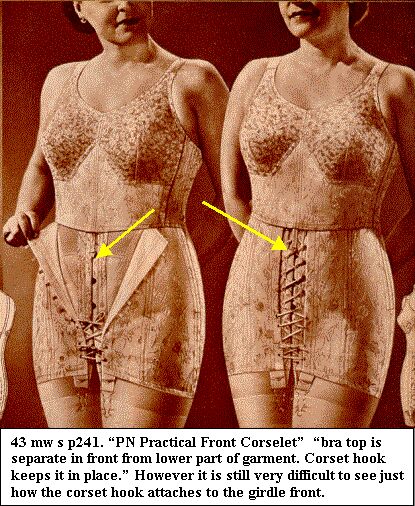
The
image shown with the corsets in Montgomery Ward in 1943 suggests it hooks into
the front lacing system or loops over one of the nubs for the front girdle
closure (but it is still not clear). However, that doesn't explain how a bra
with two front hooks is anchored. I also wondered if the hook had a sharp point
that was intended to "grab" into the girdle fabric or under a
cross-lace. That seems undesirable.
It seems that the lady would have to choose her garments with great care to be
sure all the "appurtenances" lined up properly. This could be a real
problem without a high level of standardization of design. Perhaps a reader will
clarify this point.
|
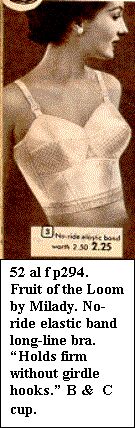
Designers
were starting to move away from this arrangement as early as 1952. The Aldens
catalog that year showed a long-line bra on page 294 and specifically stated
that the "bottom holds firm without girdle tabs".
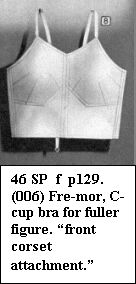
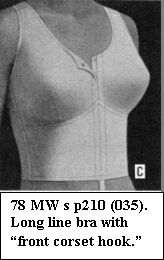
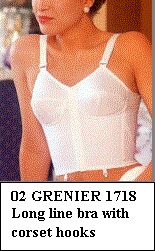
The
long line bra with a "front corset hook" from Montgomery Ward in the
summer of 1978 represents one of the last examples in a large store catalog.
However, I found a Grenier long line bra with corset hooks on the Internet.
In
1979, inventor David Ichelson developed a bra for wear while jogging. He wanted
to keep the breasts from bouncing up. The system he proposed was to have
adjustable straps that would hook onto the woman's shorts, and was similar in
many respects to the earlier system of girdle hooks.
|
 |
Inventors
and Designers:
The
US Patent Office now has most of its patents on the Internet. The patents are
indexed by all words in the patent back to 1975. However, all patents can be
viewed page-by-page with a number or category-code search. Many patents refer to
work by earlier inventors. The list of those patent numbers enabled me to
research early material that had not been digitized.
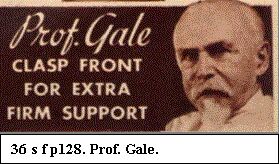 |
No
discussion of inventors would be complete without mentioning "Professor
Gale". This is his picture from the 1936 Sears. The "Gale" name
was used for decades afterward by Sears as part of their corsetry advertising.
He looks like a stern old chap. But, he may actually have been smiling under his
moustache and really enjoying himself as he conducted his research and
development on undergarments for full-figured ladies. I have tried to locate his
patents through the US Patent Office. However, nothing was referenced to the
"Gale" name. Several of the large catalog companies had their own
brand names (but I don't know if they were based on real people). Showing a
photo of Prof. Gale doesn't prove he was real - but it seems like a lot of
trouble to establish a trade name if he wasn't a real person.
|
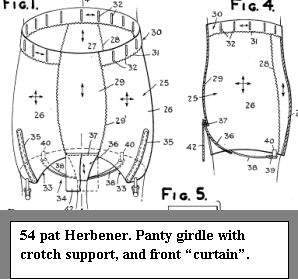
Henry
Herbner was an inventor whose name is not well known outside the industry.
However, he had at least five major patents that spanned from 1938 through 1973.
One of his early major contributions was the development of a system to
prevent the edges of foundation garments from rolling. Two of his patents have
already been discussed. Two others for adding flexibility and an unusual crotch
support system with Modesty curtain" are shown here.
One
article suggested that he may have originally been an engineer. Records of the
Munsingwear Co. (Minnesota) show that he was an employee from 1951-1953. He is
deceased. His last address was Thomasville, GA.
In
1978 People magazine recognized inventor N. O. Brantley for his development of a
brassiere for large busted women. His invention will be discussed later in the
section under nursing bras. He is also deceased.
|
|
Early
garments were quite stiff. Inventors recognized the need for better flexibility,
comfort, and ease of access for elimination purposes (previously noted).
An important invention in the development of more comfortable and
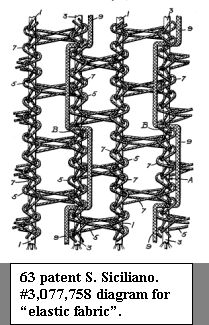
flexible control garments was "power-net" fabric. S. Siciliano
invented one of the types of elastic fabric that helped revolutionize this
industry in 1963. The image from the patent application gives some idea of the
complexity of weaving these kinds of materials.
One
fictional inventor in this field was featured in the 1968 Shirley MacLaine film
"The Bliss of Mrs. Blossom". Mr. Blossom (Ms MacLaine's movie husband)
manufactured women's underwear. His fervent wish was to provide every woman with
the bust line she desired. His invention worked with a gas-expanding bra - which
went awry.
|