A Century of the
Spirella 3 Series
Corset
|
|
A Century of the
Spirella 3 Series Corset |
|
|
|
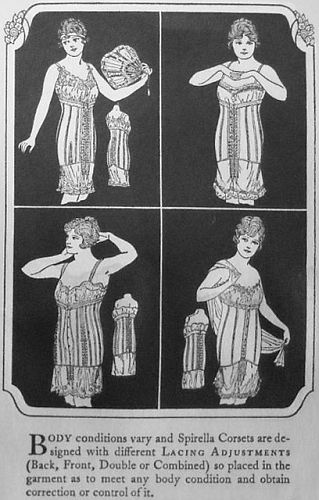
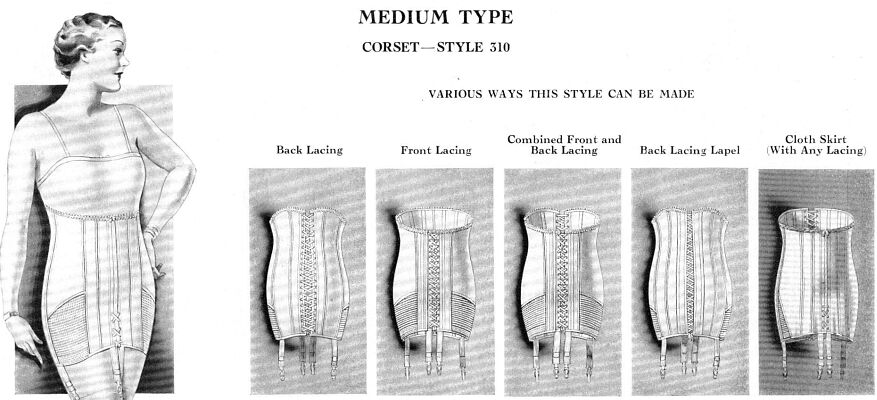
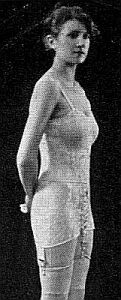
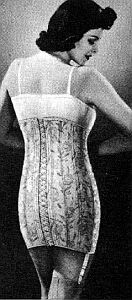
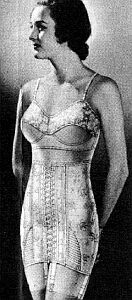
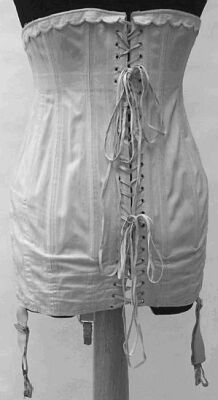
The Spirella corset dates back to the foundation of the company in 1904 (USA) and 1910 (UK). In 1909 there was a model with the designation 333; however, by the 1920's this was referred to as the '98'. In 1935, the 300 series corset was developed; however, the references to 305, 315, etc. depended on size. The original generic design was designated '310' in the 1938 catalogue, however, the idea of front, back or side-laced corsets goes back to the very beginnings of the company (left). |
|
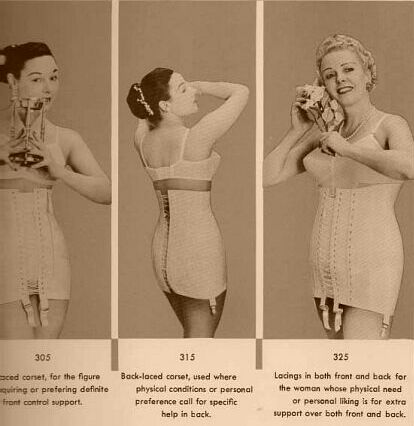
In 1943, the terminology that 305 was a front-lacer, 315, a back-lacer and 325 front and back-lacer was adopted. It lasted until Spirella was sold in the 1980's. Even then, the Spencer 'posture corset', which was very similar to the 305, continued. Spencer were always obliging to their customers' wishes, and in 2000, several front and back-laced 'posture corsets' were ordered from Spencer. In fact, these were corsets ordered from long-term Spirella 325 wearers and were virtually identical to the models constructed in the 1940's. It's fair to say that the current 'posture corset' has its roots back in 1909, but is virtually unchanged in style since the 1940's. Materials have changed, the busk was replaced by the zip post-war and the metal zip was replaced by the nylon zip (an invention of 1958) in the late 1960's.
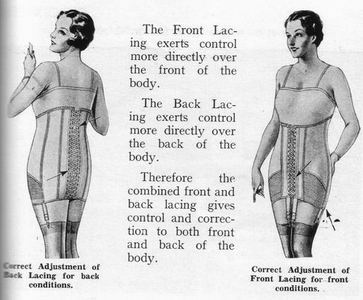
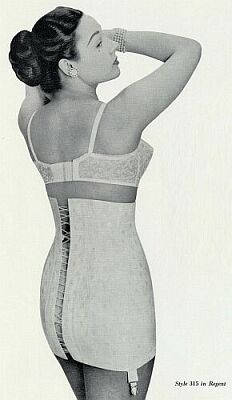
The Spirella Catalogues of 1935 and 1936 shows the basic corset design that was developed in 1909 and continues to this day. Spirella demanded that front 'conditions' required front-lacing (model 305), back problems needed a back-lacing (model 315), and for the poor woman who suffered from both (and who presumably had a very understanding maid or husband), lacing both front and rear (model 325). |
|
|
|
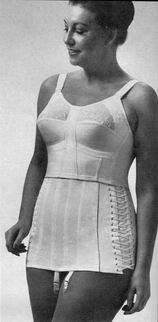
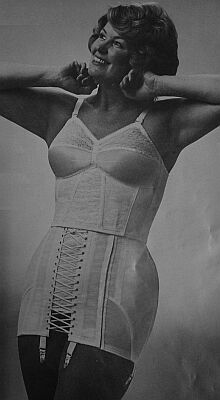
Spirella shows the 305 corset in advertising literature from 1939 (left). The formidable 325 and a pair of 305's come from 1943. In contrast to Spencer, Spirella's advertising of this period was almost austere despite the pretty fabric of the 325. The flanking example is a real pre-war 325. This is a well-used (and discretely repaired) example. |
|
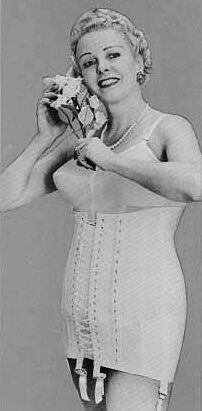
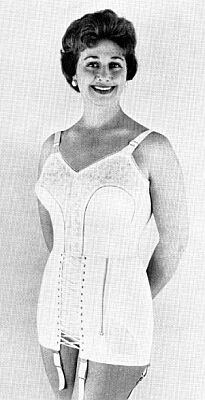
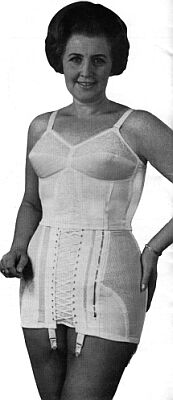
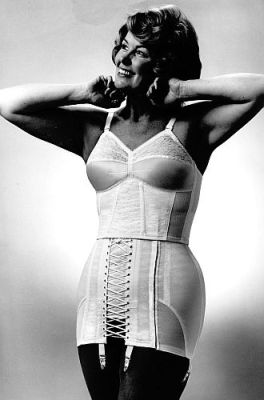
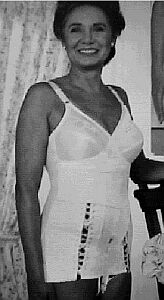
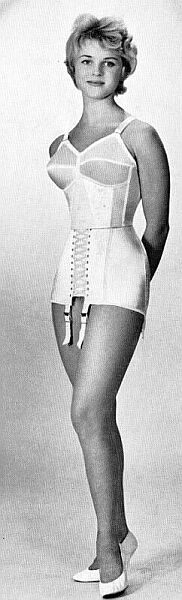
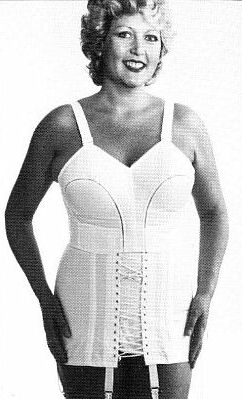
These models used regularly by Spirella show the 325 corset from 1959, and the 305 corset in 1961, 1969 and 1973 (below). Note the change from the metal to the nylon zipper. The satin 'flashes' over the suspenders of the 1961 corset are a lovely touch and could be ordered for a small extra charge. The 1970's models are smiling, which reflects the booming time in Britain in contrast to the far more serious models of the war years.
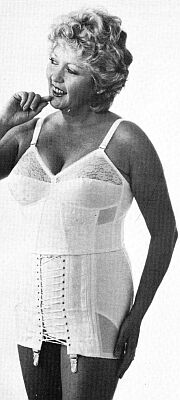
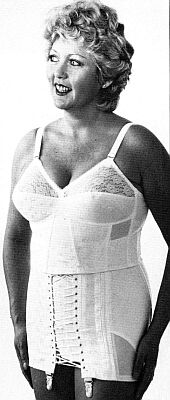
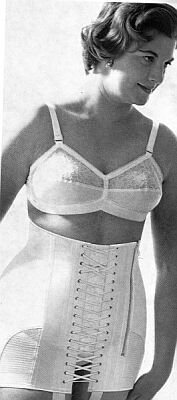
Photographed in the early 1970's, one of Spirella's favourite models shows off the 305 (middle and left). Note the same model in a Gentle Line brassiere and 515 corset. Apparently similar to the 305, the 515 was much lighter and almost falls into the 'grey ' area of the laced girdle.
|
|
|
|
|
The 305 was popular because in 1960 there was a demand from women who had been corseted since their teens in the 1910 - 1930 era. Made-to-measure corsetry is important and worth the money, and it was not a hard task for the corsetieres to sell these corsets to a population of over-40-year-olds. Exercise for women rarely extended beyond school days, and, indeed, a laced foundation was a boon to the older woman or the young mother. This ended in the late 1960's, and whilst girls were burning their bras very publicly, a whole generation of women were deserting their corsets much more privately. The girdle had a huge success during this period; however, the rapid pace of change saw the Spirella marketing department in a very re-active struggle against a booming population of girdle-wearers who could buy 'off the peg' garments from the High street stores. The corset would still be sold, but there would never be a growth market. Sadly it became a declining market, and as regular corset wearers representing decades of loyalty passed away, there was nothing other than the dedication of the corsetieres to replace them. Most of the corsetieres needed the money from their hard-earned sales, but in the end, Spirella sold out to Spencer in 1989 (in UK). There was just no room for two independent corset makers. Incidentally, Spencer bought Spirella in Canada in 1959, nearly three decades earlier. It would seem that the writing was on the Canadian wall far sooner than in Britain.
The sort of woman (left) who would never have worn a 315 corset, or, indeed, any corset in the 1960's. If lady did wear such a garment a long-line brassiere would have been de rigeur. |
|
The papers ran a few articles on the demise of Spirella with mildly witty headlines Bottom falls out of the market Corset sales are sagging Corset squeezed out by whims of fashion We have made up a page with these articles re-printed. It is called the
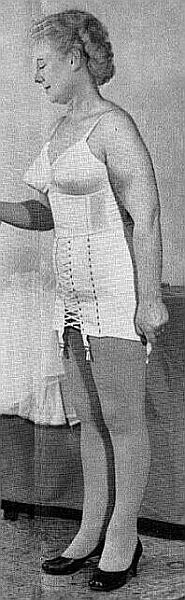
Sadly, some life-long devotees of Spirella wept when they heard the news. For them, life would never be the same again. Fortunately, the 305 corset lives on in the guise of the Spencer 'posture corset' and during the 1960's there were any number of Spirella house articles dedicated to this most popular of all foundation garments. I love the two photographs on the right. The beautiful girl on the left is a model wearing a lighter version of the 305 called a 515. She obviously doesn't need to wear a corset by today's standards and few girls in the 1960's did so, except perhaps for the 'special occasion' or the 'special outfit'. The lady on the right is not a model. She is a Spirella customer who was photographed to show the 'before-and-after' effect of the 305 corset on the fit of her clothes. Again, by today's standards, a woman of this age would not even consider a corset; however, in the 1960's this was not uncommon and, in this lady's case, most effective. Both ladies appear quite charming and for quite different reasons.
A model demonstrates a 515 (a softer cousin of the 305) in 1960 and a Spirella client courageously poses in 1962 |
|
Then there was the question of colour that we've touched upon under The Corsetiere. The choices mainly centred around white, black, peach and tea rose.
|
|
|
These three models demonstrate the black option; however, the majority of the Spirella advertisements and articles were for white foundations. Even in the 1960's black was considered a bit 'racey'. Peach and tea rose were the choice of older woman or for the 'surgical' garments.
In the 1960's, corsets such as these were available in a wide range of materials from heavy cottons and brocades to the lighter and more easily washable rayon satins and nylon. Light-weight 'aertex' style cloth was used on corsets for overseas use. The heavier fabrics and the rather plain but functional coutil were the preserve of the corset worn for genuine corrective support. Although a clever corsetiere could convince a client that anything other than a perfect figure needed 'correction', there were many women who genuinely needed their support. This was the preserve of the surgical corset.
|
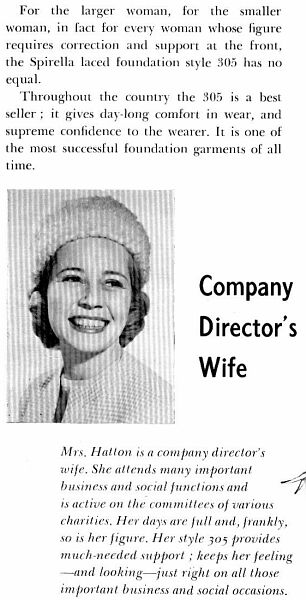
All through the 1960's the Spirella magazine stressed the benefits of the 'laced foundation'. It's almost as if they knew that the corset would soon be on an irreversible decline. Below is the text from three articles which stress that the 300-series corset is for all ages and lifestyles. Similar articles were published throughout the 1960's. Company Director's Wife: (article right) Grandmother: Mrs. F. has been a 305 wearer for many, many years. In fact she wouldn't know what to do if she had to stop wearing her 305 now. She's come to depend on it so much for comfort, appearance and health. It keeps her young and active for her years; enables her to take a keen interest in life, and to take part in the activities of her family and her grandchildren. She's convinced: "I wouldn't be half the woman without my 305". Housewife: Mrs. K. has a house, a husband and three vigorous sub-teen children to look after. Every afternoon she used to suffer from that nagging 'kitchen sink' backache. Housework used to get her down --making beds, cooking, washing up-- all that bending over. Now it doesn't matter, because her 305 has banished all unpleasantness. She even enjoys her housework and still has the energy to enjoy the early evening with her family. Businesswoman: After her baby was born Mrs. F's doctor recommended a more controlling garment to help her regain her good figure. Mrs. F was delighted with her 305 for two reasons: being the owner of a successful fashion business it was essential that she looked neat and trim (her 305 did just that for her); and as a modern working woman she felt the benefit and freedom from fatigue which her 305 gave her after the strain of childbirth. Note how the word 'corset' is completely omitted in this article. 'Style 305' or 'controlling garment' being used.
|
|
November 1963 Style 305 - one of the most successful designs in the Spirella Range
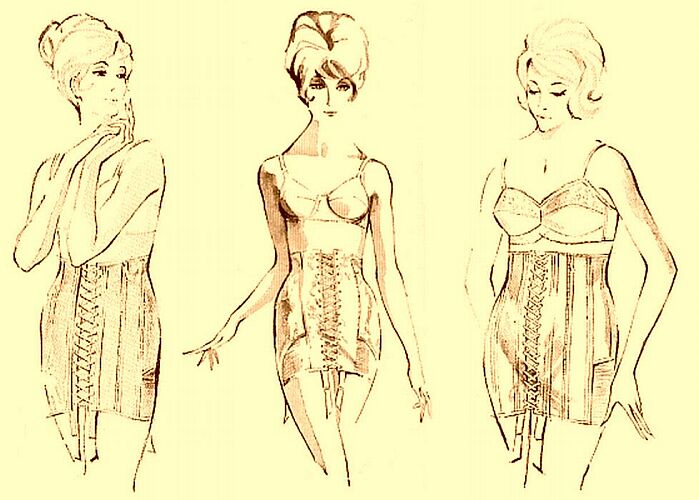
In August 1964, Spirella admitted that the 305 was a 'laced foundation.'
Laced Foundations ... the 300 series
There is often a tendency to think of corsets as being for the larger figure only, but figure support and control is sometimes as much a problem of the small woman with a 24" waist as for the large woman with a 44" waist. Even the petite woman can have figure problems, for which only a laced foundation can satisfactorily cater. Irrespective of figure size, if a woman has a figure needing correction or positive control she should wear a laced foundation rather than a girdle.
One of the basic principles of corset design is that the degree of support and control provided by a foundation decreases as the amount of elastic in the garment increases. Corsets use a very limited amount of elastic in their construction and in the main this is in the form of gores in the skirt to give freedom of leg movement. Girdles, on the other hand, are a combination of cloth and elastic, and so give more gentle support and control than corsets.
|
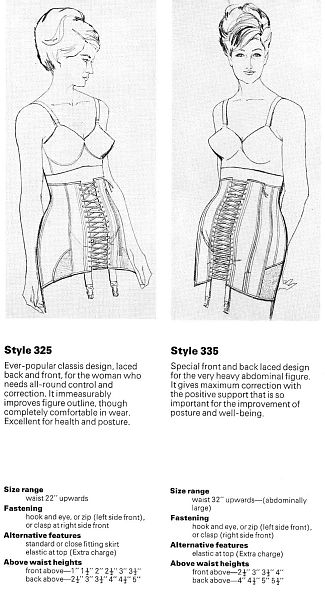
Lacings increase the degree of support and control, and localise it to some extent. This is why a front-laced corset is chosen for a woman whose figure needs intensified control at the front, and a back-laced corset for one who needs support at the back of the figure. The lacings, together with pull-loops and holding knots, give this control and support exactly where it is most needed, and are varied according to the individual needs of each figure. Every woman who needs a laced foundation will find in the Spirella range a corset suitable for her. There are no exceptions to this and no limitations of size or figure. Some corsetieres perhaps do not realise just how comprehensive the Spirella made-to-measure corset service is or how much variety there is in it. The basic service consists of four styles - the 305, 315, 325 and 335, These four styles between them cover the whole range of figure types and sizes, and offer considerable variety when the alternative construction features available are taken into account. For example, the 305, 315 and 325 can have a standard or close-fitting skirt, and all four can be made with elastic at the top. The is also the choice of fastening --zip, hook and eye or clasp (busk)-- and of the position of the fastening. The above waist heights are variable and so are the suspender fittings. And of course there is a wide choice of materials, some (such as Tropical) being really light and modern. When all these factors are taken into account the great variety and flexibility of our corset service becomes apparent. Whatever the figure problem may be, there is a Spirella corset to cater for it. Amazingly, the catalogue picture (right) comes from the Canadian Spencer (!) catalogue of 1959. Spencer and Spirella had already merged in Canada, three decades before Britain.
|
|
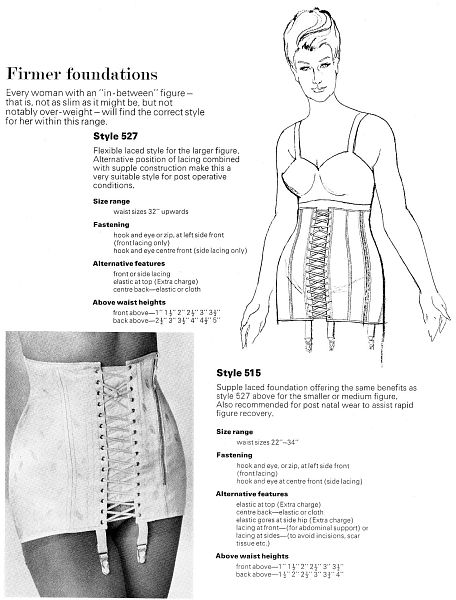
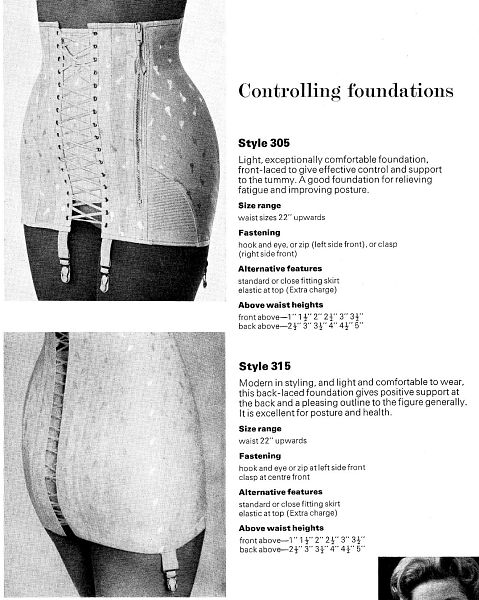
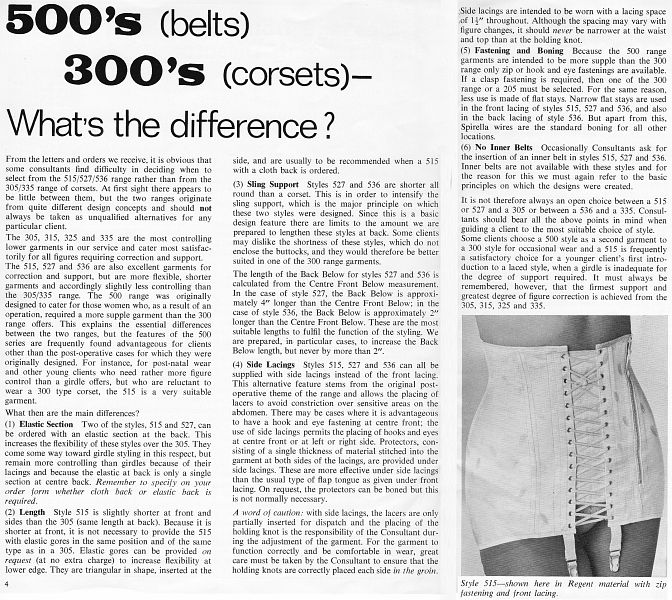
Spirella was at pains to emphasise the difference between firmer foundations and controlling foundations. As one can see below, it is rather the difference between a 'belt' and a 'corset'.
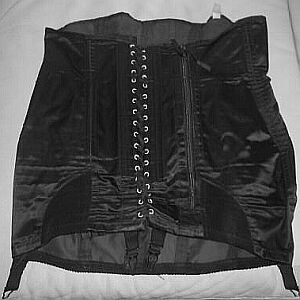
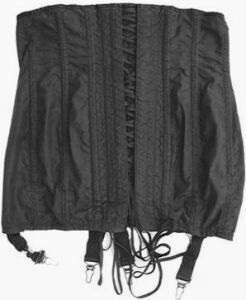
| Real Examples The Spirella 305 On the right is a beautiful example of a Canadian 305 corset. Really quite basic, this front-laced, zippered corset in black nylon is a charming undergarment. The fact that it has seen little use, and even has a small split along one of the seams reveals that it was probably used for 'special occasions' only. The trouble with rarely worn corsets is that they never get 'worn in' properly and can suffer from seam failure as a consequence.
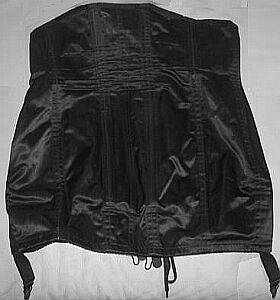
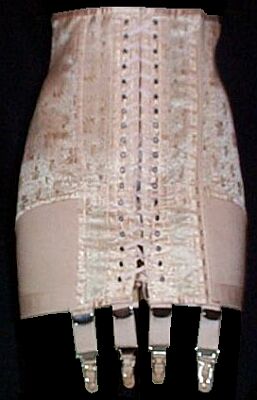
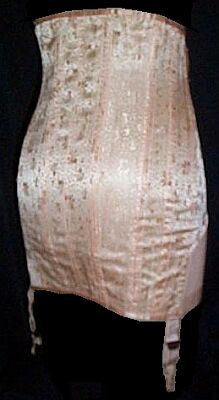
The British 305 corset (below) is made from that so popular 'orchid' artificial satin material. It was owned by a larger lady and worn quite often but probably not on a daily basis. The waist creases indicate that the corset was worn tight enough to support a fair-sized abdomen, and yet put a good definition of the waist. The lower creases are simply a consequence of sitting for long periods. This corset is much more recent than many auction sellers imagine. I have seen these corsets advertised as Victorian! The giveaway points are:- nylon zip, four suspenders and the material. This is a corset from the 1980's! Zip fasteners were metal in the 1970's. Six suspenders were mandatory when an older woman's stockings were far more elastic than today's. Black orchid ceased as a Spirella option in the late 1980's.
|
|
|
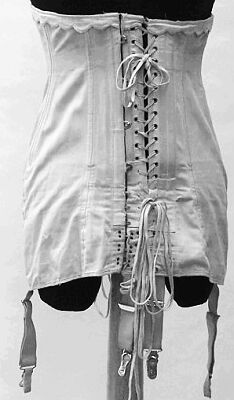
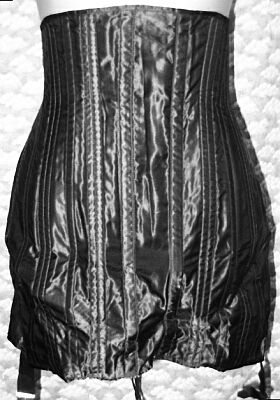
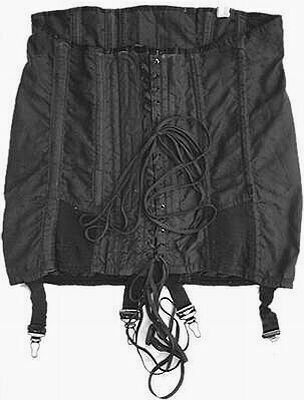
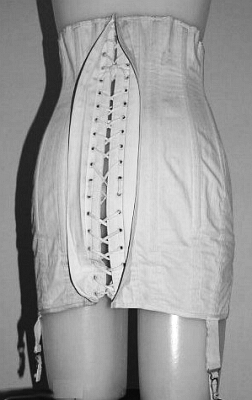
The Spirella 325 Too many of these corsets appear at auction to suppose that they were rarities in any way. This particular garment, in a hard-wearing patterned nylon, has seen years of service to a large and fairly stout woman. The corset is designed to support the abdomen by daily tightening of the front-lacing. The back-lacing would be adjusted far more rarely, and then to accommodate some figure fluctuation. These corsets were being made by Spirella until they closed in the late 1980's.
|
|
|
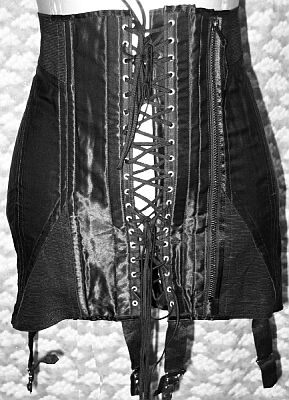
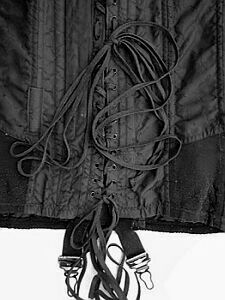
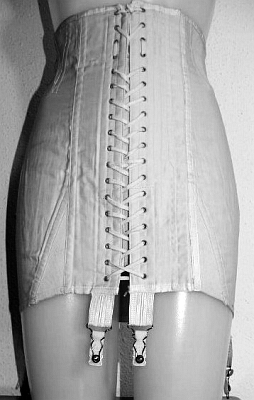
This American 325 (right) is an older (1950's) no-nonsense corset in a hard-wearing coutil. Note the old-fashioned suspender 'knobs' and the concealed back-lacing, also evident on the black corset (above). The corset was never worn since the front-lacing appears closed, un-twisted, and with no spare lacing to open it fully. It has been laced this way purely for display. On real corsets, the spare lacing could amount to a yard of embarrassment should it come loose unexpectedly!
The Spirella 315
The Spirella 315 (below) is an altogether rarer garment. Front-lacing became increasingly popular after WWI, and the number of women who genuinely liked the back-laced corset were very few. My corsetiere friend who has been fitting since 1958 has sold virtually none. Nevertheless, the 325 had a devoted following largely because, as I mentioned, the back-lacing was rarely adjusted and certainly not on a daily basis. The 300-series corset was the main-stay of Spirella in North America, Britain and Europe. The patterns were the same for many years with regional preferences for materials being the only real distinction. |
|
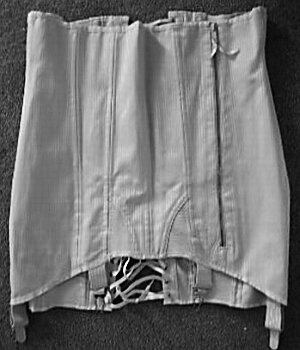
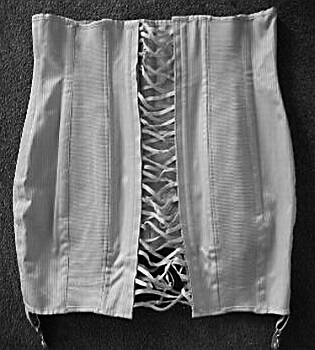
The Spirella 305 and its derivates have been staple wear for the models who have worked with us on our calendars. In 2011, we took the following pictures to illustrate the diversity of styles within the 300-series range of corsets.
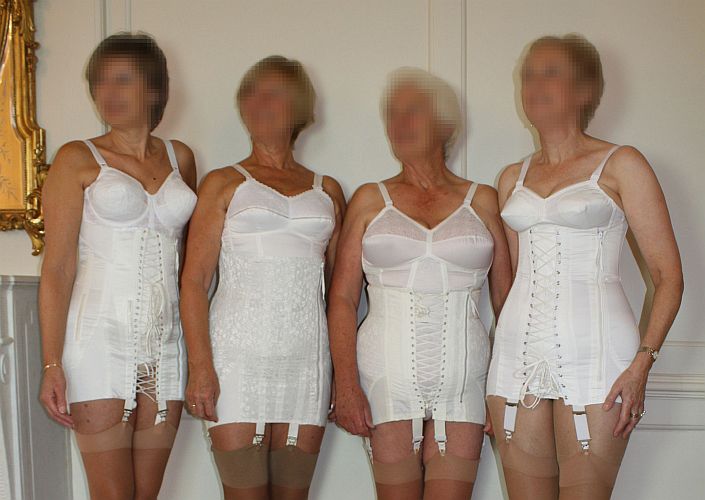

The pictures allow you to see which corsets are front, back or both front and back-laced. From left to right on the left-hand picture we have a 325, a (rare) 315, a 305 and a 325. The 305 was by far Spirella's most popular corset for many decades. These pictures tell a story that all women are different and this was a great selling point in the days of made-to-measure corsetry. The two left-hand corsets are actually Canadian Spencers, but Spencer and Spirella merged in Canada well before they did in Britain, and although Spencer called these garments 'posture corsets' they are really 300-series Spirellas. The corsets belonged to a tall, thin Canadian lady and are a bit long for both our models. The lady must have been fairly well to-do, since the 325 is fashioned from a very expensive and heavy satin. The side loops were for a lumbar strap that was probably discarded early on as quite unnecessary. Next is the British 305 in a hard-wearing, easily washable nylon; it actually fits the model very well and really flattened her abdomen. The last model wears a British 325 made from the ever popular nylon satin, orchid material. This combined durability with affordability although Spirella's corsets were never cheap.