Headquarters and the Models
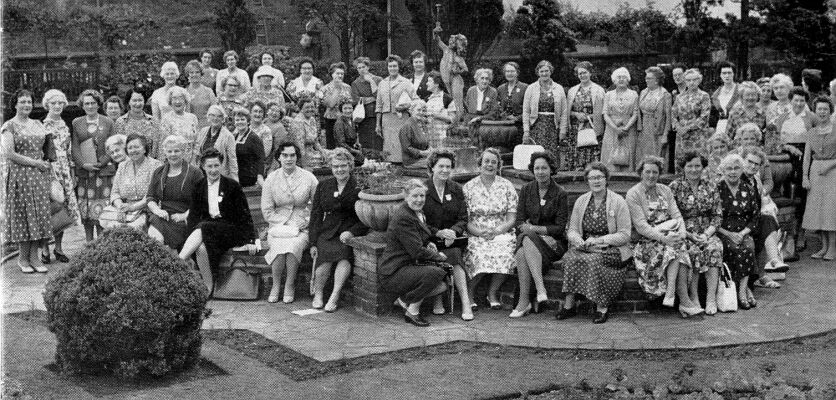
The 1960 visit showing just under half of the corsetieres who attended.

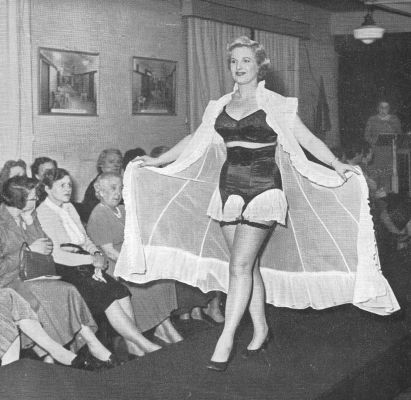
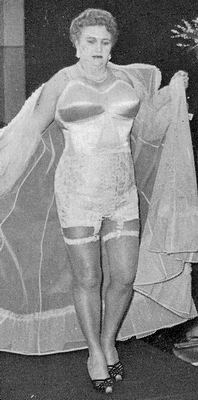
Professional models and factory workers alike demonstrate the garments. The model on the left, then a Miss Topping, was one of Spirella's favourites. One suspects that she had an enviable figure with or without their products! The factory was a very happy place in which to work even if the ladies employed there struggled to afford their own products. A girdle cost around two weeks wages! (At that time, a genuine Dior girdle would have cost several month's wages). The corsetieres themselves fared differently in that they were expected to wear Spirella's products that they could buy at cost, however, they were not salaried and lived on commission. Regard the models on the right of the photographs above. They are wearing Spirelette 1080 waist-nippers. The only occasion that Spirella parted with their wares when when an employee got married in which case they received a beautiful, satin waist nipper for their wedding.
The Annual Visit to HQ
The relationship of the corsetiere to Headquarters was very strong, particularly after the Second World War, and during this period all corsetieres were given a chance to visit Letchworth each year. This gave the company a chance to say "thank you" to its sales force, and also gave the corsetieres the chance to see the latest models that they would soon be selling.


The latest styles of brassiere and corselette are handed round in 1957 and 1960. Both are far stronger quality than the less successful garments of the 1980's.
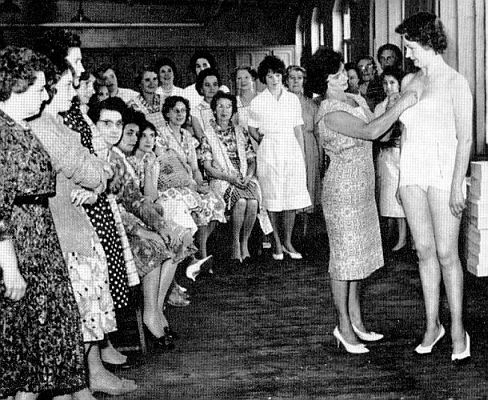
Two corsetieres in their 60's in the late 50's meet and discuss the latest styles at Letchworth. Quite obviously, one of these 'elderly' women has adopted one of Spirella's more modern brassiere styles (1958). In the same year, another group of corsetieres discuss the merits of the latest girdle.


In 1957, Spirella puts on an amazing display of their wares at HQ. In 1965, two ladies regard the newest lightweight material that can be incorporated into the 515 lacing girdle. Note how the light colour of the stand shows through the material of the garments to reveal their structure. This is often used to good effect by several vendors on the Ebay auctions.
|
The Models from HQ Spirella had a number of favourite models, and these ladies would demonstrate the latest lines to hundreds of keen corsetieres from all over the country. Sometimes, Spirella's favourite 'mature' models would demonstrate the corsets, but equally, in the catalogues, some remarkably young models are laced into their 305's. What appears quite extraordinary today is that these women would wander around the displays discussing their underpinnings with the corsetieres.
Shirley Green and Fenella Topping were Spirella favourites. |
|
Modelling Shows

Wembley 1924


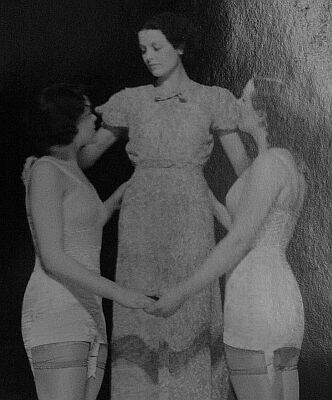
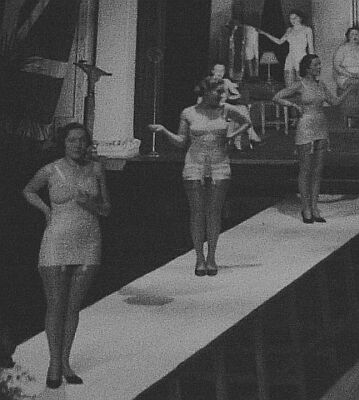


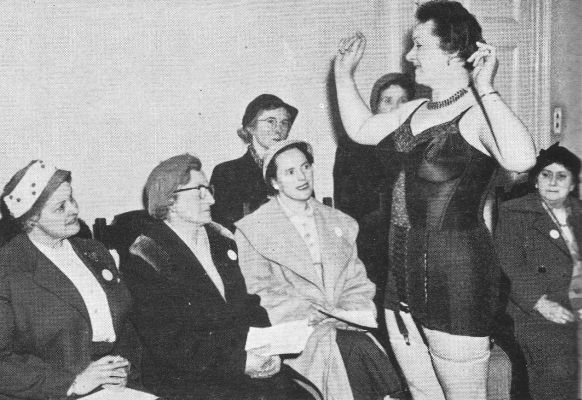


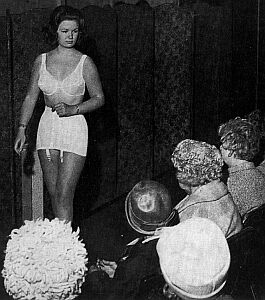
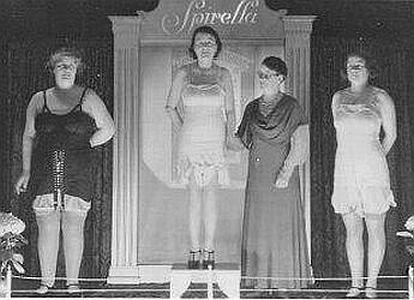
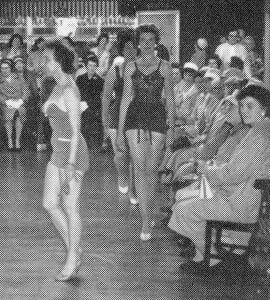


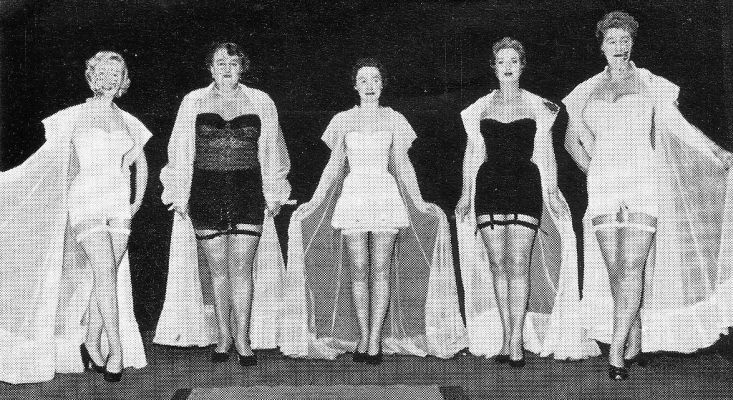
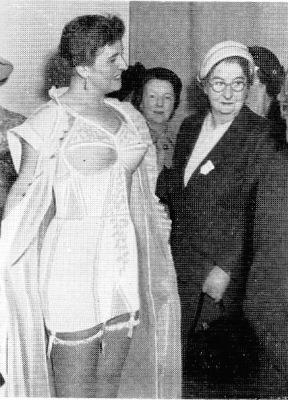
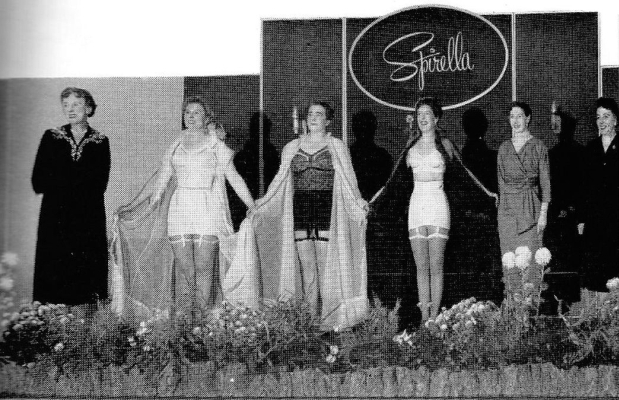
From 1938 (top), 1950 (below) and 1957 (below right), the display of corsetry by professional models both on and off the cat-walk was a regular event.

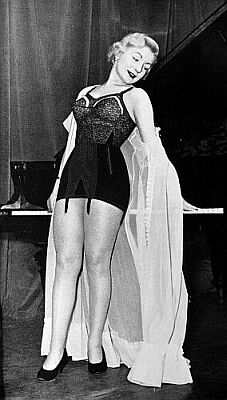
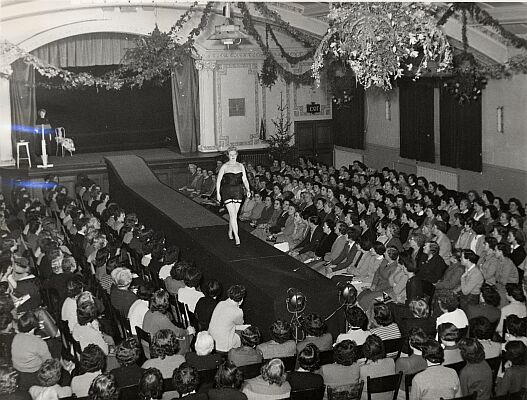
Not something I could ever do in a million years! It takes courage to parade your girdle in front of 100's of critical spectators! Occasionally Spirella would ask the models to demonstrate vintage corsets (below).
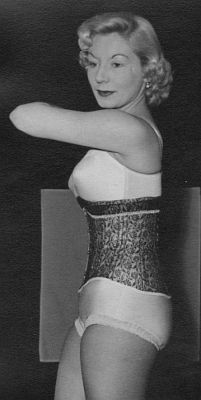
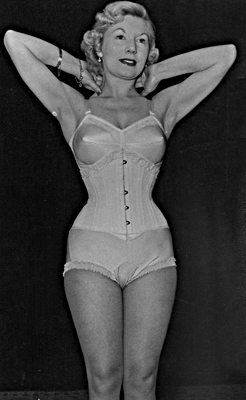
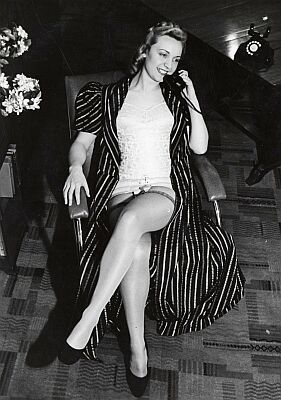
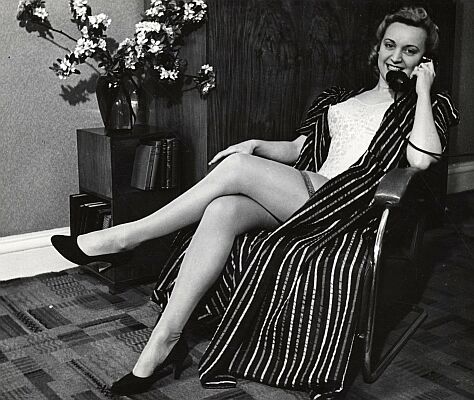
Some of the most professionally composed Spirella photographs, that, for Spirella, are close to being risqué.
Amateur Shows:
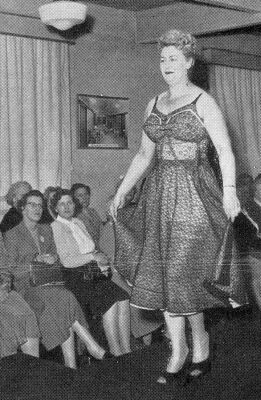
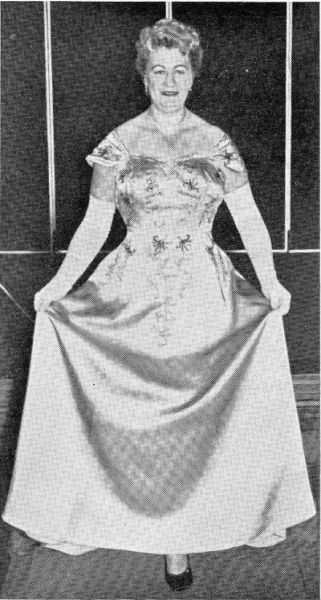
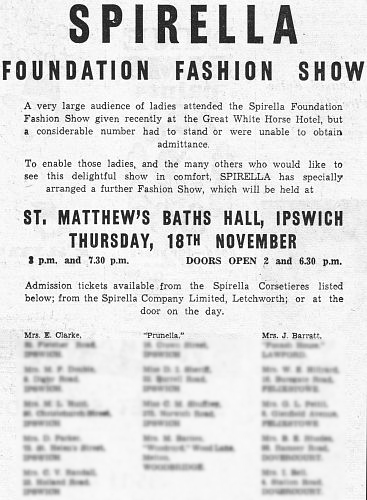
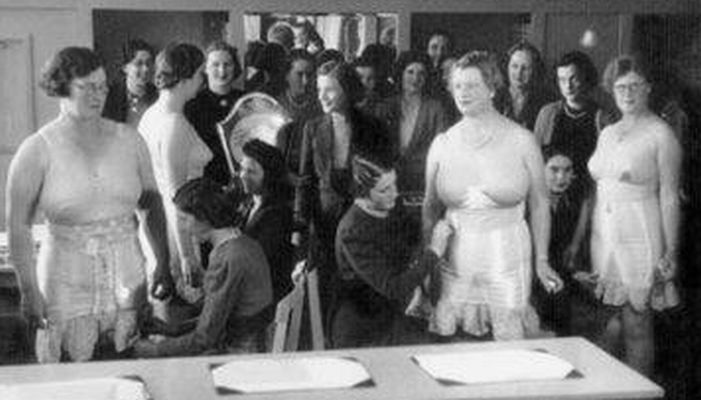
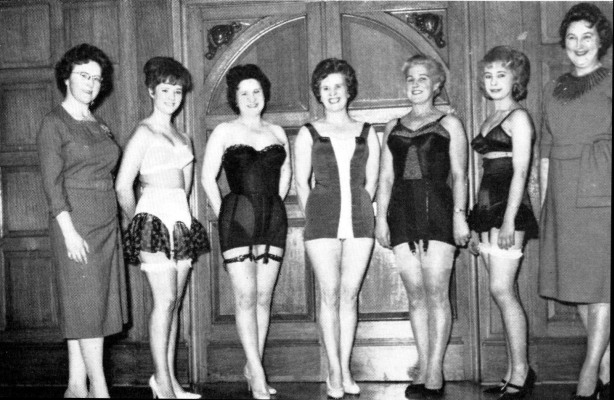
What is quite obvious from the house magazines of the time is that many of the ladies at the Spirella shows were not professional models, but simply corsetieres themselves. This would be good practice for them, since all forms of advertising were used by the company from adverts in the local newspapers to modelling shows where (amazingly for the 1960's) corsetieres and their friends would parade in front of prospective customers in their underwear. These shows took place away from Head Office in local halls and even corsetiere's houses. Daughters and friends were encouraged to join in. It is noticeable that the women at these shows often wore black underwear, whereas white and tea rose were the most popular colours actually sold. Perhaps wearing black was more like a show, or 'something special' rather than candidly walking around in one's everyday underwear. Notice that Spirella had stockings made with coloured tops to match the foundations being modelled. It certainly photographs better than a standard stocking. It seems that Spirella had these stockings made for the publicity photographs since they appear on the professionally modelled pictures. The long-suffering corsetieres had to pay, which explains the various styles of stocking top in the amateur photographs.


|
Fitters from 1960 model girdles, corsets and a corselette from the Spirella range. The models are all corsetieres, friends and somebody's daughter. The levels of confidence vary considerably, but this was 1960.
Amongst the prosaic Mrs. So-and-so's from Coutil Close, lies "Prunella". What a charming way to raise yourself above your corsetière peers! |
|
Even the Scottish in 1966 would parade in their intimates, including a Grandmother with 15 children standing second from the right, next to the corsetiere. The ladies are all satisfied customers and really very stylish. In fact, they make a very good advertisement for Spirella, and put many modern women to shame.
|
|
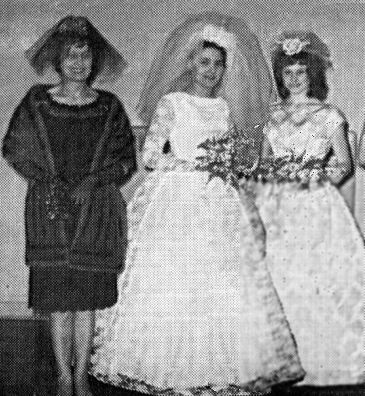
Spirella was always keen on its wedding photographs. In so many of their magazines, daughters of corsetieres were shown at their weddings. The captions emphasised the fact that all the ladies present wore Spirella, and apart from some marketing exaggeration, the photos are all genuine. But the photo above is obviously wrong. They tried hard, but, as is patently obvious, we have a group of amateur friends of the corsetiere in wedding guise. Charming, innovative, quaintly naive, but, one has to admit, less than convincing. (Spirella 1959).
The bridal dresses, all handmade by devoted mothers, aunts and grannies reveal a tendency that will ultimately doom the corsetry firms. Waist and bust are apparent, although not emphasised, but the hips are hidden in layers of tulle and netting. The girdle might be worn, but in such guise it was unnecessary, and ultimately, as we see today, will virtually vanish.
|
As a charming footnote to this piece, we recently (2010) discovered a picture of two of the ladies that modelled professionally for Spirella in the 1960's. As you would expect they are still stylish and elegant and have done well in their lives, one even having a title!
Shirley Green’s Corset Adventure
Thursday, April 26, 2007
Shirley spent nine years making and modelling beautiful bespoke corsets for the rich, and they were the happiest years of her life. Shirley Green, 67, was born Shirley Hickling in Letchworth GC and worked for the Spirella Corset Company, on Bridge Road, from 1954 to 1963.
"They were the best years of my life. Everybody was so friendly. We all helped each other and if we had a difficult job, others would lend a hand. In the main, we were very, very happy and Letchworth was a lovely area to live in."
Spirella was founded in 1910 by William Wallace Kincaid, and moved into the Spirella Building in 1920. It continued production of custom-made corsets until the 1970s when demand slowed and eventually the company closed. The building was also known as Castle Corset or the Factory of Beauty.
The company was extremely important to the town's economy as one of the biggest and most influential employers, particularly during the 1920s to 1940s. Around 2,000 people were employed there.
"It was a massive place so it was alive with noise when the machines were going. We used to have the radio on and we would all sing along. The windows were open in the summertime so I imagine the whole of Letchworth could hear us."
The Spirella Corset Company only made customised corsets and none of its products were sold in the shops. Instead, corsetieres were sent to customers' homes to take measurements and specific order requirements.
"You would be measured very minutely and you would pick out the colour and the style and the finished product would be absolutely stunning. Being made-to-measure, the corsets were rather expensive but you couldn't have had anything more perfect. I couldn't afford to buy one because it would have cost me two weeks wages. Women had to be measured, the material had to be cut, tacked and sewn. It was quite a process and the inspection control was very strict."
The Spirella Corset Company made garments for the rich and famous, including Marilyn Monroe, Mae West, Sarah Churchill, Margaret Thatcher and Violet Carson.
Shirley remembers being shown three finished corsets for Marilyn - a black, a white and a peach one. "I'm sure she wore the black one in The Prince and the Showgirl - a film she starred in with Laurence Olivier.” [History relates that Marilyn declined to wear the corset – I.L.]
"The making of the corsets was a secret at the time and we were only shown the finished products when they were brought round and we were told what they were for."
As she contemplated her past, Shirley said: "The system itself was so different to what it is now. If you were a long time in the toilet you would have your money docked. But then you respected people who made that decision because it was good management. They ran a tight ship."
When asked what her favourite part of her job was, Shirley didn't hesitate.
"The modelling was the highlight and we had a fantastic time. If you can imagine doing a job that you love and getting the hotel and everything paid for, there can't be anything better. We modelled everything from sports wear to evening wear. We paraded around and then we took off our dresses to show people what we had underneath."
Shirley went on tour all over Great Britain, from London to Scotland, with four other girls. She was the youngest, at just 16, and modelled in front of audiences that included mayors and duchesses. [You would have to be 18 today! I.L.]
When asked what she liked least about her work, Shirley struggled to come up with something. "I don't honestly know. I think maybe the heat in the summertime, but then you had to put up with that anywhere you worked."
"The memories I have got are absolutely amazing. I wish I had a film of it.”
Heritage Open Days 2009
Two former Spirella models met up for the first time after 53 years at the former corset and swimwear factory on Saturday in the world’s first Garden City. Lady Valerie Skeet and Shirley Green were Spirella models in the 1950s and recounted many memories of the Spirella Building.

Lady Valerie Skeet and Shirley Green